

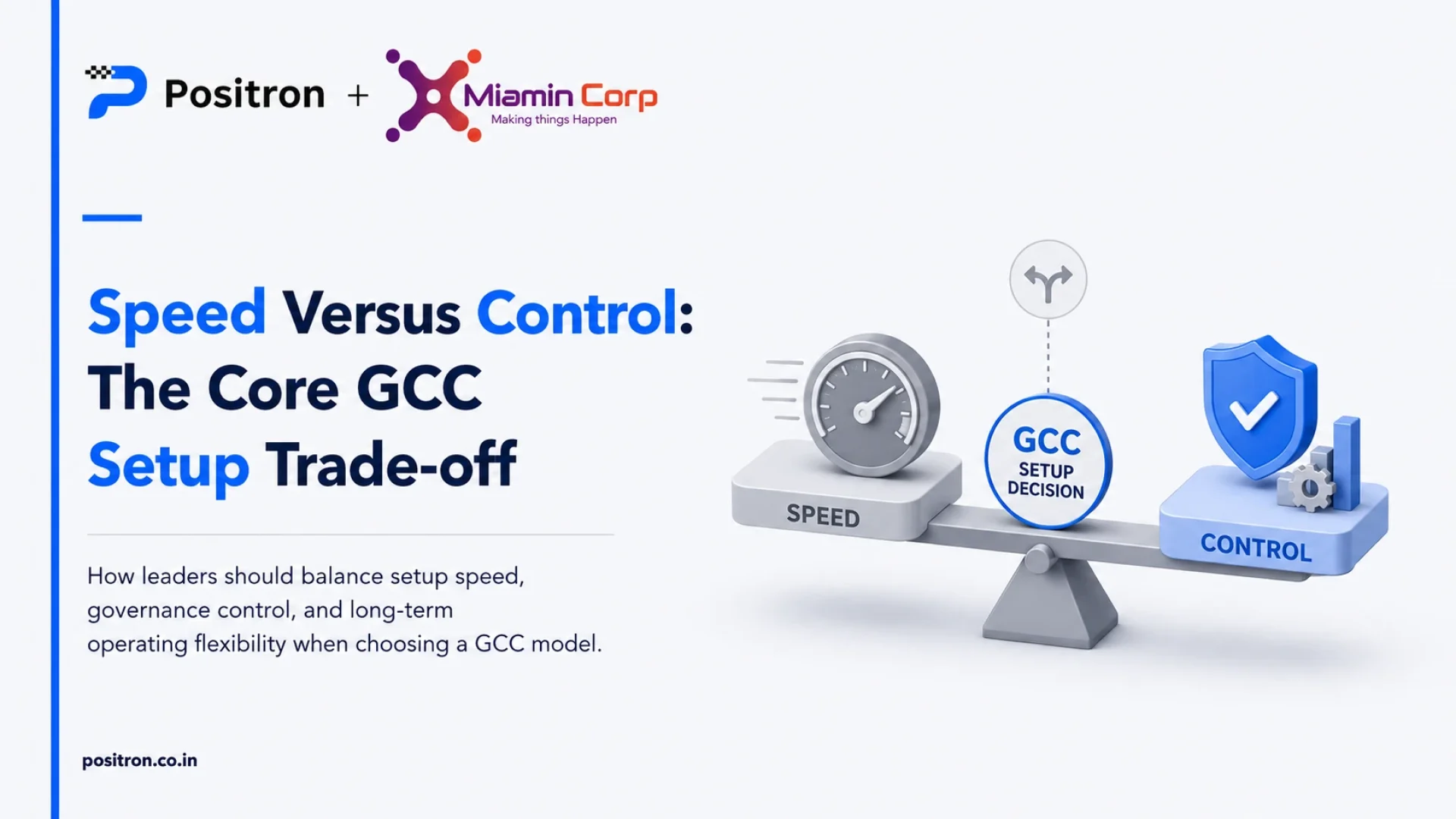
Leaders need to distinguish reversible choices from decisions involving security, employment, tax, data, suppliers and transfer commitments. A minimum viable control environment allows execution to move without postponing the risks that matter most.
In our latest article, we examine the speed-versus-control trade-off and explain how to accelerate setup without building avoidable downstream cost.
Every GCC launch promises speed and control. In practice, the organisation must decide which controls it needs now, which can mature, and where a faster path creates an obligation later.
Speed is valuable. A strategic backlog may be growing, a product roadmap may be constrained by skills, or the enterprise may need regional capacity. But “fast” is often measured as entity registration, office opening or offers accepted. None of those proves that the centre can deliver securely and reliably.
Control is equally easy to misunderstand. It does not mean headquarters approves every action. Excessive central approval slows work and can make local leadership accountable without authority. Effective control means clear ownership, guardrails, evidence and escalation.
Different models place the trade-off differently
An owned GCC gives the enterprise direct control over the operating model, employer proposition, systems and long-term capability. It may take longer to establish because the company must build or extend local infrastructure.
A BOT model can use a partner’s operating readiness to accelerate setup while preserving a path to ownership. Its central risk is deferred complexity: unclear employee transfer, systems migration, intellectual property, data return or acceptance criteria can turn the final transfer into a second transformation.
A managed team can start faster and preserve flexibility, especially for bounded or uncertain demand. The trade-off is that the enterprise must govern provider dependency, service integration, knowledge retention and exit.
These are tendencies, not guarantees. A poorly prepared managed model can be slow, while an enterprise with mature global infrastructure can launch an owned centre quickly.
Sort decisions by reversibility and risk
Use two categories.
Reversible decisions can move quickly with lightweight governance. Early workplace choices, some tools, initial recruiting channels or the sequence of non-critical roles can often be adjusted.
Hard-to-reverse decisions need deeper diligence: legal and tax structure, data architecture, long leases, core technology, leadership appointments, partner contracts, intellectual-property arrangements and location concentration. Moving fast on these choices may create years of switching cost.
Then add risk. A reversible decision involving privileged data may still need strong control. A costly decision with low operational risk may need financial approval rather than security review. This produces targeted governance instead of one slow process for everything.
Establish a minimum viable control environment
Before production work moves, define:
- Accountable leaders and material decision rights.
- Identity, access, data classification and security monitoring.
- Legal, employment, tax and regulatory requirements for the specific structure.
- Service measures, incident response and escalation.
- Knowledge-transfer evidence and customer acceptance.
- Business continuity and supplier obligations.
NIST’s Cybersecurity Framework 2.0 places governance alongside identify, protect, detect, respond and recover, and highlights supply-chain risk. The lesson for GCC setup is that governance and security should be designed with operations, not added after hiring.
Run setup in parallel tracks
Do not wait for one long design phase to finish before execution begins. Run capability scope, legal and compliance, technology and security, leadership and talent, workplace, change, and benefits measurement as connected tracks. Use dependency gates so safe actions continue while hard-to-reverse decisions receive scrutiny.
For example, employer-brand research and leadership mapping can begin while entity options are assessed. A small non-production team can test talent and collaboration assumptions before sensitive data access. Standard policies can be prepared while local legal requirements are validated.
PwC describes GBS transformation as a sequence that includes strategy, location or provider diligence, implementation, transition and ongoing operation. Treating those as connected disciplines helps avoid a launch date that is disconnected from operational readiness.
Define speed as time to trusted output
Measure the time from approval to a stable business outcome, not to an opening ceremony. Include productive ramp, quality, controls and customer confidence. A centre that hires in four months but spends the next eight resolving access and ownership problems was not fast.
The best setup does not choose speed instead of control. It applies control in proportion to reversibility and risk, delegates decisions inside guardrails, and makes transfer or exit obligations explicit from the beginning.
That is how an enterprise launches quickly without borrowing hidden problems from the future.
Frequently Asked Questions
What are the biggest GCC trends in India?
Are GCCs in India still mainly technology centers?
Why is AI important for India GCCs?
What should companies watch before setting up a GCC in India?
Sources
- PwC — Global Business Services transformation — accessed 12 August 2026.
- NIST — Cybersecurity Framework 2.0 — 26 February 2024.
- NIST — Cybersecurity Supply Chain Risk Management Quick-Start Guide — October 2024.
- ISO — ISO 31000:2018 Risk management guidelines — published February 2018; confirmed current in 2023.