

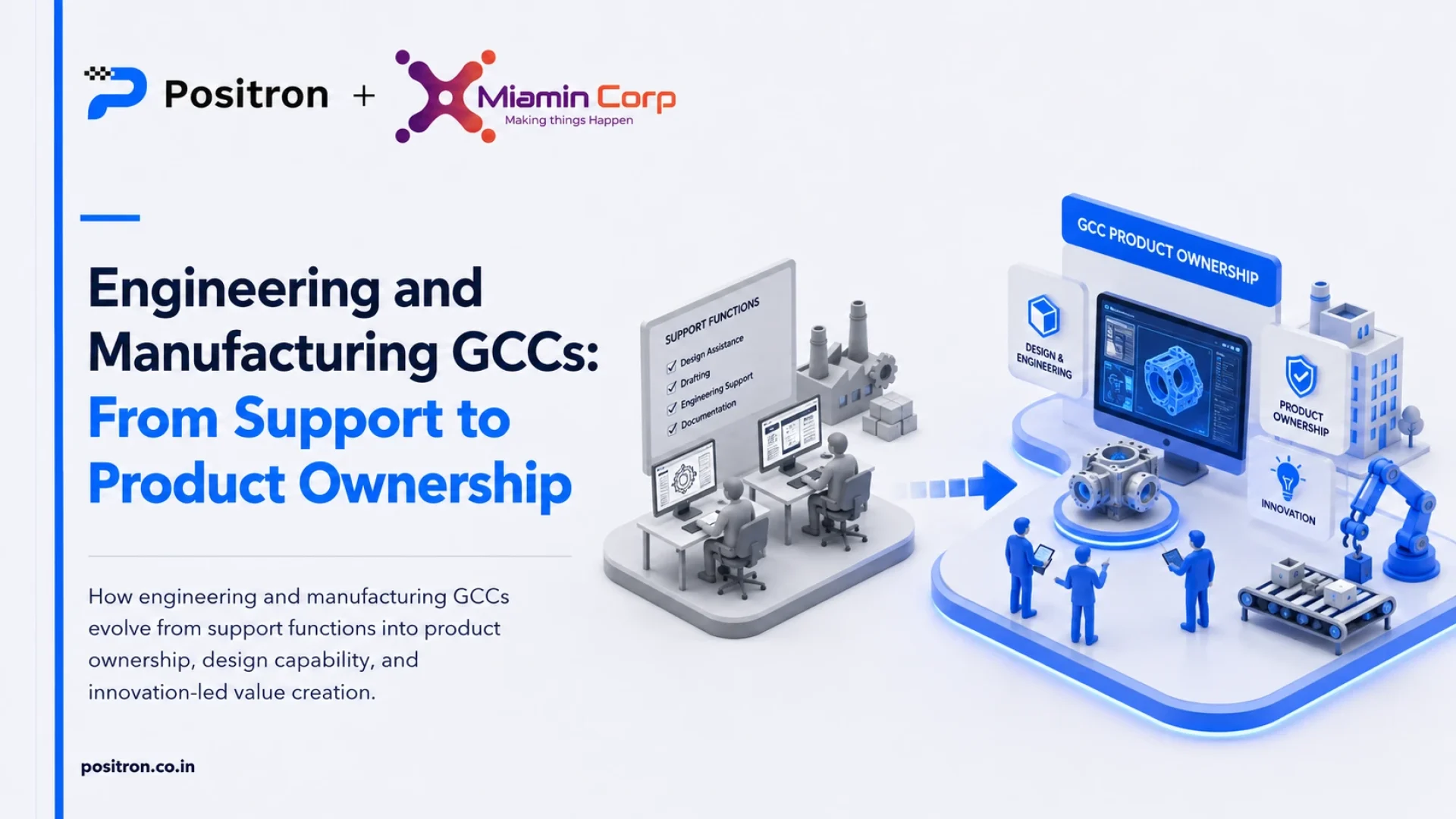
The transition requires design authority, physical-system context, configuration discipline, operational-technology resilience and technical leadership. Capability should advance through explicit stages, with lifecycle accountability earned through evidence.
In our latest article, we explain how engineering and manufacturing GCCs can move from support work to product ownership without fragmenting global standards at each stage.
An engineering GCC does not become strategic because it employs more engineers. It becomes strategic when it owns a defined part of the product or industrial system.
Many centres begin with testing, CAD support, application maintenance, documentation or analytics. Those activities can create a useful entry point. But if architecture, design authority, plant context and lifecycle decisions remain permanently elsewhere, the centre accumulates tasks without accumulating capability.
The move to product ownership requires a different operating model.
Define ownership in engineering terms
“End-to-end” is too vague for a complex product or manufacturing environment.
The charter should specify the subsystem, module, platform, value stream or operational capability the centre owns. It should identify requirements authority, interfaces, configuration responsibility, verification, release, field performance and end-of-life obligations.
For a software-enabled product, that may mean owning a service and its reliability. For industrial equipment, it may mean a subsystem across design, simulation, supplier coordination and validation. For a plant network, it may mean an operational-technology platform or a digital maintenance capability.
This clarity exposes the real gaps. Product ownership may require systems engineers, domain specialists, safety and quality expertise, supplier knowledge, test facilities and chief-engineer leadership—not simply a larger development team.
Connect the centre to the physical system
Manufacturing capability cannot mature through tickets and documents alone.
Engineers need access to plants, labs, field data, operators, suppliers and product users. They need to see how design choices behave under production constraints and how failures appear after release. Short-term mobility, co-location during critical phases and shared digital engineering environments can reduce the distance between design and reality.
The digital thread matters because product decisions span requirements, design, software, bills of material, process plans, quality records and field feedback. Tools can support that continuity, but ownership still depends on governance: common identifiers, configuration control, authoritative data sources and clear approval rights.
Treat OT security and resilience as engineering requirements
Manufacturing centres work across information technology and operational technology. Those environments have different availability, safety and lifecycle constraints.
NIST’s September 2025 draft Cybersecurity Framework 2.0 Manufacturing Profile added guidance for governance, supply-chain risk, platform security and infrastructure resilience. It remains an initial public draft as of this review, so it should be treated as developing guidance rather than a final standard. NIST’s established manufacturing resources still support a risk-based approach to industrial control systems and factory environments.
The practical implication is clear: cybersecurity cannot be a late enterprise review. Threat modelling, segmentation, secure remote access, component provenance, vulnerability handling and recovery should be built into engineering and change processes.
Progress through explicit capability stages
A centre can move from support to ownership in deliberate steps:
- Execution: Perform bounded engineering or operational work to defined standards.
- Module responsibility: Own planning, delivery, quality and support for a component or process.
- System responsibility: Govern interfaces, trade-offs, lifecycle and performance across multiple modules.
- Product or value-stream ownership: Influence roadmap, customer outcomes, suppliers, economics and continuous improvement.
Each stage needs entry and exit criteria. Promotion should follow demonstrated capability, not a calendar or headcount target.
The World Economic Forum’s Global Lighthouse Network provides useful examples of digitally enabled manufacturing performance across selected advanced sites. Its results are not a universal benchmark and should not be copied as promised benefits. They do show that technology, workforce development and operating redesign must move together to produce value.
Install technical leadership early
The centre needs respected design authorities who can make trade-offs and challenge global peers. It needs technical career paths, communities of practice and succession for scarce domain roles. It also needs product leaders who can connect customer, plant and commercial context to engineering priorities.
Governance should allow local decisions within global standards. If every design choice returns to headquarters, the centre cannot learn to own. If the centre diverges from shared architecture and configuration, the product fragments.
The goal is distributed ownership with common engineering truth.
That is the shift from support to product responsibility: the GCC becomes accountable not only for completing work, but for how a product or industrial capability performs across its lifecycle.
Frequently Asked Questions
What are the biggest GCC trends in India?
Are GCCs in India still mainly technology centers?
Why is AI important for India GCCs?
What should companies watch before setting up a GCC in India?
Sources
- NIST, *Cybersecurity Framework 2.0 Manufacturing Profile—Initial Public Draft* — 29 September 2025.
- NIST, *Manufacturing Sector Cybersecurity Resources* — updated 13 May 2026.
- World Economic Forum, *Global Lighthouse Network 2025* — 14 January 2025.
- World Economic Forum, *Global Lighthouse Network: The Mindset Shifts Driving Impact and Scale* — 2025.