

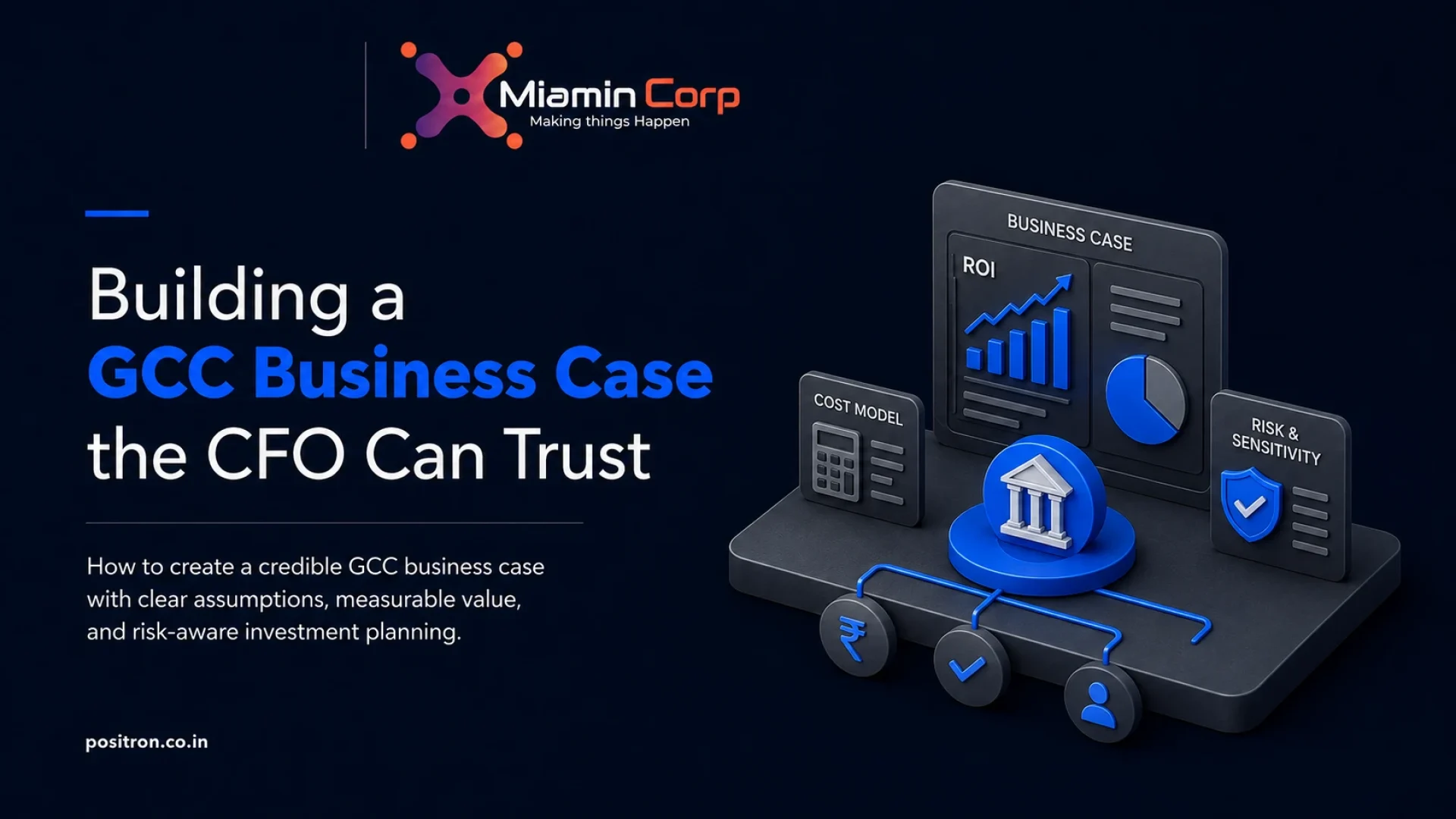
The model must separate transition cost from run rate, cashable savings from capacity value, and strategic benefits from financial claims. It should also expose tax, currency, wage, hiring and productivity assumptions through scenarios and sensitivity tests.
In our latest article, we explain how to build a GCC case that can survive investment scrutiny and become the benefits register after approval.
A GCC business case loses credibility when the savings are precise but the assumptions are invisible.
Finance leaders do not need a pessimistic case. They need a traceable one: a clear baseline, complete cost categories, dated assumptions, scenarios, benefit owners and a way to reconcile the forecast after launch.
The model should answer seven questions.
1. What is the real baseline?
Define the current cost and performance of the work in scope. Include employees, contractors, vendors, technology, facilities, management overhead and material service failures. Record volumes, quality, cycle time and capacity as well as spend.
If the baseline contains several countries or business units, normalise currency, accounting treatment and allocation rules. Otherwise the future GCC may look efficient only because the current model was measured differently.
2. What does transition cost?
Separate one-time investment from steady-state operations. Transition may include advisory and legal work, entity or employment setup, recruiting, leadership, workplace, technology, security, travel, knowledge transfer, severance, change management and duplicated capacity while old and new teams run together.
Show timing. A three-year net present value can hide a difficult first-year cash requirement. The CFO needs the cash curve, not only the eventual total.
3. What will the complete run rate be?
Build the run rate from role-level workforce cost and add leadership, benefits, payroll, facilities, licences, cloud or infrastructure, compliance, insurance, partners, travel, learning and retained headquarters effort. Include taxes based on qualified advice and the actual entity and transaction structure.
Global tax rules continue to evolve. OECD guidance on Pillar Two forms part of the global minimum-tax framework for large multinational groups. This article is not tax advice; it is a reminder that a generic country-rate assumption is not a substitute for entity-specific analysis.
4. Which benefits are cashable?
Separate benefit types:
- Cost removed from an existing budget.
- Cost avoided as demand grows.
- Capacity released but retained for other work.
- Revenue, speed, quality or risk benefits.
- Strategic options whose value is not yet cashable.
This prevents capacity improvement from being counted as both a saving and additional output. It also prevents innovation from appearing as an unexplained lump sum.
PMI’s benefits-realisation framework recommends aligning benefits with strategy, defining how and when they will be measured, assigning owners and sustaining them after transition. Apply that discipline to every major line in the model.
5. How uncertain are the assumptions?
Use at least three scenarios. The downside case can model slower hiring, lower productivity, higher wage inflation, currency movement, transition delay or reduced demand. The base case should use defensible evidence, not the number required to reach approval. The upside case should depend on specific capabilities or adoption milestones.
Run sensitivity analysis to show which assumptions change the decision. If the case fails when one salary assumption moves slightly, the operating proposition is fragile.
6. What value is being created beyond labour cost?
Deloitte’s 2025 GBS survey reports substantial savings among many respondents, but it also highlights next-generation capability, customer experience, governance and digital technology. Model those benefits with operational evidence: faster release cycles, fewer control failures, improved service levels, greater automation adoption or access to capabilities that unblock strategic work.
Do not force every benefit into currency on day one. A transparent non-financial measure is better than invented financial precision.
7. How will actuals be governed?
Turn the approval model into a benefits register. Give every assumption a source, date, owner and refresh frequency. Reconcile forecast versus actual cost, timing, demand and benefit quarterly. Record why variances occurred and whether the business case still supports the next investment wave.
Use the same definitions in the programme dashboard, finance ledger and executive review. If recruitment reports filled roles while finance reports average headcount and operations reports productive capacity, leaders need a reconciliation rule.
The CFO-ready standard
A trusted business case makes exclusions visible. It states what has not been modelled, which benefits depend on business adoption, where legal or tax advice is pending, and which decisions can be reversed.
The purpose is not to make the GCC appear cheaper. It is to help the enterprise compare this operating model with credible alternatives and then manage the investment with the same logic after approval.
When the model can survive challenge, it becomes more than a finance document. It becomes the shared contract between strategy, delivery and value.
Frequently Asked Questions
What are the biggest GCC trends in India?
Are GCCs in India still mainly technology centers?
Why is AI important for India GCCs?
What should companies watch before setting up a GCC in India?
Sources
- PMI — Benefits Realization Management Framework — November 2016.
- Deloitte — 2025 Global Business Services Survey — 29 August 2025.
- OECD — Secretary-General Tax Report to G20 Finance Ministers — February 2025.
- ISO — ISO 31000:2018 Risk management guidelines — published February 2018; confirmed current in 2023.