

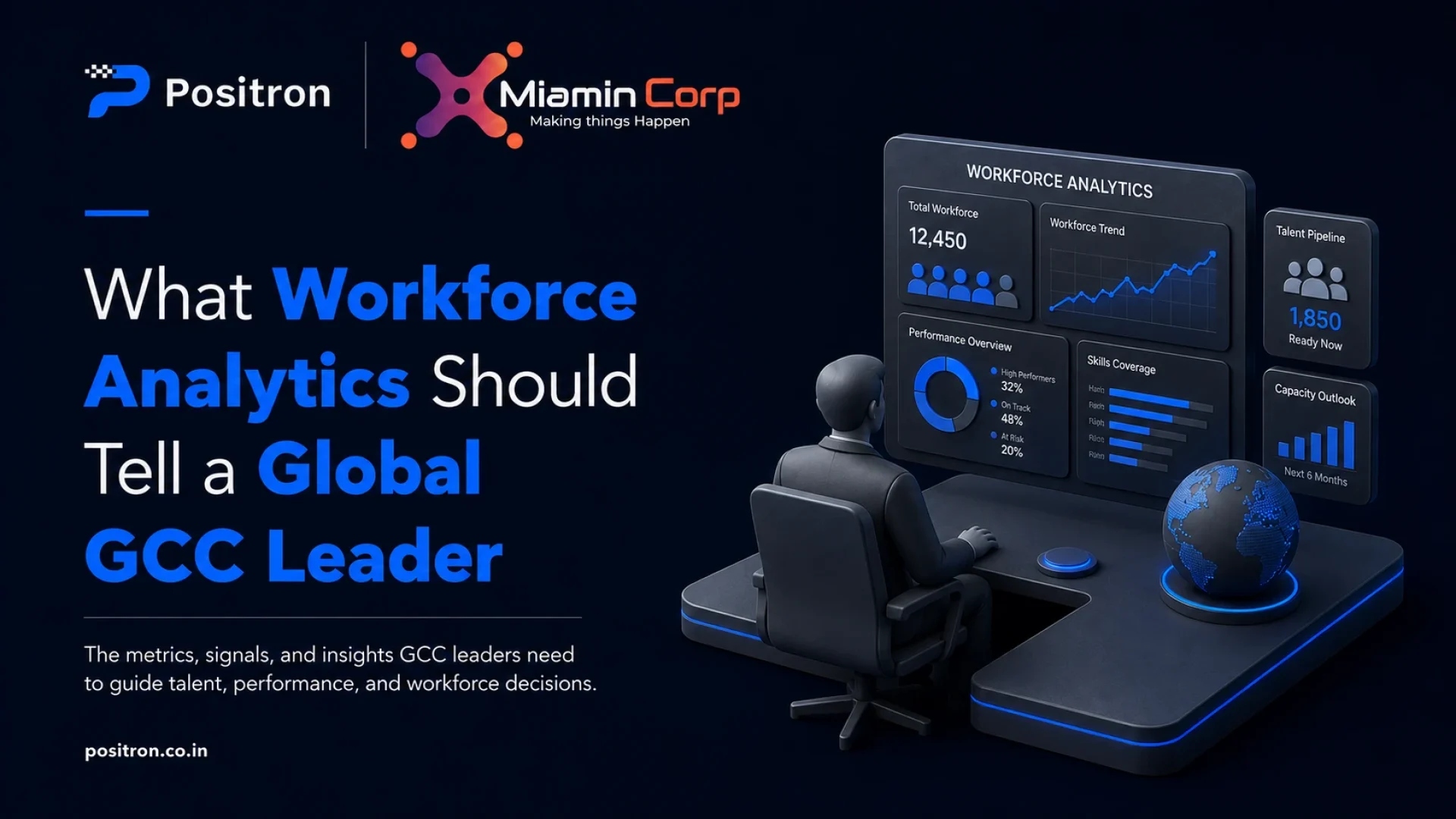
The useful questions concern capacity, future capability, talent-flow delays, career mobility, sustainable work and concentrated risk. Every metric needs a clear definition, denominator, owner and decision it is expected to support.
In our latest article, we explain how to build a workforce analytics cadence that turns reliable evidence into accountable action—without overlooking data quality or employee privacy.
A workforce dashboard can contain accurate numbers and still fail a GCC leader.
The failure occurs when reporting describes the workforce without helping anyone make a decision. Headcount, open roles and attrition may show what happened. They do not automatically explain whether the GCC has the capabilities, capacity and organisational health required for the next stage of its mandate.
Useful workforce analytics begins with leadership questions, then works backwards to data.
Six questions the system should answer
Do we have the capacity to deliver?
Connect demand, available effort and critical-role coverage. Show vacancies, absence, planned leave, contractor dependence and productive capacity in the same view. Headcount alone treats a new joiner, an experienced specialist and an unavailable employee as equivalent units.
Do we have the capabilities the roadmap needs?
Map skills and proficiency against future work, not only current job titles. Identify capabilities with no successor, limited learning pathways or dependence on one location. Distinguish verified evidence from employee self-report and manager opinion.
Where does talent flow slow down?
Measure the movement from approved demand to productive contribution. That includes time in approval, sourcing, assessment, acceptance, notice period, access provisioning, onboarding and readiness. A single time-to-hire figure can hide the stage where delay actually occurs.
Is the organisation building careers?
Track internal moves, cross-location projects, specialist progression, promotions, succession readiness and access to development. Compare opportunity across role families, levels and relevant demographic groups where lawful and appropriate. Mobility is both a retention signal and a measure of whether the global network is operating as one talent system.
Is work sustainable?
Bring together workload, working-time exceptions, leave, engagement themes, manager spans, regretted exits and psychosocial-risk signals. Do not infer an individual’s health from behavioural data. The objective is to identify harmful work patterns and improve the system, not to create employee surveillance.
Where is workforce risk concentrated?
Show critical dependencies by capability, location, supplier, leader and access privilege. Add upcoming regulatory, contract and mobility events. A role may be fully staffed and still present high risk if knowledge, approval authority or client access sits with one person.
Make every metric decision-ready
Each measure needs a definition, owner, data source, refresh cycle and decision it supports. State the denominator. “Ten exits” has little meaning without workforce size, time period, role mix and whether those exits were expected.
Separate leading and lagging indicators. Attrition is lagging. Repeated internal applications with no movement, manager overload or declining learning participation may provide earlier signals. A forecast should show its assumptions and uncertainty rather than presenting one number as a promise.
ISO 30414:2025 provides a broad human-capital reporting baseline covering workforce composition, diversity, cost, productivity, wellbeing, leadership and culture, recruitment, mobility, turnover, and skills. It does not tell a GCC which dashboard to buy. It helps leaders see the range of human-capital areas that a coherent reporting system may need to connect.
ISO 30435 focuses specifically on workforce data quality through determination, capture, maintenance and review. This distinction matters: sophisticated analysis cannot repair inconsistent role codes, missing effective dates or different definitions of an employee across locations.
Protect the people represented by the data
Workforce data can be sensitive even when a dashboard hides names. Small groups, combined attributes and longitudinal patterns can make people identifiable. Apply purpose limitation, role-based access, retention rules and aggregation thresholds. Involve privacy, legal, security and worker representatives where appropriate.
The NIST Privacy Framework is voluntary and jurisdiction-neutral. Its risk-based approach is useful because it separates beneficial data use from the privacy risks created by processing. It does not replace local data-protection or employment law.
Put analytics into a management cadence
Analytics creates value when it changes a decision. Use a monthly or quarterly workforce review to choose actions, assign owners and revisit outcomes. Record where leaders accepted a risk, changed hiring, redesigned work or funded development.
Avoid creating a data theatre in which every meeting adds a metric but none removes ambiguity. If a measure has not informed a decision, question or control for several cycles, it may not belong in the leadership view.
The test is simple: after reading the workforce report, can the GCC leader say what capability is at risk, why, what action is required, who owns it and when the effect will be checked? If not, the organisation has reporting, not workforce intelligence.
Frequently Asked Questions
What are the biggest GCC trends in India?
Are GCCs in India still mainly technology centers?
Why is AI important for India GCCs?
What should companies watch before setting up a GCC in India?
Sources
- ISO — ISO 30414:2025, Human Capital Reporting and Disclosure — August 2025.
- ISO — ISO 30435:2023, Workforce Data Quality — July 2023.
- NIST — Privacy Framework 1.0 — 16 January 2020; page updated 7 May 2026.
- ISO — ISO 37000:2021, Governance of Organizations — September 2021.