

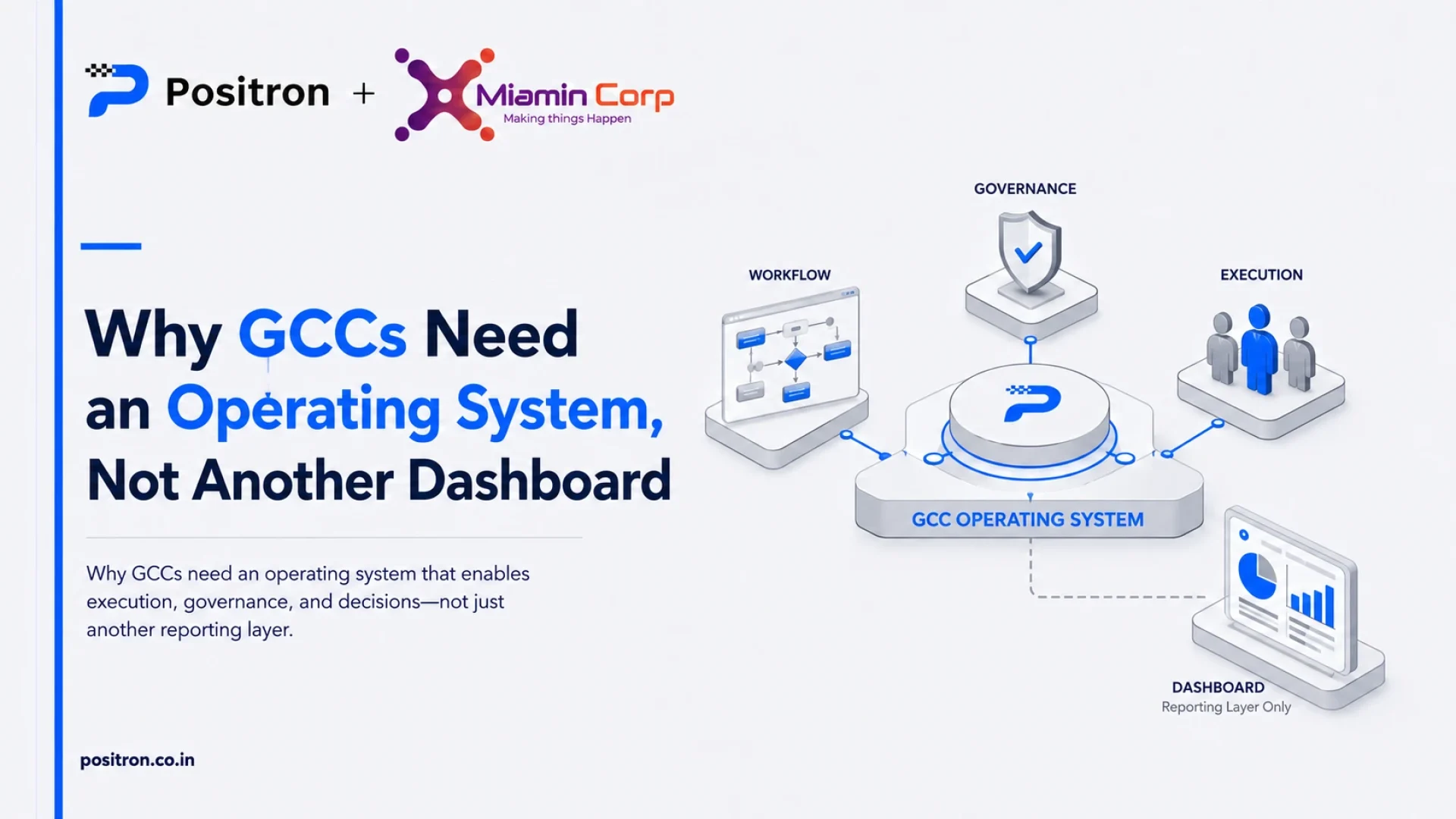
An operating system connects mandate, decision rights, controls, data, management cadence and exception handling. Technology can orchestrate and record that system, but it cannot substitute for the operating design underneath it.
In our latest article, we explain what a real GCC operating system should enable and how to evaluate platform claims through integrations, controls, portability and operating outcomes.
A dashboard can show that hiring is late, access is blocked and a service target has been missed. It cannot decide who acts, change the workflow or prevent the same failure next month.
That distinction explains why a growing GCC needs an operating system, not simply another reporting layer.
“Operating system” here does not mean one software product. It means the connected management design through which the GCC turns enterprise intent into repeatable action: mandates, decision rights, workflows, controls, data, review cadences and improvement.
Technology can enable that system. It cannot replace the design.
Connect six operating layers
Mandate
State which capabilities and outcomes the GCC owns, which remain shared, and which constraints cannot be traded away. A system cannot optimise work when the purpose is ambiguous.
Decision rights
Assign who recommends, approves, executes and must be consulted for recurring decisions. Include thresholds for exceptions. If every approval rises to headquarters, the GCC is connected but not empowered.
Workflow
Map the path from demand to outcome across functions and locations. Show inputs, hand-offs, service expectations, controls and escalation. This is where workforce planning, recruitment, onboarding, access, finance, security and delivery become one operating flow instead of separate departmental processes.
Control
Build required legal, financial, quality, privacy and security checks into the workflow. Controls should generate evidence and make the safe path easier to follow. A policy stored outside the work is more likely to be bypassed.
Data model
Use common identifiers and definitions for capabilities, roles, locations, workers, demand, risks and outcomes. The dashboard should be a view of operating data, not a manual reconciliation prepared for a meeting.
Management cadence
Define which forums review performance, risks and changes; which decisions each forum makes; and how actions are tracked to closure. Add a method for learning from incidents, employee feedback and missed outcomes.
ISO describes a management system as the way an organisation manages interrelated parts of its business to achieve objectives. Its 2026 guide to integrated management systems emphasises connecting requirements with existing governance and operations to reduce duplication. This is close to the management meaning of a GCC operating system: one coherent system, not many parallel control programmes.
Know what a dashboard cannot do
A dashboard is valuable when it gives the right person timely evidence. It becomes theatre when measures are not connected to thresholds, owners and actions.
For every indicator, define the decision it informs. If access readiness falls below an agreed threshold, who can pause a start date? If one capability has no successor, who funds development or changes the sourcing plan? If a supplier breaches a control, who restricts access and initiates transition?
NIST’s Cybersecurity Framework 2.0 is useful as an analogy because its Govern, Identify, Protect, Detect, Respond and Recover functions describe a continuous risk lifecycle. Detection alone is not a security programme. In the same way, visibility alone is not a GCC operating model.
Decide what technology should enable
Choose technology after the workflows and ownership are understood. A platform may orchestrate approvals, maintain a capability and workforce record, enforce access gates, integrate suppliers, preserve evidence and show exceptions. It should reduce repeated reconciliation and make accountability visible.
Assess integration, configuration, data portability, role-based access, audit logs, residency, vendor dependency and exit. Avoid recreating every legacy process in a new interface.
Miamin Systems publicly describes its platform as a “GCC OS.” That description and its stated benefits are first-party company claims. The decision test for that platform, or any alternative, is practical: which operating layers does it connect, which controls are evidenced, what still relies on manual work, and how can the enterprise retain its data and processes?
For Positron, the strategic opportunity is to connect workforce design and execution to that wider operating context. The value will need to be demonstrated through defined client outcomes and transparent delivery, not the label alone.
Build the minimum viable system
Start with one end-to-end journey, such as approved capability demand through productive onboarding. Define owners, standards, data and exception paths. Instrument it, run it, review failures and improve it. Then extend the same architecture to mobility, supplier governance, delivery and risk.
A GCC does not need more screens. It needs a reliable way to decide, act, control and learn across borders. The dashboard should show that system working—not stand in for it.
Frequently Asked Questions
What are the biggest GCC trends in India?
Are GCCs in India still mainly technology centers?
Why is AI important for India GCCs?
What should companies watch before setting up a GCC in India?
Sources
- ISO — Management System Standards — accessed 12 August 2026.
- ISO — Integrated Management Systems: A Practical Guide — 2026.
- NIST — Cybersecurity Framework 2.0 — 26 February 2024.
- ISO — ISO 30414:2025, Human Capital Reporting and Disclosure — August 2025.
- Miamin Systems — GCC OS — accessed 12 August 2026; first-party product description.