

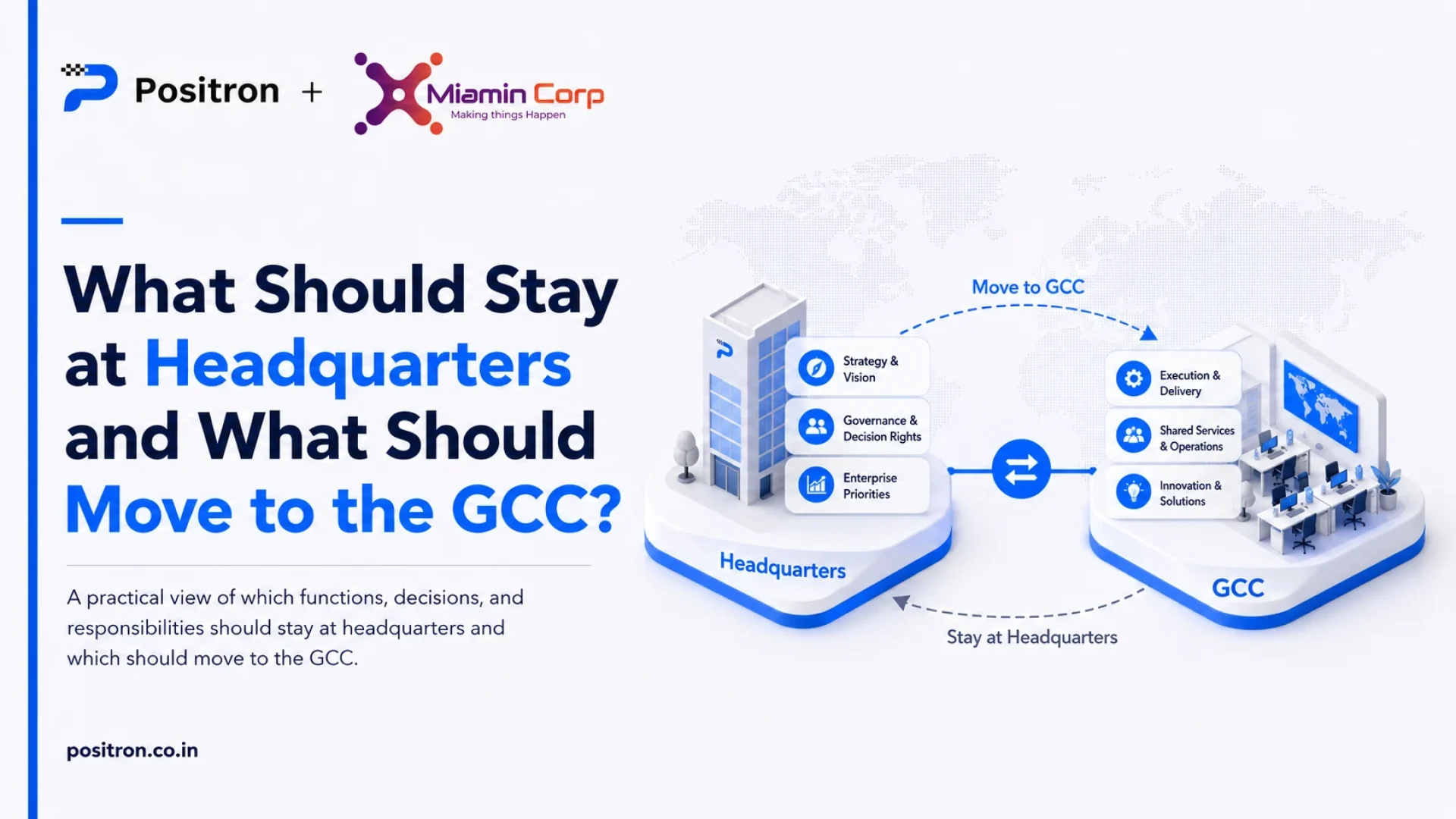
Work allocation should consider customer proximity, judgement, process maturity, talent, data, regulation and continuity. The result is usually a mix of headquarters-led, GCC-owned and jointly governed work, with authority moving as confidence and controls mature.
In our latest article, we explain how to decide what should stay at headquarters, what should move and what should remain shared.
The wrong way to scope a GCC is to move the easy tasks and keep every meaningful decision at headquarters.
That approach may reduce the cost of individual activities, but it creates a permanent queue between execution and authority. The GCC receives instructions, headquarters answers exceptions, and neither side owns the end-to-end outcome. The centre cannot develop deep careers because judgement remains elsewhere. Headquarters does not become more strategic because it is still resolving operational details.
The opposite extreme is also risky. Moving critical decisions before leadership, controls, business context and data access are ready can weaken customer outcomes or expose the enterprise.
Work allocation therefore needs a decision framework, not a list of tasks labelled “high” or “low” complexity.
Evaluate six characteristics
Proximity
Which work requires immediate access to customers, regulators, physical operations or senior enterprise decision-makers? Proximity may be geographic, cultural, linguistic or organisational. Some customer negotiations and public-policy decisions need local presence; many product, finance and analytics activities can be globally distributed when interfaces are well designed.
Enterprise judgement
Distinguish decisions that require board, regulated or enterprise risk authority from decisions that are merely accustomed to headquarters. Corporate strategy, capital allocation and certain legal sign-offs may stay central. Product prioritisation, architecture or process policy can often become shared or delegated once the GCC has credible leaders and guardrails.
Process maturity
Do not move a broken process simply because it is documented. First make demand, variants, exceptions and ownership visible. Standardisation can support transfer, but excessive standardisation can remove valuable local differences. Move a coherent outcome with its improvement authority whenever possible.
Capability and talent
Where can the enterprise build the strongest team over several years? A GCC may be the right home for cloud platforms, data engineering, cybersecurity, R&D, finance analytics or other specialised work if the chosen ecosystem has the required talent and leadership. The World Economic Forum’s 2025 research shows fast-growing demand for AI, big data and cybersecurity skills, reinforcing the need to treat talent as a strategic design input.
Data, IP and regulation
Map data classes, access needs, intellectual property, licensing, professional accountability and cross-border restrictions. The European Commission explains that personal-data transfers outside the EEA require appropriate safeguards. That does not mean the work must always remain at headquarters; it means legal mechanisms, technical controls and ownership must be designed before access is granted.
Continuity and interdependence
Consider time zones, upstream systems, business continuity and the cost of hand-offs. Work that depends on constant informal clarification is not ready to move as currently designed. Either retain it temporarily or redesign the interfaces. Work that benefits from broader time coverage may move well, but only if decision-makers and documentation support the hand-off.
Use three allocation zones
The first zone is headquarters-led. It includes matters that require enterprise authority, proximity or a control that cannot yet be delegated. “Led” does not mean all analysis and execution must stay there.
The second zone is GCC-owned. It includes products, processes or services for which centre leaders can hold end-to-end accountability inside agreed standards. Ownership should include prioritisation, improvement and performance—not only labour.
The third zone is jointly governed. This is often the most important during maturity. Headquarters may own policy while the GCC owns operations; the business may own product outcomes while GCC teams own engineering execution and selected roadmap decisions. Joint governance must still name the final decision owner when agreement fails.
Move in waves of authority
Start with stable delivery, then transfer related decisions as evidence grows. A wave might progress from task execution, to service management, to process improvement, to global process or product ownership. Each step should have acceptance criteria: performance, control effectiveness, leadership readiness, customer confidence and data quality.
BCG’s analysis of strategic global business services stresses end-to-end outcomes and internal partnerships. Deloitte’s 2025 survey similarly highlights unified leadership and next-generation capability. Both point away from a permanent extended-workbench design.
Review the allocation annually. Automation, regulation, market strategy and leadership depth can change where work belongs. The goal is not to maximise what moves. It is to place each capability where the enterprise can make the best decisions, develop the right talent and manage risk.
Headquarters should retain accountability that truly requires the centre of the enterprise. The GCC should own outcomes it can operate and improve. Everything else needs an explicit path out of the grey zone.
Frequently Asked Questions
What are the biggest GCC trends in India?
Are GCCs in India still mainly technology centers?
Why is AI important for India GCCs?
What should companies watch before setting up a GCC in India?
Sources
- BCG — Transforming Global Business Services into a Strategic Function — 14 February 2024.
- Deloitte — 2025 Global Business Services Survey — 29 August 2025.
- World Economic Forum — Future of Jobs Report 2025 — 7 January 2025.
- European Commission — Rules on international data transfers — accessed 12 August 2026.