

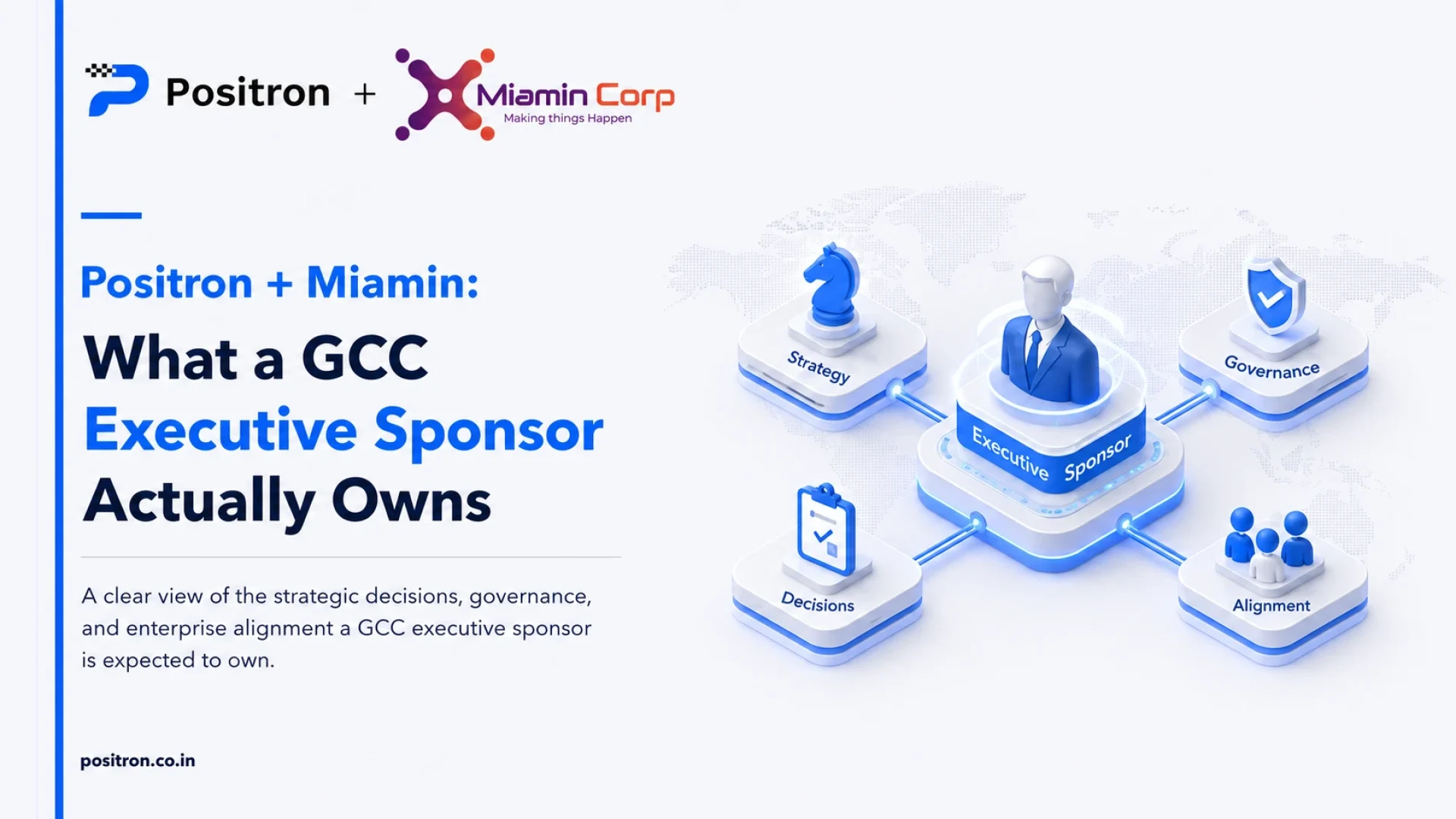
That includes the mandate, cross-functional coalition, decision rights, investment trade-offs, benefit accountability and leadership legitimacy. Daily delivery stays with operating leaders; enterprise deadlocks and mandate protection do not.
In our latest article, we explain what the sponsor must own and how a regular value-and-risk cadence keeps that accountability active after launch.
The GCC executive sponsor does not own every delivery decision. The sponsor owns the enterprise conditions that allow the centre to succeed.
That role is easy to misunderstand. Some sponsors become ceremonial supporters who appear at launch and receive quarterly updates. Others move too far into daily management and weaken the authority of the GCC leader. Both patterns leave a gap: no one is actively protecting the mandate across headquarters, functions and regions.
A strong sponsor has six responsibilities.
1. Own the strategic mandate
The sponsor must be able to explain why the GCC exists, which enterprise outcomes it supports and which capabilities it is expected to own over time. When business units try to turn the centre into a destination for unrelated vacancies, the sponsor protects coherence.
This also means approving exclusions. If customer-facing judgement, regulated sign-off or a sensitive decision remains elsewhere, that boundary should be deliberate and reviewable.
2. Build the coalition
A GCC depends on HR, finance, legal, tax, security, technology, procurement, real estate and the business. Each function can optimise its own requirement while slowing the whole system.
The sponsor brings these leaders into one governance structure, secures named decision-makers and resolves conflicts that the programme team cannot. This is not stakeholder communication in the abstract. It is the work of making the enterprise capable of acting across its internal boundaries.
3. Allocate decision rights
The sponsor approves who decides portfolio priorities, budget changes, leadership appointments, technology standards, data access, vendor choices and exceptions. The GCC leader needs enough authority to operate, while headquarters retains the decisions that truly require enterprise control.
NIST’s Cybersecurity Framework 2.0 treats governance as the way an organisation makes and carries out informed cybersecurity decisions. The same principle applies more broadly: controls fail when authority is implied instead of assigned.
4. Own the investment trade-offs
The sponsor protects investments that do not appear in a hiring count: leadership, learning, systems, change, controls, travel, knowledge transfer and duplicated capacity during transition. They also challenge spending that is not linked to the mandate.
When demand changes, the sponsor decides whether to alter scope, pace, location or model. ISO 31000 emphasises integrating risk into governance, strategy and planning; a sponsor should therefore treat uncertainty as a decision input, not as a reason to freeze the plan.
5. Be accountable for benefits
The GCC leader can manage performance, but enterprise benefits often sit outside the centre. A faster product cycle requires business prioritisation. A better finance process requires regional adoption. Reduced risk requires control owners to change behaviour.
The sponsor assigns benefit owners, approves baselines and makes sure results are reviewed after transition. PMI’s benefits-realisation guidance stresses identifying, delivering and sustaining benefits aligned with strategy. Without sponsorship, benefits can disappear between the project team that builds the centre and the business units expected to use it.
6. Protect leadership and culture
The sponsor ensures the GCC leader has direct access to enterprise decision-makers and is not treated as a remote site administrator. They advocate for meaningful career paths, global mobility, succession and visibility for local leaders.
Culture is shaped by operating choices. If all high-value decisions remain at headquarters, employees will correctly conclude that the centre is an execution arm, whatever the launch speech says. The sponsor must align authority with the promised ambition.
What the sponsor should not own
The sponsor should not approve routine hiring, manage sprint priorities, replace functional owners or become the only escalation route. Those behaviours create delay and make the organisation dependent on one executive.
Instead, use a clear cadence:
- Monthly operating review led by the GCC leader.
- Quarterly value and risk review chaired by the sponsor.
- Defined exception thresholds for immediate escalation.
- Annual mandate and capability-roadmap reset with business leaders.
Deloitte’s 2025 GBS survey reports an association between global GBS leadership and stronger reported savings, while also highlighting governance and effective decision-making. This does not mean a title causes performance. It reinforces a practical point: global value needs unified direction.
The sponsor’s job is therefore neither symbolic nor operational. It is constitutional. They establish the mandate, coalition, authority, investment discipline and accountability that let distributed teams operate as one enterprise capability.
Frequently Asked Questions
What are the biggest GCC trends in India?
Are GCCs in India still mainly technology centers?
Why is AI important for India GCCs?
What should companies watch before setting up a GCC in India?
Sources
- Deloitte — 2025 Global Business Services Survey — 2025.
- NIST — Cybersecurity Framework 2.0 — 26 February 2024.
- ISO — ISO 31000:2018 Risk management guidelines — published February 2018; confirmed current in 2023.
- PMI — Benefits Realization Management Framework — November 2016.