

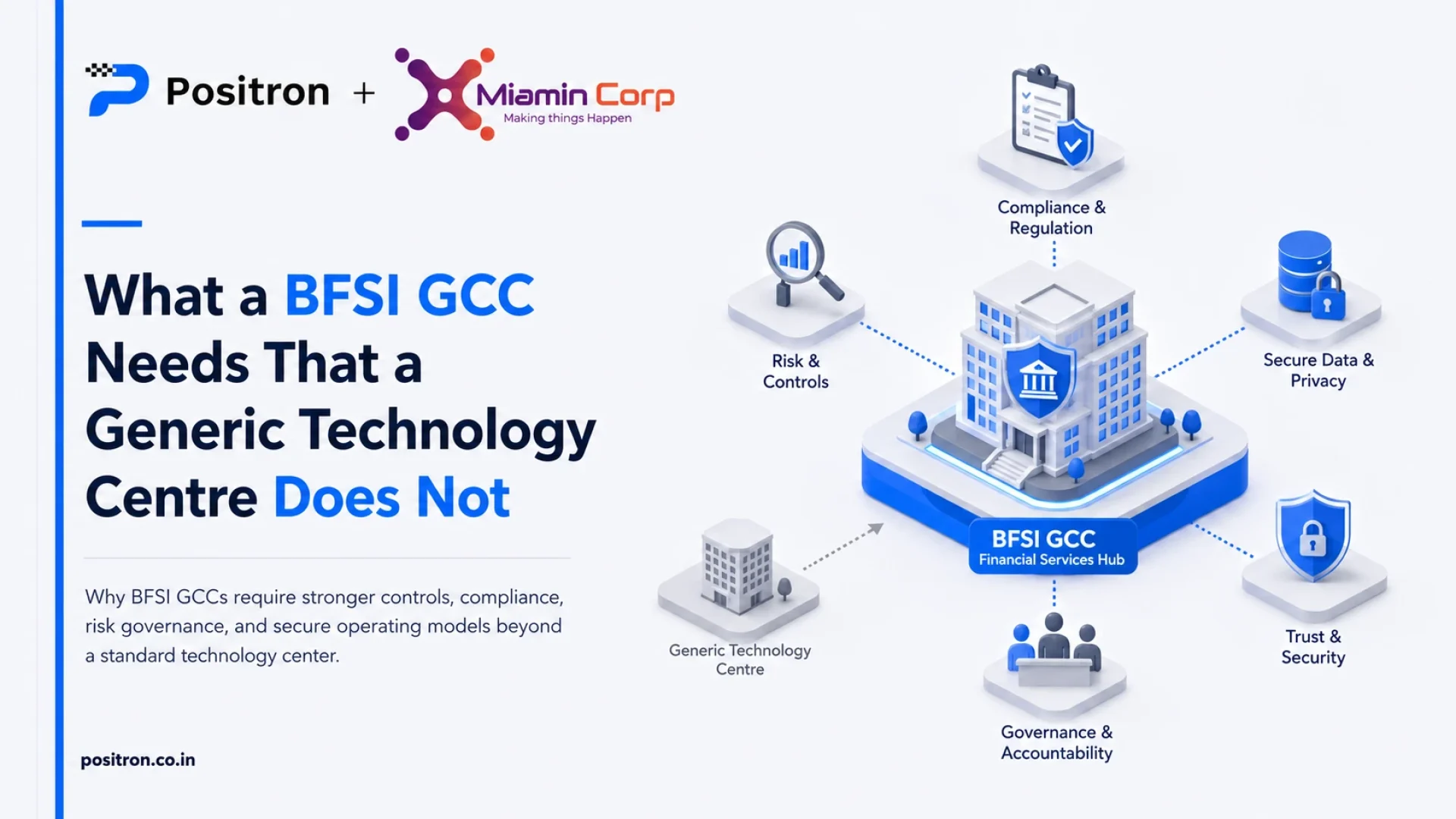
Critical operations require visible accountability, dependency mapping, evidence, tested recovery and regulated judgement. Moving work into an intragroup centre does not transfer the parent institution’s obligations or reduce the need for clear authority.
In our latest article, we explain how a BFSI GCC can deliver speed while remaining explainable, recoverable and within the enterprise’s risk appetite.
A BFSI GCC does not become regulated-ready by adding a compliance team after the technology organisation is built.
Banks, insurers, payments companies and investment firms depend on technology, but their centres also sit inside risk, conduct, financial-crime, resilience and supervisory systems. That changes the design of the organisation from its first day.
A generic technology centre can focus primarily on engineering throughput, product delivery and service quality. A BFSI centre must deliver those outcomes while proving who made a decision, which control operated, what evidence exists and how a critical service will continue through disruption.
Start with critical operations, not functions
The first design task is to map the services the institution must continue to deliver: payments, customer access, trade processing, fraud controls, regulatory reporting or other business-critical operations.
The Basel Committee’s operational-resilience principles define the outcome as the ability to deliver critical operations through disruption. Its guidance calls for mapping the people, technology, processes, information, facilities and third parties that support those operations.
That is a different starting point from moving “application support” or “finance operations” into a centre. It reveals end-to-end dependencies and shows where a team in the GCC must have recovery authority, specialist knowledge and access to decision-makers.
Build the control model into the organisation
A BFSI GCC needs clear alignment to the enterprise’s risk and control framework.
That includes ownership across the first line, independent risk and compliance oversight, internal audit access, issue management, policy exceptions and escalation. The exact model varies by institution and jurisdiction, but accountability must remain visible. Moving activity to an intragroup centre does not make the parent institution’s regulatory obligations disappear.
Evidence must be designed into everyday work. Access approvals, segregation of duties, data lineage, model changes, deployment records, reconciliations, incident decisions and control attestations should be recoverable and reviewable. If proof is assembled only before an audit, the operating model is already too fragile.
Treat technology resilience as a business obligation
The EU’s Digital Operational Resilience Act has applied since 17 January 2025 to in-scope financial entities. It brings together ICT risk management, incident reporting, resilience testing and third-party risk oversight. It is an EU regime, not a universal rule, but it illustrates the level of attention regulated firms now face around digital dependencies.
The GCC therefore needs more than a disaster-recovery document. It needs tested service recovery, defined disruption tolerances, current dependency maps, crisis communication, secure administration and credible exit options for critical third parties.
The same discipline applies to cyber and data. NIST’s Cybersecurity Framework 2.0 added a dedicated Govern function and stronger supply-chain emphasis. A BFSI centre should translate enterprise risk appetite into role-level access, engineering standards, monitoring and incident authority.
Hire for regulated judgement
Technical skill is necessary, but it is not sufficient.
The centre needs leaders who understand how products, controls and customer obligations connect. Depending on the mandate, that may include operational-risk, privacy, financial-crime, model-risk, regulatory-reporting, security, resilience and audit professionals embedded alongside engineering and operations.
Training should be role-specific. A developer changing a decisioning service, an analyst handling suspicious-activity workflows and an operations leader approving a manual workaround face different risks. Annual generic compliance modules will not create the required judgement.
Give the centre authority with accountability
A BFSI GCC should not remain a permanent execution layer waiting for headquarters approval on every material issue. That slows response and weakens ownership.
The better model delegates defined decisions while preserving enterprise oversight. Product, service and control owners in the centre should know their limits, escalation paths and evidence obligations. Senior leaders should participate in global risk committees and scenario exercises. Regulators and auditors should be able to understand the model without navigating a maze of dotted lines.
This is what distinguishes a mature BFSI GCC from a generic technology centre: it is designed around critical services, controls and recoverability as well as delivery.
The centre succeeds when it can move quickly without making risk invisible—and when the enterprise can demonstrate that resilience and accountability travel with the work.
Frequently Asked Questions
What are the biggest GCC trends in India?
Are GCCs in India still mainly technology centers?
Why is AI important for India GCCs?
What should companies watch before setting up a GCC in India?
Sources
- Basel Committee on Banking Supervision, *Principles for Operational Resilience* — 31 March 2021.
- European Securities and Markets Authority, *Digital Operational Resilience Act (DORA)* — applicable from 17 January 2025.
- European Banking Authority, *Guidelines on Outsourcing Arrangements* — published 4 March 2019; applicable from 30 September 2019.
- NIST, *Cybersecurity Framework 2.0* — 26 February 2024.