

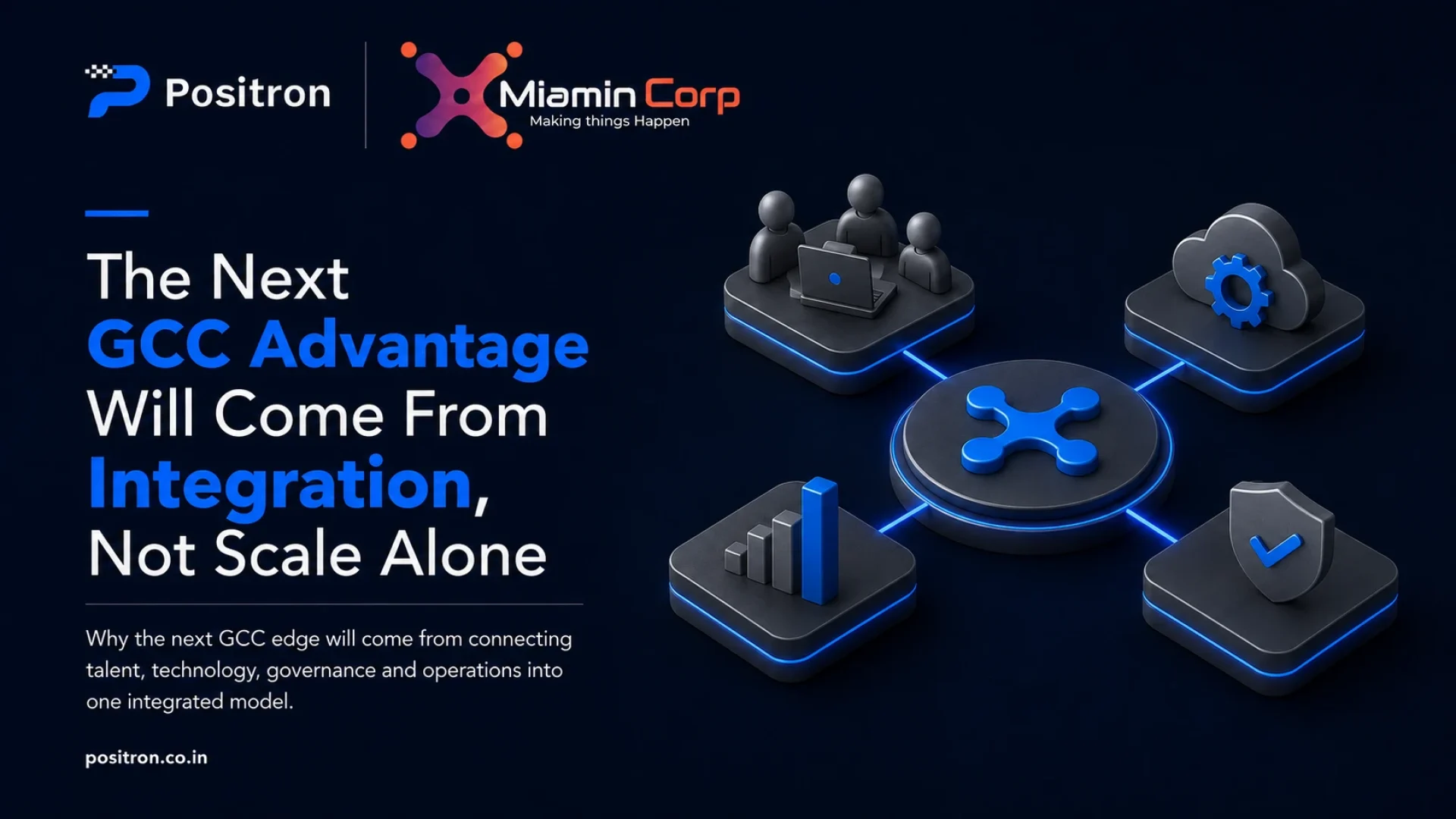
Large centres can still operate as silos while the organisation absorbs delay and rework between them. Integration connects mandates, data, platforms, risk, talent and customer feedback through shared interfaces without centralising every decision.
In our latest article, we explain how to move from a portfolio of locations to one capability system—and how clients can experience that integration across the full GCC lifecycle.
The first era of GCC advantage was often measured in headcount and cost. The next will be measured by how well the enterprise connects its capabilities.
A company can build large centres in several countries and still operate as a collection of queues. Product decisions remain at headquarters. Data definitions differ by function. Risk reviews happen after delivery. Career paths stop at location boundaries. Each centre reports local efficiency while the customer experiences the friction between them.
More scale does not solve that problem. It can make it larger.
Integration begins with a portfolio of mandates
Every centre needs a reason to exist inside the global network.
One may anchor engineering scale. Another may own regional customer and regulatory proximity. A specialist node may support a regulated or industrial capability. A recovery node may provide deliberately independent continuity.
The mandates should explain ownership, interfaces and evolution—not just functions and headcount. Duplicate work can be intentional for resilience, but accidental duplication should be visible and challenged.
Portfolio governance then decides where a new capability belongs, when a centre should expand and which work should move closer to customers, systems or specialist ecosystems.
Create common operating interfaces
Integration does not require centralising every decision. It requires shared interfaces that allow distributed teams to act coherently.
Those interfaces include:
- common product and service ownership definitions;
- enterprise data standards and authoritative sources;
- architecture, security and risk outcomes;
- consistent worker and finance events;
- cross-location career levels and talent mobility;
- incident, continuity and escalation protocols; and
- comparable outcome and cost measures.
ISO’s 2026 practical guidance on integrated management systems makes a similar point in another context: organisations can connect multiple management standards through one coherent system, reducing duplication and strengthening performance. The lesson is not to impose more documentation. It is to use common structure where separate systems are solving related problems.
NIST’s Cybersecurity Framework 2.0 enterprise-risk guide also emphasises a common language for integrating risk monitoring and decisions across organisational units. Integration depends on shared meaning before it depends on shared tools.
Connect customer, technology, workforce and control loops
Many GCC models optimise these systems separately.
Recruitment fills roles without a capability roadmap. Technology platforms launch without workforce adoption. Risk teams review changes without joining design. Customer evidence reaches product teams after priorities are fixed. Finance sees local cost but not the economics of delay, rework or handoffs.
The next advantage comes from joining those loops.
A product signal should influence priorities, skills and platform investment. A control failure should update process design and training. An incident should change architecture and continuity tests. Workforce data should reveal where leadership, succession or capacity threatens a service outcome.
Google Cloud’s 2024 DORA research offers relevant signals: user focus, stable priorities, leadership and learning are associated with better product, delivery and organisational outcomes. The findings are not a blueprint for every enterprise, but they underline why local output measures cannot substitute for a coherent system.
Measure network performance
Local dashboards encourage local optimisation.
A network view should examine product and service outcomes, customer impact, resilience, control effectiveness, end-to-end flow, leadership depth, skill mobility and total economics. It should show the cost of coordination and rework as well as the cost of labour.
This does not eliminate centre-level accountability. It places it inside an enterprise result.
Operating cadences should do the same. Portfolio reviews, architecture forums, talent councils, risk committees and customer reviews need cross-location participation and explicit decision rights. Otherwise, integration remains a presentation theme rather than a management practice.
Make collaboration real after the announcement
The strategic meaning of Positron becoming a Miamin Systems company will come from this same principle. Workforce strategy, talent delivery, GCC setup, technology, compliance and operations create more value when they form one client lifecycle than when they remain adjacent services.
That integration will need visible ownership, common data, service boundaries and outcome measures. A corporate combination creates the opportunity; the operating model determines whether clients experience it.
The same is true inside every global enterprise.
Scale will remain useful. It can deepen talent, spread platform investment and support larger mandates. But scale without integration produces bigger silos.
The next GCC advantage belongs to organisations that make expertise move across locations, connect decisions to outcomes and operate the network as one enterprise capability system.
Frequently Asked Questions
What are the biggest GCC trends in India?
Are GCCs in India still mainly technology centers?
Why is AI important for India GCCs?
What should companies watch before setting up a GCC in India?
Sources
- ISO, *Integrated Management System—A Practical Guide* — 17 March 2026.
- NIST, *Cybersecurity Framework 2.0: Enterprise Risk Management Quick-Start Guide* — October 2024.
- Google Cloud DORA, *Accelerate State of DevOps Report 2024* — published 2024; page updated 13 April 2026.
- OECD, *Tax Administration 3.0: From Vision to Strategy* — 2025.