

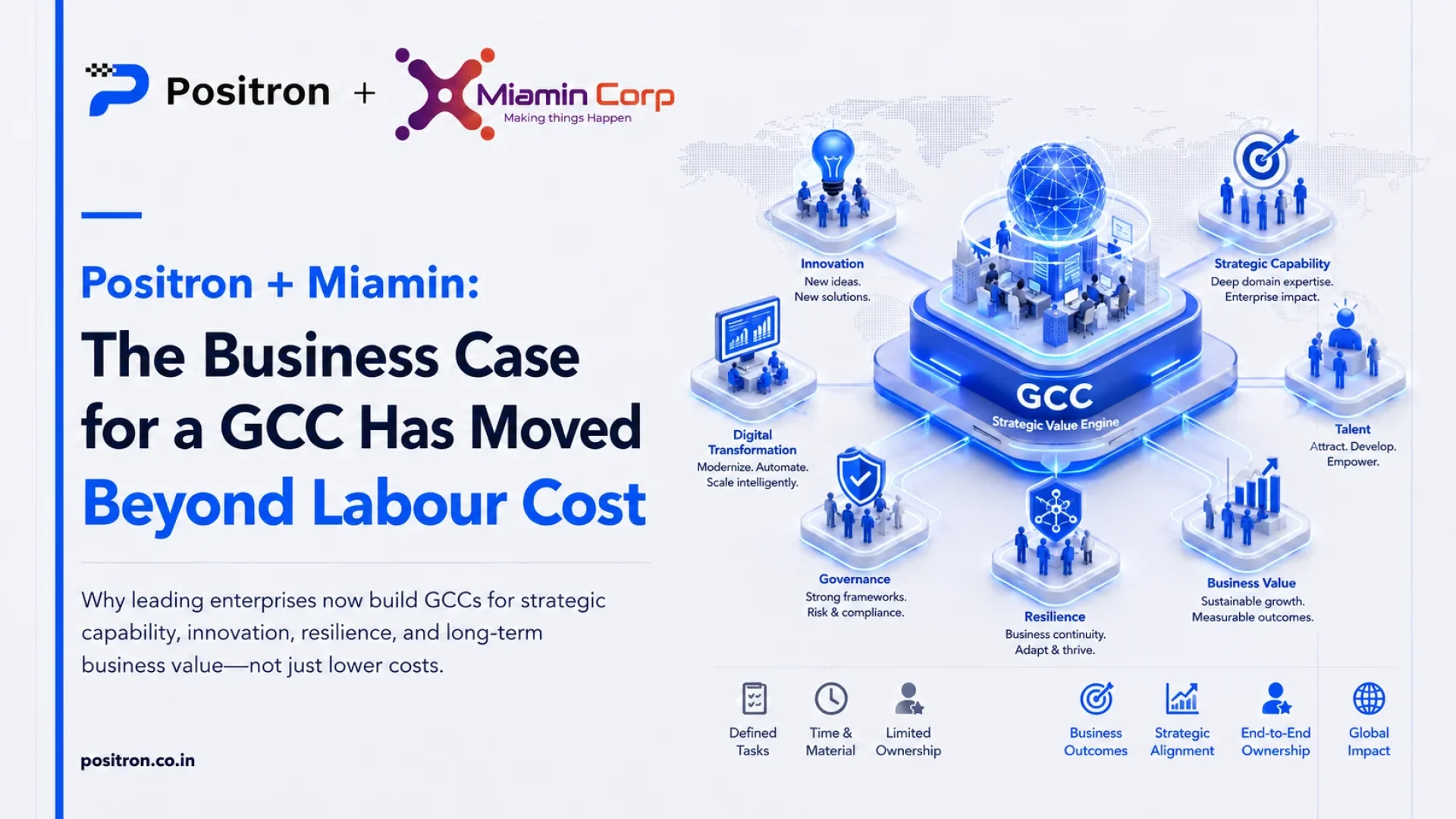
In our latest article, we explain how to build a GCC value case that can guide decisions after approval, not just win approval in the first place.
Labour-cost advantage can help a Global Capability Center get approved. It is rarely enough to make the centre strategically valuable.
For years, the simplest GCC case compared the cost of work at headquarters with the cost in another market. The difference funded transition and created a visible saving. That logic still matters. Deloitte’s 2025 global survey reports that roughly half of responding organisations achieved average savings above 20 percent from GBS, while also highlighting governance and digital technology as important elements of value realisation.
But the same survey shows why the old spreadsheet is incomplete. GBS leaders are prioritising next-generation capabilities and customer experience. BCG describes the need to move beyond a transactional model toward end-to-end outcomes, digital capability and new value-added services. The business case has expanded from “Where can this work cost less?” to “What can the enterprise do better because this capability exists?”
A five-part value equation
1. Sustainable economics
Start with total cost, not salary comparison. Include setup, leadership, recruitment, facilities, technology, security, travel, tax, compliance, partners, transition, duplicated roles during ramp-up and the cost of management attention. Model wage inflation, currency movements and productivity assumptions explicitly. A cheaper role does not automatically create a cheaper process.
2. Capability access
A GCC can provide access to skills that are scarce or difficult to assemble near headquarters. The relevant unit is not “engineers” or “analysts” in general; it is a defined capability such as cloud platform engineering, financial crime analytics, product security or clinical data operations. The World Economic Forum’s Future of Jobs Report 2025 found that AI and big data, networks and cybersecurity, and technology literacy were among the fastest-growing skill areas. A good case shows how the centre will attract, develop and retain the exact skills the strategy requires.
3. Speed and capacity
The value may come from parallel execution, broader time-zone coverage or the ability to build a dedicated team without waiting for one local labour market. Measure what improves: release frequency, product backlog age, finance cycle time, incident response coverage or time to enter a new market. Avoid claiming “24/7 productivity” unless hand-offs, documentation and decision availability are genuinely designed for it.
4. Resilience and control
A multi-location capability can reduce concentration risk, but it can also create new dependencies. The business case should price both sides. Consider business continuity, geopolitical exposure, data-transfer rules, cyber controls, leadership depth and vendor concentration. Resilience is not achieved merely by putting people in a second country. It requires alternative capacity, tested recovery plans and clear authority during an incident.
5. Innovation and enterprise learning
The most mature case explains how the GCC will improve the enterprise, not only execute for it. This may include product ownership, automation, reusable platforms, process redesign, data products or centres of expertise. These benefits are harder to value, so define leading evidence: percentage of work with end-to-end ownership, adoption of reusable assets, time from idea to deployment, or revenue and risk outcomes influenced by the centre.
Separate evidence from hope
Each benefit needs a baseline, an owner, a time horizon and a measurement method. Savings should be net of transition and recurring costs. Productivity should not be counted again as both a cost reduction and a capacity increase. Innovation should not appear as a round number without a delivery mechanism.
Build three cases rather than one: a downside case with slower hiring and higher cost, a base case using defensible assumptions, and an upside case that requires named capability milestones. Then identify the few assumptions that can change the decision. This makes the proposal more useful to the CFO and creates an operating dashboard after approval.
The strongest GCC case does not abandon cost. It puts cost in the correct position: one source of value alongside capability, speed, resilience, control and innovation.
That changes the launch question. Instead of asking how much work can be moved, leaders ask which enterprise constraint the GCC will remove—and how they will know when it has done so.
Frequently Asked Questions
What are the biggest GCC trends in India?
Are GCCs in India still mainly technology centers?
Why is AI important for India GCCs?
What should companies watch before setting up a GCC in India?
Sources
- Deloitte — 2025 Global Business Services Survey — 29 August 2025.
- BCG — Transforming Global Business Services into a Strategic Function — 14 February 2024.
- World Economic Forum — Future of Jobs Report 2025 — 7 January 2025.
- PMI — Benefits Realization Management Framework — November 2016.