

External capacity may accelerate delivery, but the enterprise still owns role quality, lawful decisions, candidate fairness, data governance and workforce priorities. Those responsibilities should never disappear inside a supplier contract.
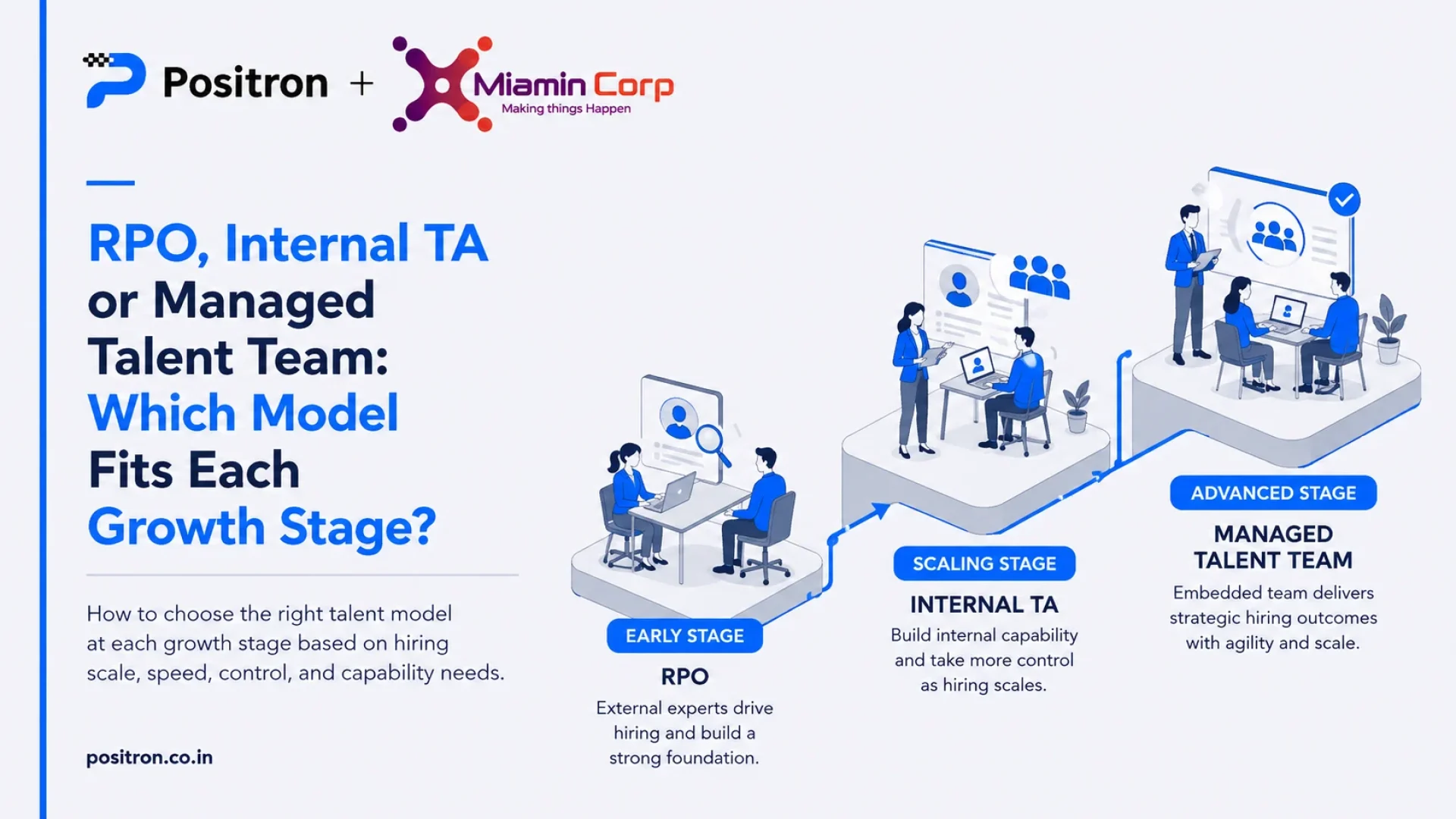
In our latest article, we compare the three talent models and explain how to align control, capability and demand risk with each stage of growth.
Internal talent acquisition, recruitment process outsourcing and managed talent teams are not three levels on one maturity ladder. They allocate capability, control and demand risk differently.
The right model can also change as a GCC moves from exploration to launch, scale and steady operation. The decision should follow the shape of hiring demand, not a preference for insourcing or outsourcing in the abstract.
The labels are used differently across providers, so define the contractual scope before comparing them.
An internal TA team is employed and managed by the enterprise. It usually offers the closest connection to workforce plans, culture, hiring managers and long-term capability.
RPO generally transfers a defined recruitment process, or a substantial part of it, to a provider under agreed service, technology and governance terms. The provider may supply recruiters, process management, sourcing and reporting at an enterprise or programme scale.
A managed talent team is typically a dedicated external team configured around a business unit, capability or growth programme. It may sit between project recruitment and full RPO, but there is no universal definition. Scope, decision rights and employment responsibility must be explicit.
Match the model to the stage
Exploration
Demand is still uncertain, role architecture is incomplete and leaders may be testing one or two capabilities. A small internal owner with selective specialist search can preserve learning. Outsourcing the entire process too early can industrialise requirements that have not yet been designed.
The internal owner should capture market evidence: which skills are genuinely available, which requirements conflict, why candidates withdraw, and what compensation or location assumptions need review.
Launch
The GCC has an approved mandate and a time-bound first hiring wave, but internal local capacity may be limited. A managed talent team or focused RPO programme can add recruiters, local sourcing and process discipline quickly. Internal leaders should still own workforce priorities, role quality, selection standards and final decisions.
The setup must include employer-brand truth, data access, candidate communication, local compliance, vendor escalation and a planned transition if the model is temporary.
Scale
Demand becomes larger, more repeatable and distributed across functions or locations. RPO can provide process consistency and variable delivery capacity when scope and governance are mature. An internal TA centre of expertise may retain workforce planning, executive hiring, assessment design, employer proposition and vendor governance.
Do not reward volume alone. Measures should include quality and impact of hire, candidate experience, hiring-manager readiness, diversity outcomes where lawful, process exceptions and early retention.
Steady operation
Hiring is now part of an enduring talent system. Internal TA often becomes more valuable for succession, mobility and capability planning. External capacity can still support peaks, new locations or scarce skills. The mature answer is frequently a portfolio, not a complete return to one model.
Use six decision tests
Assess demand predictability, capability diversity, geographic spread, required control, internal process maturity and the cost of building permanent capacity. Then examine candidate-data risk, technology integration, supplier concentration and exit readiness.
ISO 30405 treats recruitment as a planned lifecycle covering stakeholders, candidate experience, evaluation and learning. That discipline applies regardless of who employs the recruiter. ISO 30409 similarly keeps the focus on workforce planning: filling requisitions is not a substitute for deciding what workforce the organisation needs.
Keep non-delegable responsibilities visible
A provider can operate sourcing, scheduling, assessment logistics and reporting. The enterprise remains accountable for lawful and fair hiring, role requirements, employment decisions, working conditions and oversight of candidate data.
The ILO’s fair-recruitment principles apply to enterprises and labour recruiters and state, among other things, that workers should not bear recruitment fees and should receive clear information. The OECD’s responsible-business guidelines also cover employment, equality, worker rights and due diligence. These are international baselines; jurisdiction-specific obligations still require local review.
Contracts should state who controls candidate data, which subprocessors are used, where data is accessed, how AI tools are approved, how complaints are handled, and what happens to records at exit. Define knowledge transfer and access revocation before the programme begins.
Positron’s practical view is that hiring capacity should expand without separating recruitment from workforce architecture. The provider model may change by stage, but capability ownership and governance must remain continuous.
Choose the model by answering one question: which responsibilities must stay close to the enterprise, and which delivery capacity would be safer or more effective to flex?
Frequently Asked Questions
What are the biggest GCC trends in India?
Are GCCs in India still mainly technology centers?
Why is AI important for India GCCs?
What should companies watch before setting up a GCC in India?
Sources
- ISO — ISO 30405:2023, Guidelines on Recruitment — June 2023.
- ISO — ISO 30409:2016, Workforce Planning — September 2016; confirmed November 2022.
- ILO — General Principles and Operational Guidelines for Fair Recruitment — 17 February 2019.
- OECD — Guidelines for Multinational Enterprises on Responsible Business Conduct — 8 June 2023.