

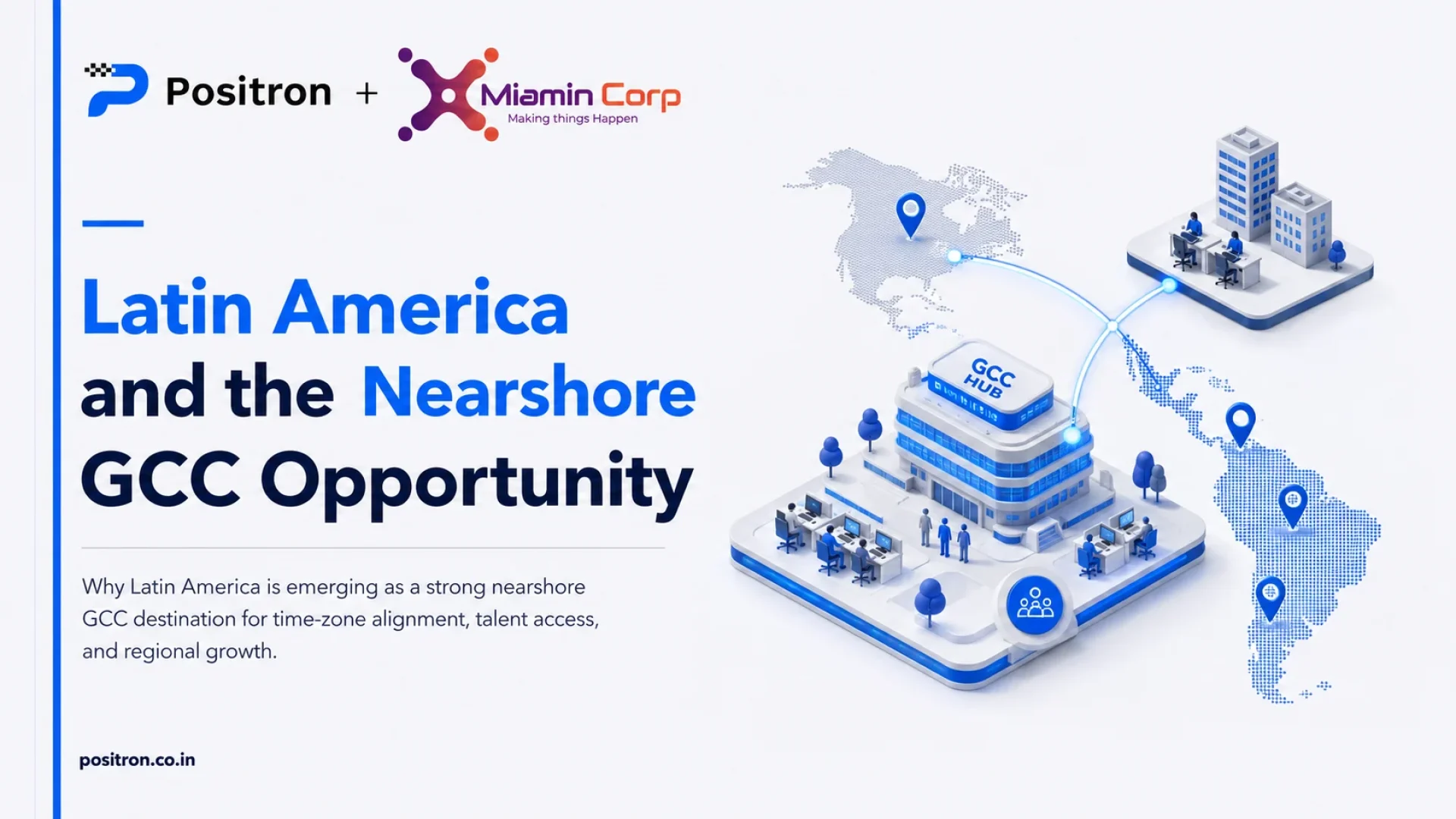
Time-zone alignment can tighten customer, product and operational feedback loops, but only when the centre has direct access, clear ownership and authority to act. Regional headlines still need city-level evidence on talent, infrastructure, data, employment and volatility.
In our latest article, we explain where Latin America can create distinctive value inside a global capability portfolio.
Latin America’s strongest GCC proposition is not simply lower-cost talent near the United States. It is the ability to place product, engineering and operations teams inside the working day of the Americas.
That can change how work moves. A team that shares substantial business hours with customers, product leaders and operational stakeholders can resolve ambiguity faster, participate in live decisions and take responsibility for outcomes rather than waiting for a handoff.
Nearshore value is therefore a collaboration and market-access thesis before it is a labour-arbitrage thesis.
The region supports several portfolio roles
Latin America is not one homogeneous market. Different country and city ecosystems may support software and data engineering, customer and commercial operations, finance, cybersecurity, multilingual services, or industry-specific capabilities.
The wider digital environment is also evolving. ECLAC’s 2025 analysis of digital foreign direct investment observed a shift beyond traditional telecommunications into data centres, cloud services, software and digital platforms. Its work also cautioned that gaps in connectivity, inclusion and digital capability remain. An IDB 2025 skills review highlighted initiatives for reskilling, remote work and participation in global digital services.
These are signals of opportunity, not proof that every location can meet an enterprise mandate.
Use time-zone proximity intentionally
Simply placing a team in a compatible time zone does not create collaboration. The operating model must give it access and authority.
A nearshore product or engineering centre should participate in customer research, roadmap choices, architecture and incident learning. A customer operations hub should have the tools and decision rights to resolve issues, not merely escalate them. A finance team should own defined controls and process outcomes rather than complete isolated transactions.
This is the hidden advantage of proximity: it can support tighter feedback loops. But those loops require shared rituals, common platforms, clear service ownership and leaders who can work across regional and global contexts.
Diligence must go below the regional narrative
An enterprise shortlist should test five questions.
Can the city supply the complete team? Graduate volume is not the same as experienced product managers, security leaders, architects or domain specialists.
Is the employment model sustainable? Labour law, benefits, employer obligations, contractor classification and collective arrangements vary by jurisdiction. The ILO’s work on new forms of employment also underlines the continuing relationship between flexible work and informality in the region.
Will infrastructure support critical operations? Connectivity, power, cloud access, office resilience and home-working conditions should be tested for the actual service.
Can the enterprise control data and intellectual property? Sector rules, cross-border transfers, customer commitments and security requirements need a country-specific legal review.
What volatility must the business absorb? Currency, inflation, political change, public security and regulatory shifts can affect different locations in different ways. Scenario modelling should show both local-currency and enterprise-currency effects rather than treating a favourable exchange rate as a permanent saving.
Build a regional portfolio only when roles are distinct
There can be a case for more than one Latin American node: for example, one ecosystem for engineering and another for multilingual customer operations or resilience. But every new site adds leadership and coordination cost.
The design should therefore begin with capabilities, not flags on a map. A node earns its place when it provides something the rest of the network cannot deliver as effectively: a skill cluster, customer adjacency, language coverage, regulatory familiarity or independent continuity.
Validate the thesis through operating evidence
Before a major ramp, enterprises can test the assumptions with structured market evidence: interview local leaders, run role-level talent mapping, validate compensation and benefit data, assess vendors, review infrastructure and complete legal analysis. A bounded initial team can then demonstrate hiring quality, collaboration, service performance and retention before the mandate expands.
This is not a reason to keep the centre permanently small. It is a way to make growth conditional on evidence rather than on a broad regional narrative. The pilot should test the future operating model, including ownership and leadership—not only the ease of hiring junior roles.
Latin America can complement India’s capability scale, Europe’s regulated nearshore ecosystems and market-facing hubs elsewhere. Its distinctive contribution is Americas alignment combined with an expanding digital and services base.
The strategic question is not whether Latin America is “the next” GCC destination. It is which enterprise outcomes improve when a capable team works inside the region’s time zones, markets and cultures.
Answer that first. The location shortlist becomes much clearer.
Frequently Asked Questions
What are the biggest GCC trends in India?
Are GCCs in India still mainly technology centers?
Why is AI important for India GCCs?
What should companies watch before setting up a GCC in India?
Sources
- ECLAC, *Foreign Direct Investment in Latin America and the Caribbean 2025* — 3 November 2025.
- ECLAC, *Digital Foreign Direct Investment in Latin America and the Caribbean: Opportunities and Challenges* — 20 November 2025.
- Inter-American Development Bank, *Skills for Work in Latin America and the Caribbean* — July 2025.
- International Labour Organization, *New Forms of Work and Informality in Latin America and the Caribbean* — 16 December 2024.