

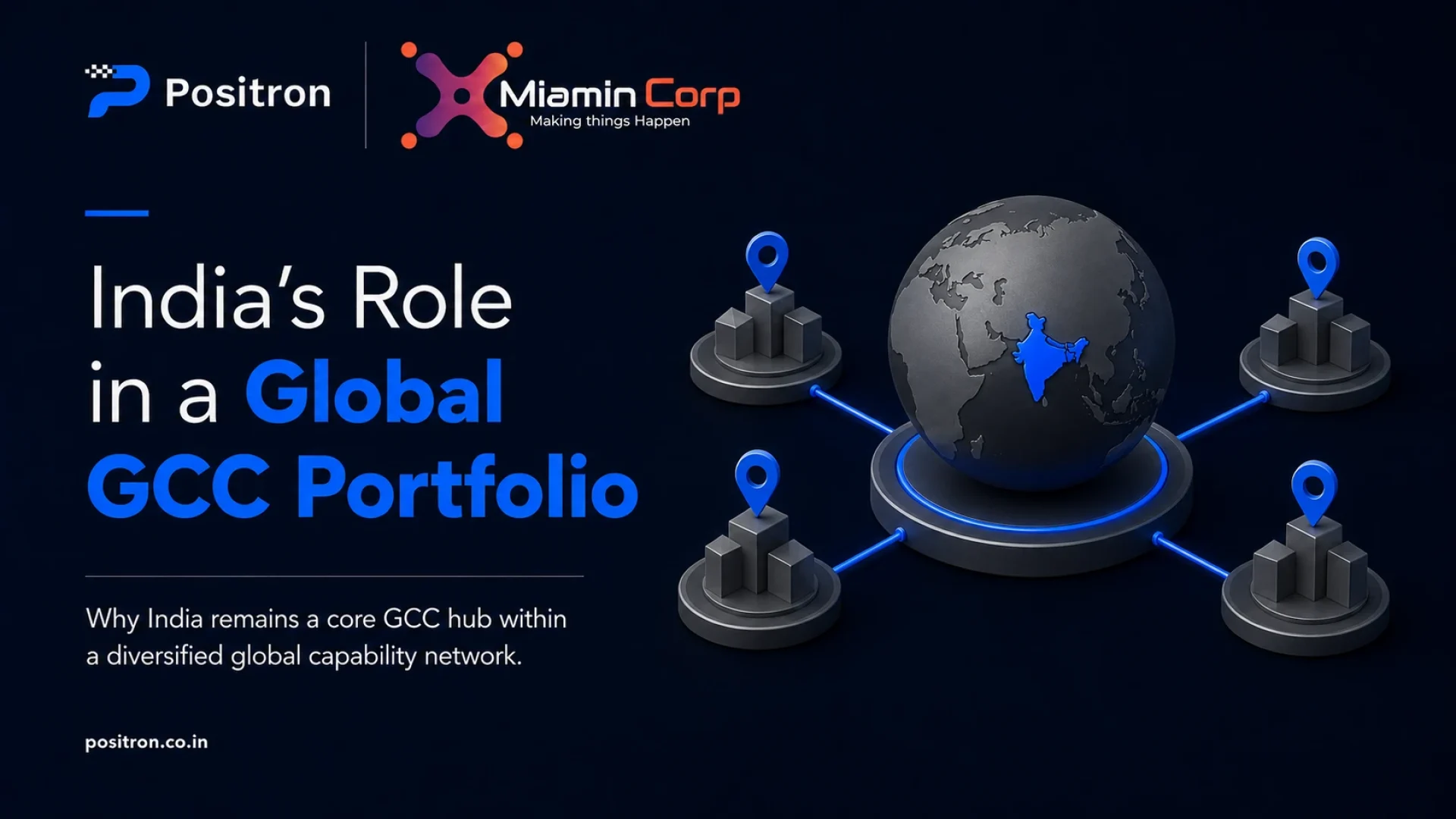
The market offers depth across connected disciplines including engineering, data, cybersecurity, enterprise operations and leadership. Other nodes may still be required for market proximity, language, regulatory engagement or resilience.
In our latest article, we examine how enterprises can position India inside a global capability network and measure its contribution through outcomes rather than scale.
India should rarely be treated as the entire global capability strategy. It can, however, be the portfolio’s capability anchor.
That distinction matters. A company that views India only as a lower-cost delivery location may build a large centre while leaving product authority, architecture, customer context and leadership elsewhere. A company that gives India a clear portfolio role can use its scale to create enterprise capability—not just capacity.
Official Indian sources describe a substantial and increasingly strategic ecosystem. A February 2025 government release cited more than 1,700 GCCs, 1.9 million professionals and $64.6 billion in revenue as of 2024. A later government backgrounder described centres moving into engineering, research, design and strategic operations. Those figures are useful ecosystem snapshots, but they remain time-sensitive estimates and should be rechecked before an investment case.
Where India can create portfolio leverage
India’s strongest role is often where an enterprise needs depth across related capabilities rather than isolated jobs.
That can include platform and product engineering, data and AI, cybersecurity, finance operations, enterprise applications, customer operations and engineering R&D. The advantage is not that every skill is universally abundant. It is that several large city ecosystems can support teams, managers, specialist vendors, universities and career pathways around those domains.
This creates four forms of portfolio leverage:
Scale with adjacency. A centre can expand from one capability into connected disciplines without automatically creating a new country operation.
Leadership density. Mature clusters improve the possibility of hiring people who have already built and governed global teams, although leadership demand can also make senior hiring competitive.
Enterprise integration. A sufficiently broad centre can own end-to-end outcomes across technology and operations instead of receiving fragmented tasks.
Ecosystem participation. Startups, service providers, research organisations and multinational peers can help a centre learn beyond the boundaries of its parent company. India’s 2026 GCC Conclave on Innovation, convened by NITI Aayog and STPI, is one current signal of policy interest in deeper GCC-startup collaboration.
What India should not be asked to solve alone
A global portfolio still needs proximity.
Customer-facing design, regulatory engagement, languages, local market operations and executive relationships may need teams closer to the business. Follow-the-sun services may require nodes in the Americas and Europe. Business continuity may require a deliberately independent recovery location rather than another office in the same infrastructure or talent corridor.
Concentration is also a strategic question. Putting most engineering, operations and institutional knowledge in one country can simplify management, but it can amplify exposure to local infrastructure, regulation, labour-market pressure or a regional disruption. The answer is not arbitrary dispersion. It is to identify critical services, decide which dependencies may be shared and determine which must be separable.
Design India’s mandate before its headcount
The centre needs an explicit charter. It should state which products, platforms or processes it owns; which decisions it can make; how it interacts with business units; and which capabilities it must develop over time.
Leadership must arrive early enough to shape this system. Hiring hundreds of individual contributors before establishing product ownership, architecture, risk and people leadership creates a large dependency rather than a mature capability.
Metrics should also reflect the mandate. Headcount, cost and hiring speed are inputs. Stronger measures include service resilience, product outcomes, control effectiveness, leadership succession, internal mobility, customer impact and the share of work owned end to end.
This is where a workforce and GCC partner can add value: not by presenting India as the answer to every requirement, but by connecting the mandate to city-level talent evidence, governance and portfolio design. For Positron and Miamin Systems, that is the more meaningful opportunity created by India’s maturing GCC ecosystem.
India’s role in a global portfolio should therefore be ambitious and bounded. Use it where ecosystem depth can compound. Pair it with other locations where proximity, specialisation or resilience requires a different answer.
The result is not an India strategy. It is a global capability network with India playing a deliberately powerful role.
Frequently Asked Questions
What are the biggest GCC trends in India?
Are GCCs in India still mainly technology centers?
Why is AI important for India GCCs?
What should companies watch before setting up a GCC in India?
Sources
- Government of India, Ministry of Labour & Employment, *GCCs Emerge as Centres of Excellence and Innovation Hubs* — 25 February 2025.
- Government of India, *From Policy to Prosperity: GCCs Leading India’s Growth Journey* — 11 December 2025.
- Software Technology Parks of India, *Annual Report 2024–25* — 2025.
- NITI Aayog and STPI, *GCC Conclave on Innovation 2026* — 30 June 2026.