

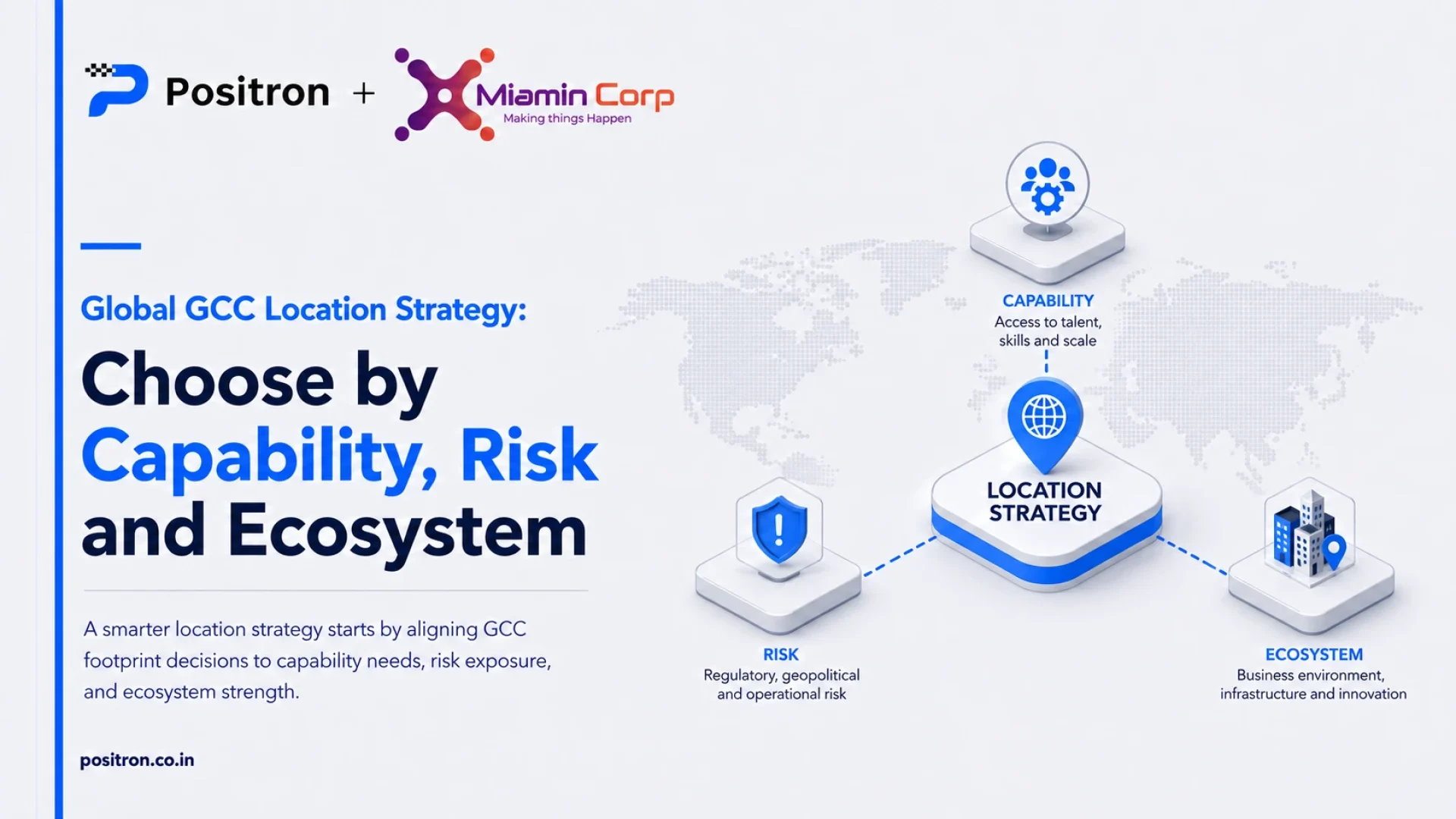
Location strategy should begin with the capability the enterprise needs, then test ecosystem depth, resilience, control, connectivity and total economics. The result may be one centre or a portfolio of specialised locations.
In our latest article, we explain how to move from a generic location ranking to a defensible capability, risk and ecosystem thesis.
The most expensive location decision is often the one justified by labour cost alone.
A salary comparison can look precise, but it answers only a narrow question: what does a role appear to cost today? It does not show whether the location can sustain the capability, protect the enterprise, connect to the right customers or produce the next generation of leaders.
That matters because a Global Capability Center is not simply a workforce container. It is part of the enterprise operating system. Its location affects product speed, regulatory exposure, service continuity, innovation access and the ability to move work across the global network.
Replace the league table with a capability thesis
Start by defining what the centre must become in three to five years.
A transaction-processing hub, an engineering centre, a regulated operations unit and a regional innovation node require different ecosystems. The right question is not, “Which country ranks highest?” It is, “Which location has the institutions, talent, infrastructure and business links needed for this capability?”
The answer should be tested across six dimensions:
- Capability depth: Relevant skills, experienced managers, universities, specialist communities and the ability to hire adjacent roles.
- Ecosystem quality: Customers, suppliers, research institutions, startups, professional services and industry clusters that make the centre smarter over time.
- Risk and resilience: Political, regulatory, cyber, climate, infrastructure, concentration and business-continuity exposure.
- Enterprise connectivity: Time-zone overlap, travel, language, cultural fluency and access to decision-makers.
- Operating control: Data rules, intellectual-property protection, employment structures, tax, entity options and governance requirements.
- Total economics: Fully loaded employment, facilities, leadership, compliance, attrition, transition and coordination costs—not salary alone.
Public frameworks can make this analysis more disciplined. The World Bank’s B-READY programme evaluates business conditions through regulation, public services and operational efficiency. The ITU’s Global Cybersecurity Index assesses national commitment across legal, technical, organisational, capacity-building and cooperation pillars. The OECD’s FDI Qualities work adds outcomes such as skills, innovation, job quality and decarbonisation. None of these determines the answer, but each exposes questions that a salary benchmark misses.
A portfolio can outperform a single “winner”
Many enterprises should not search for one universal location. They should assign different roles to different nodes.
One location may provide engineering scale. Another may provide market and regulatory proximity. A third may offer specialist language or domain capability. A smaller recovery node may reduce concentration risk. The network then becomes intentional: each centre has a mandate, interfaces and clear reasons to exist.
This is not diversification for its own sake. Every additional site creates coordination cost. A portfolio is valuable only when the benefits of capability access, customer proximity or resilience exceed that complexity.
Sequence the decision correctly
First, define the work and its future trajectory. Second, identify non-negotiable controls. Third, shortlist ecosystems at the city and cluster level. Fourth, model operating scenarios. Finally, test the location through real hiring, regulatory, property, vendor and leadership diligence.
City-level evidence matters because national averages hide the operating reality. Two cities in the same country can differ sharply in talent depth, infrastructure, attrition and sector maturity. Likewise, a strong digital economy does not automatically mean the right domain leaders are available for a specific enterprise.
A credible location case should therefore state its assumptions: role mix, hiring pace, management ratios, office model, salary inflation, attrition, currency, compliance costs and continuity design. It should also show downside scenarios, not just the base case.
Make reversibility part of the location case
Location decisions create long-lived commitments, so the design should include options before they are needed. Which capabilities could move to another node? How quickly could a critical vendor be replaced? Are data, contracts and intellectual property portable? Can the enterprise slow, expand or change the mandate without damaging the service?
Reversibility does not mean planning to leave. It means avoiding a model whose economics work only while every original assumption remains true. A location with slightly higher launch cost but stronger leadership, transferable systems and credible alternatives may create more enterprise value over the full lifecycle.
The board-level decision is ultimately simple to state: choose the ecosystem that can carry the mandate at an acceptable level of enterprise risk. Then design a global portfolio in which each node strengthens the others.
Cost remains important. It just belongs inside the decision, not above it.
Frequently Asked Questions
What are the biggest GCC trends in India?
Are GCCs in India still mainly technology centers?
Why is AI important for India GCCs?
What should companies watch before setting up a GCC in India?
Sources
- World Bank, *Business Ready (B-READY) 2025* — 2025.
- International Telecommunication Union, *Global Cybersecurity Index 2024* — 10 September 2024.
- OECD, *FDI Qualities Policy Toolkit* — 2022.
- UN Trade and Development, *World Investment Report 2025* — 19 June 2025.