

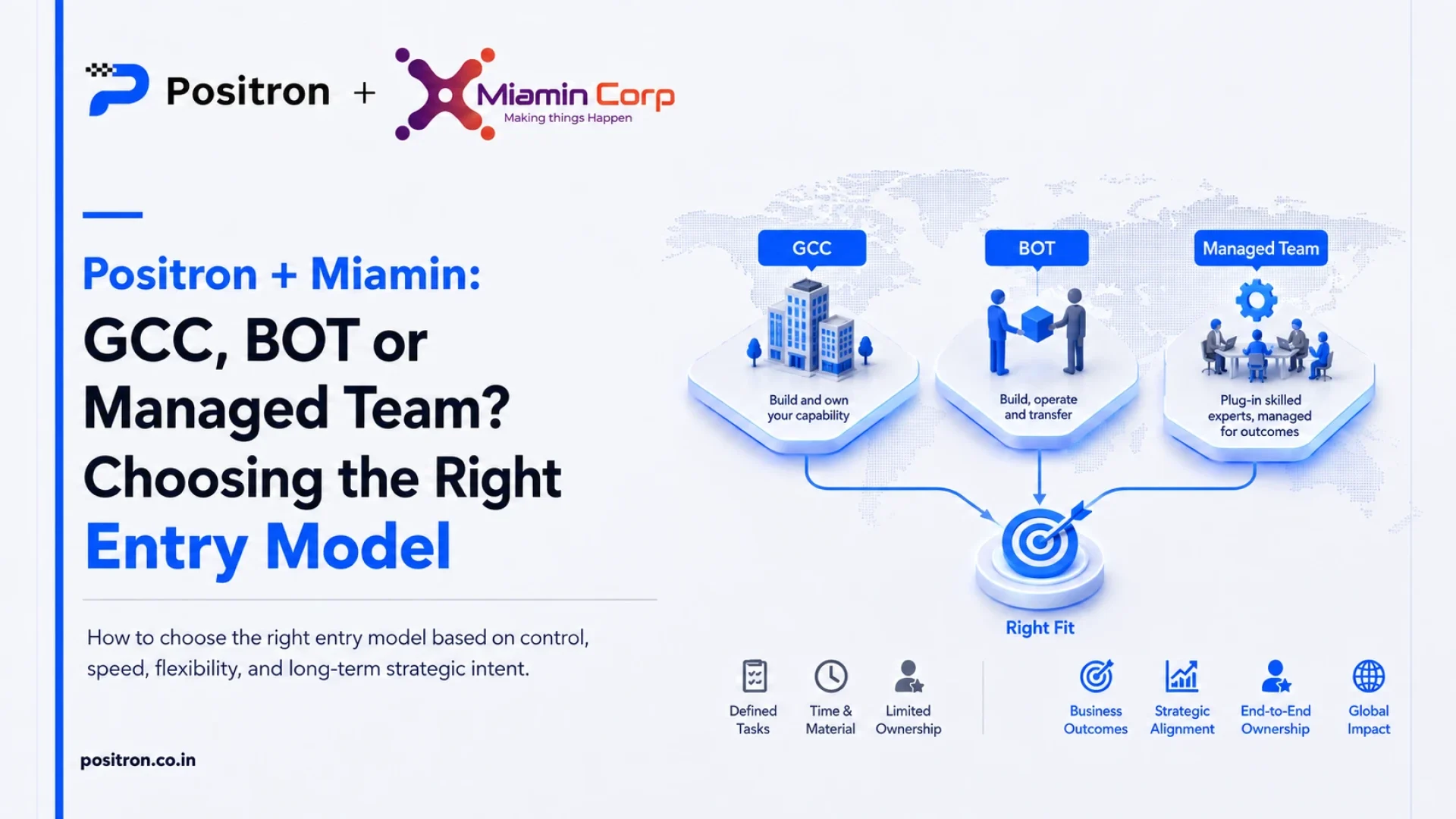
In our latest article, we compare the three entry models and explain how enterprises can select one without locking themselves into the wrong operating structure.
Choosing between an owned Global Capability Center, Build-Operate-Transfer and a managed team is not a choice between good, better and best. It is a choice about when the enterprise needs control, how much uncertainty it carries, and who is equipped to operate the first phase.
The labels are sometimes used loosely, so begin with the intended destination.
An owned GCC is an enterprise capability operated under the company’s control. The organisation invests in the entity or employment structure, leadership, systems, governance and employer proposition required for long-term ownership.
A BOT model uses a partner to build and operate the capability for an agreed period, then transfer defined assets, people, processes and responsibilities to the enterprise. The transfer is not an administrative footnote; it is the central design feature.
A managed team gives the enterprise dedicated or specialist delivery without requiring it to own the full operating structure. The provider normally carries more of the employment and operating responsibility, within contractual service and governance arrangements.
Decide on five dimensions
Strategic importance
When a capability contains differentiating intellectual property, controls a critical product or needs deep integration with enterprise strategy, long-term ownership becomes more valuable. An owned GCC may fit. If the work is important but the enterprise is not yet ready to build locally, BOT can create a path to that ownership. If the work is bounded, variable or readily specified through outcomes, a managed model may preserve flexibility.
Speed to productive operation
Managed teams can often start with less setup because the provider already has employment, recruitment and operational infrastructure. BOT can use the same advantage while preparing for transfer. An owned GCC may require more work before hiring at scale, especially in a new jurisdiction.
Speed should be measured to stable output, not to the first offer accepted. Rapid hiring without security access, managers, knowledge transfer and decision rights only moves the delay downstream.
Demand certainty
If three-year demand is credible across several capabilities, fixed investment in an owned model may be justified. If demand could change significantly, a managed team can reduce commitment. BOT sits between these positions, but only if the contract allows scope and transfer timing to adapt without making the economics opaque.
Internal operating capacity
Some enterprises have strong global HR, finance, security and legal infrastructure but need local talent access. Others are entering a market for the first time and need extensive operational support. The more the company must learn during setup, the more valuable a structured partner phase can be.
This is also a leadership test. A partner can operate processes, but it cannot permanently substitute for an enterprise sponsor or the business leaders who set priorities.
Exit and transfer complexity
Every model needs an exit design. For BOT, specify which employees may transfer, how service tenure and benefits are treated, which systems and data move, how intellectual property is assigned, and what acceptance criteria trigger transfer. For managed teams, define continuity, replacement, data return and transition assistance. For an owned GCC, consider entity closure, redeployment and location concentration risks.
Do not choose on the headline rate
Compare the models using total cost over a realistic horizon. Include setup fees, duplicated roles during transition, leadership, technology, facilities, taxes, compliance, vendor margin, productivity ramp and the cost of retained headquarters teams. Then add risk-adjusted scenarios for slower hiring, wage growth, currency movement and delayed transfer.
Governance should also be model-specific. NIST’s supply-chain risk guidance stresses defining and communicating supplier requirements. That is relevant whenever partners provide technology or operations. In an owned centre, internal interfaces deserve the same discipline even when no external vendor is involved.
A portfolio is often more realistic
An enterprise does not have to select one model for every capability. It might own product engineering, use BOT for a new regional finance hub, and retain managed specialists for cybersecurity or seasonal operations. The important point is to keep architecture, data standards and decision rights coherent across the portfolio.
The decision rule is simple: own what must compound inside the enterprise; use BOT when ownership is the destination but operating readiness needs time; use a managed team when flexibility and specialist delivery matter more than building the full structure now.
Then write that logic into the business case and contract. A model is only useful when the operating reality matches the label.
Frequently Asked Questions
What are the biggest GCC trends in India?
Are GCCs in India still mainly technology centers?
Why is AI important for India GCCs?
What should companies watch before setting up a GCC in India?
Sources
- Positron — Engagement Models — accessed 12 August 2026.
- PwC — Global Business Services transformation phases — accessed 12 August 2026.
- Deloitte — 2025 Global Business Services Survey — 29 August 2025.
- NIST — Cybersecurity Supply Chain Risk Management Quick-Start Guide — October 2024.