

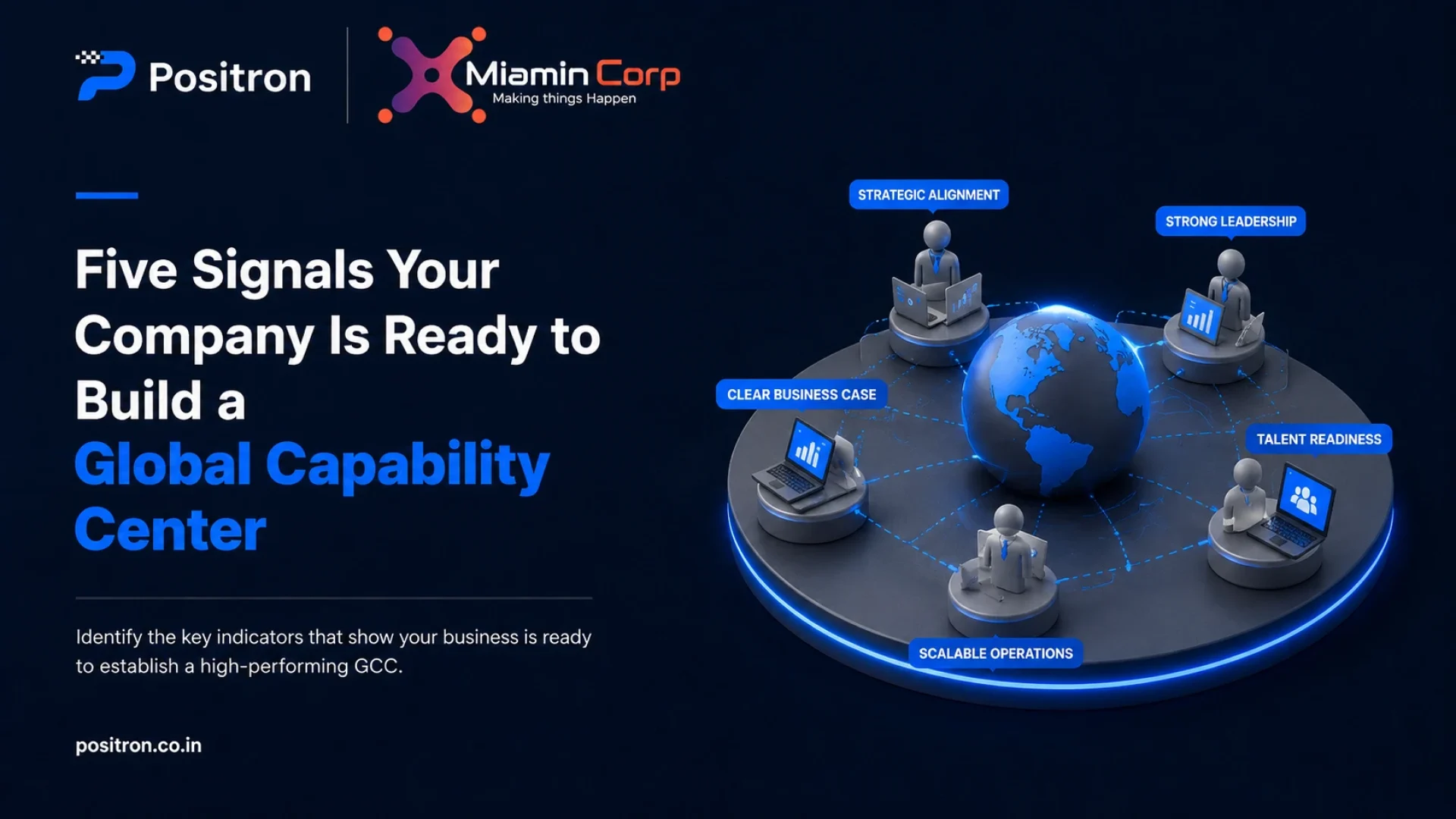
In our latest article, we outline five practical signals that show whether an enterprise is genuinely ready to build a Global Capability Center.
A company is not ready for a Global Capability Center merely because it has a large hiring plan or has found a lower-cost location.
Readiness appears when the enterprise has a capability need, enough continuity to invest, and the leadership discipline to operate across borders. Location selection and recruitment come after that test.
These five signals provide a practical starting point.
1. A strategic backlog is not being solved by the current model
The first signal is persistent demand for capability, not a temporary shortage of hands. Product roadmaps are slowing because a specialist engineering discipline is missing. Finance transformation is fragmented across regions. Cybersecurity needs follow-the-sun coverage. Analytics demand is growing faster than distributed business teams can support.
The backlog should connect to a business constraint: speed, capacity, risk, customer experience or innovation. If the requirement is simply a six-month project or an uncertain spike, a managed team may be more appropriate. A GCC becomes relevant when the capability will matter for several years and deserves its own leadership and learning system.
2. The work can be described as a capability, not just a list of roles
“Hire 200 developers” is not a GCC scope. “Build and operate the enterprise cloud platform” is closer.
A ready organisation can define the customers of the capability, the outcomes they need, the processes or products in scope, the knowledge dependencies, and the boundaries with headquarters. It may not know every future role, but it understands what the centre will own.
This protects the GCC from becoming a convenient destination for disconnected vacancies. BCG’s work on global business services argues for end-to-end ownership and stronger links to enterprise strategy rather than an extended-workbench model.
3. An executive sponsor can make cross-functional decisions
A GCC crosses HR, finance, technology, security, legal, tax, procurement, real estate and business operations. No project manager can resolve all of those trade-offs alone.
Readiness means a named senior sponsor has the authority to protect the mandate, secure investment and settle conflicts between global functions and local delivery. The sponsor does not run daily operations. The sponsor makes sure the organisation is capable of deciding.
Deloitte’s 2025 GBS research highlights the relationship between unified global leadership, governance and value. The broader lesson is not that one title guarantees results. It is that fragmented accountability makes a global operating model harder to manage.
4. Demand is durable enough for a three-year roadmap
The organisation should be able to describe at least three horizons: what must be stable in year one, what can scale in year two, and what higher-value ownership becomes possible in year three.
This does not require a perfect forecast. It requires scenario ranges for demand, cost and talent. Leaders should know the minimum viable scale, the expected case and the conditions that would accelerate or slow investment. A roadmap prevents year-one recruitment targets from becoming the entire strategy.
Durability also means funding more than salaries. Leadership, technology, controls, learning, internal mobility and change management need explicit budgets.
5. The enterprise is willing to design governance before launch
Cross-border delivery brings data, cyber, regulatory, tax, employment and continuity questions. A ready company does not need every answer on day one, but it must be willing to assign owners and make controls part of the design.
That includes decision rights, information classification, access policies, service measures, incident escalation, business continuity, vendor governance and cross-border data-transfer mechanisms where relevant. NIST’s Cybersecurity Framework 2.0 explicitly adds “Govern” to its core functions and places greater emphasis on supply-chain risk. Governance is therefore part of operating performance, not an approval exercise at the end.
A readiness decision, not a location decision
These signals are global. An enterprise may ultimately choose India for technology depth, Mexico for proximity to North American operations, Portugal or Central Europe for multilingual and regional capability, the Philippines for service expertise, or a Middle Eastern hub for regional access. Many will use more than one location.
But no destination can compensate for an unclear mandate. The company is ready when it knows why the capability must exist, what it will own, who can make decisions, how demand could evolve and which controls must travel with the work.
If two or more signals are missing, pause the entity discussion and run a design sprint. A short period of clarity is usually less expensive than scaling the wrong operating model.
Frequently Asked Questions
What are the biggest GCC trends in India?
Are GCCs in India still mainly technology centers?
Why is AI important for India GCCs?
What should companies watch before setting up a GCC in India?
Sources
- BCG — Transforming Global Business Services into a Strategic Function — 14 February 2024.
- Deloitte — 2025 Global Business Services Survey — 2025.
- NIST — Cybersecurity Framework 2.0 — 26 February 2024.
- PwC — Global Business Services Study 2025 — 2025.