

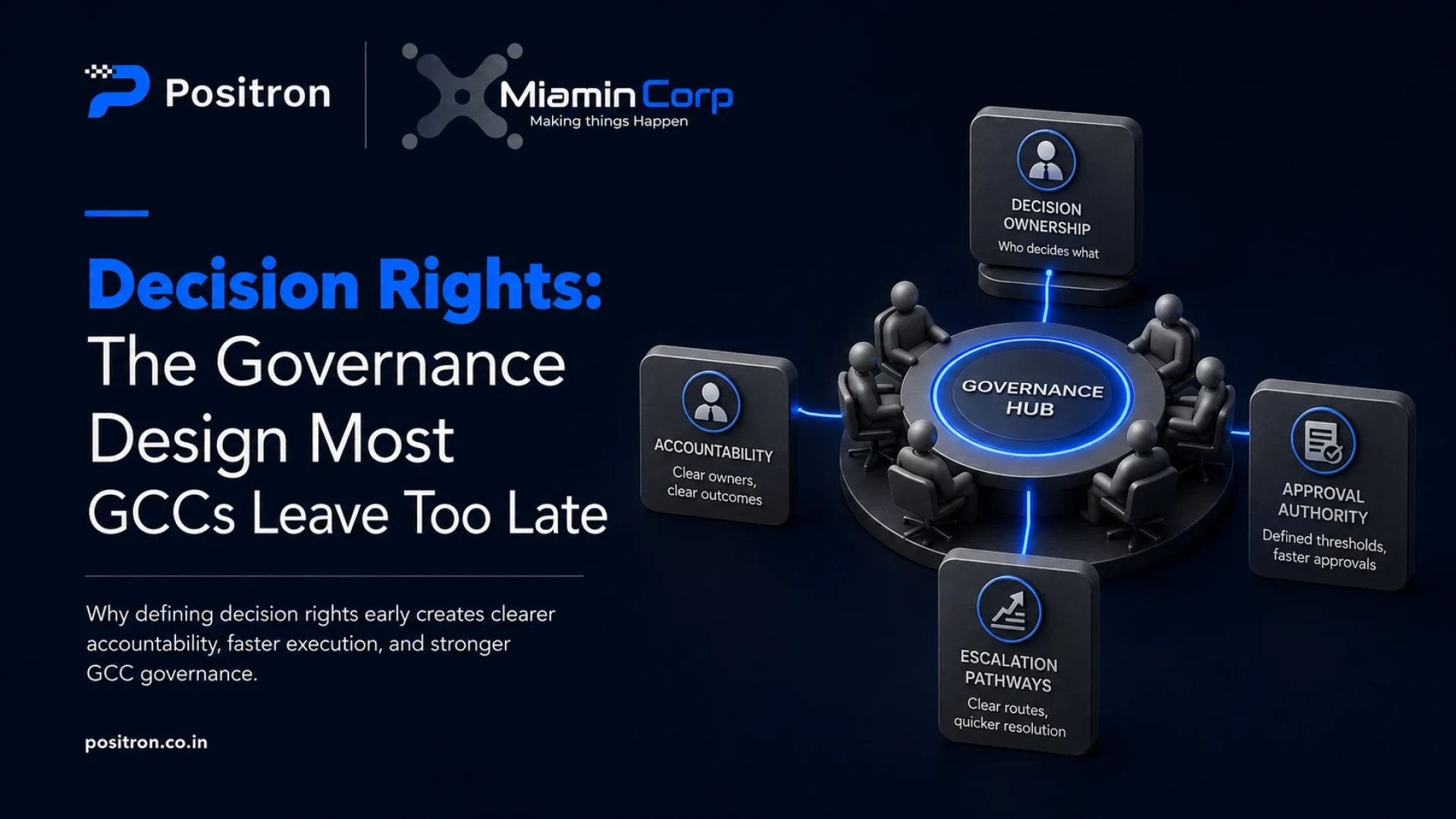
A GCC needs explicit authority across portfolio, process, people, technology, data, risk, finance and exceptions. For every material decision, the enterprise should name the owner, required inputs, guardrails, response time and escalation route.
In our latest article, we explain how to design GCC governance that reduces ambiguous escalation and speeds up decisions inside clear risk boundaries before transition and at scale.
Many GCCs document reporting lines before they document decision rights. That is why an organisation chart can look clear while everyday work remains slow.
A reporting line tells an employee who manages performance. A decision right tells the enterprise who can commit money, change a standard, accept risk, set a priority or approve an exception. Global work creates more interfaces, so ambiguity travels farther: the centre waits for headquarters, headquarters assumes the business owns the answer, and the business believes the centre should decide.
Decision-rights design should begin before the first transition wave.
Map the decisions that shape performance
Do not start with a generic RACI for every task. Identify the recurring decisions that can materially change value, risk or speed. Most GCCs need clarity across at least seven domains:
- Strategy and portfolio: mandate, capabilities, investment and scope changes.
- Product or process: priorities, service design, standards and customer commitments.
- People: organisation design, leadership appointments, compensation boundaries and critical hiring.
- Technology and data: architecture, access, tooling, retention and cross-border transfers.
- Risk and security: control ownership, risk acceptance, incidents and business continuity.
- Commercial and financial: budgets, chargebacks, vendors and contract changes.
- Exceptions: who can deviate, within which threshold, for how long and with what evidence.
The list should reflect the actual capability. A regulated finance centre will need different decisions from a product-engineering hub.
Choose one of four authority patterns
For each important decision, select a deliberate pattern.
Headquarters-owned decisions are appropriate when one enterprise standard, board accountability or regulated authority must remain central.
GCC-owned decisions are appropriate when local leaders have the context and the decision affects delivery within agreed boundaries.
Joint decisions are necessary where enterprise and centre knowledge are both essential, but “joint” must still name the person who makes the final call if consensus fails.
Policy-bound delegation gives the GCC freedom inside guardrails. For example, the centre may select tools from an approved catalogue, hire within compensation bands or change operations below a defined risk threshold.
The goal is not maximum decentralisation. It is minimum necessary escalation with explicit accountability.
Put risk authority next to operational authority
When a GCC owns a process but cannot make related access, architecture or staffing decisions, ownership is mostly rhetorical. Conversely, giving delivery authority without clear risk limits can expose the enterprise.
NIST’s Cybersecurity Framework 2.0 added a Govern function and describes governance as the context for informed cybersecurity decisions. It also emphasises supply-chain risk. That makes authority over security, suppliers and exceptions a first-class operating-model concern, not a technical appendix.
For personal data crossing borders, governance must also reflect applicable law. The European Commission notes that transfers outside the EEA need appropriate safeguards, which may include adequacy decisions, standard contractual clauses or binding corporate rules. A decision matrix should therefore identify the relevant legal and data owners rather than asking the delivery team to interpret requirements alone.
Make the design usable
A useful decision-rights register fits on a few pages. For each decision, record:
- The decision statement and business purpose.
- The final decision owner.
- Required inputs and consulted roles.
- Guardrails, thresholds and evidence.
- Target decision time.
- Escalation route and expiry of exceptions.
Test it with scenarios before launch. Who approves an urgent privileged-access exception? Who changes a global product priority when two regions disagree? Who accepts a delayed control during transition? If the group cannot answer in minutes, the governance is not ready.
Use forums to decide, not only to report
Separate operating reviews from decision forums. Routine metrics can be shared asynchronously. Governance time should focus on choices, unresolved dependencies, risks and benefits.
Track decision performance itself: time to decision, percentage resolved at the intended level, repeated escalations and expired exceptions. A rising number of escalations may show that authority is too narrow, capability is immature or policy is unclear.
Deloitte’s 2025 GBS research highlights effective governance and unified leadership in value realisation. The practical implication is not to add more committees. It is to make authority visible, bounded and close enough to the work.
Good decision-rights design does something that heavy governance often fails to do: it increases both control and speed. It tells the GCC where it may act confidently—and tells headquarters exactly when it must intervene.
Frequently Asked Questions
What are the biggest GCC trends in India?
Are GCCs in India still mainly technology centers?
Why is AI important for India GCCs?
What should companies watch before setting up a GCC in India?
Sources
- NIST — Cybersecurity Framework 2.0 — 26 February 2024.
- Deloitte — 2025 Global Business Services Survey — 2025.
- ISO — ISO 31000:2018 Risk management guidelines — published February 2018; confirmed current in 2023.
- European Commission — Rules on international data transfers — accessed 12 August 2026.