

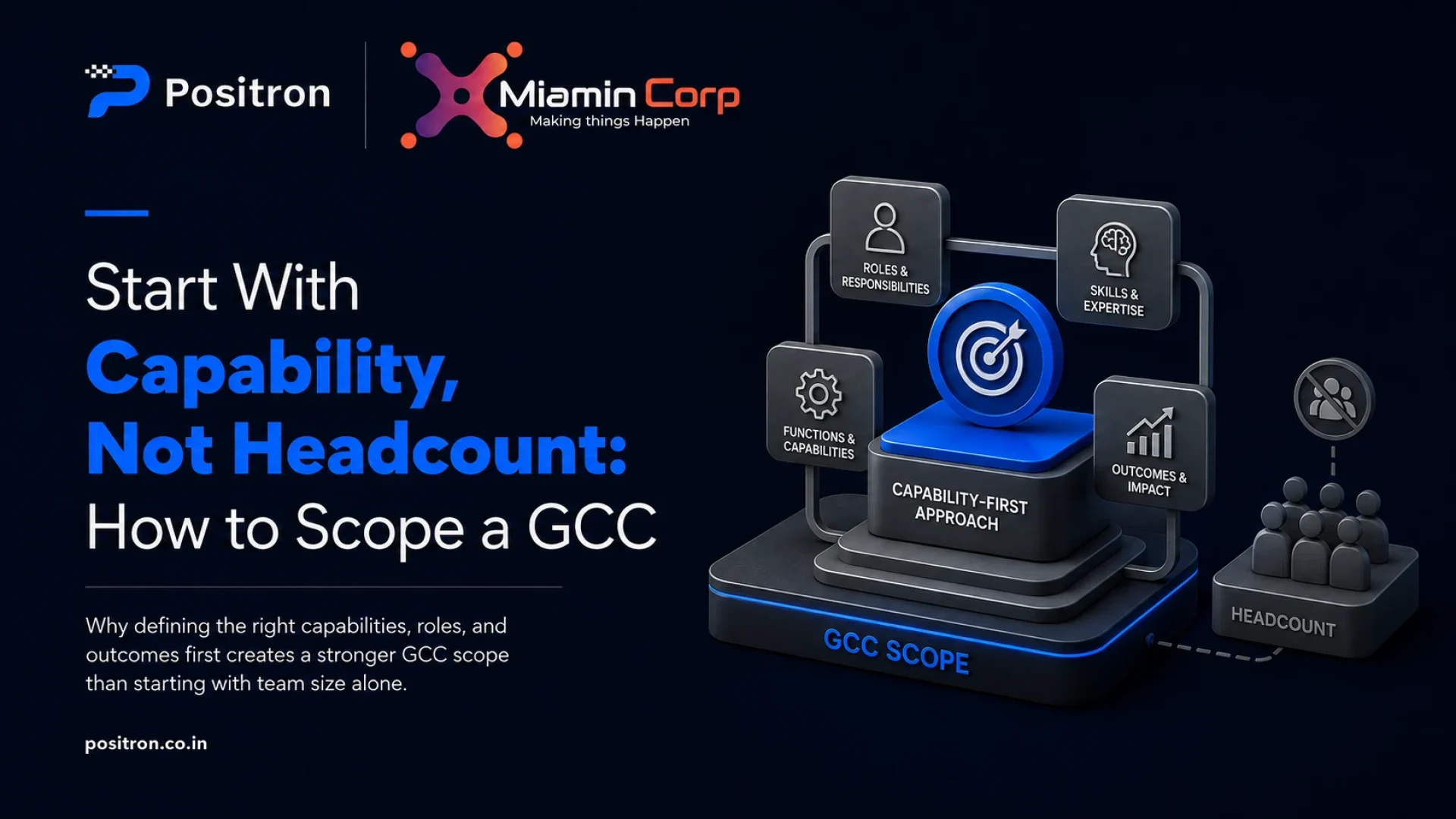
A defensible GCC scope begins with the customer, the required outcome and the boundary of ownership. Only then should leaders translate the work into roles, skills, systems and a workforce plan that separates the stable core from future growth.
In our latest article, we explain how to move from a headcount ambition to a capability statement that can guide design, hiring and measurement.
Headcount is an output of GCC design. When it becomes the starting point, the organisation risks scaling activity before it has defined value.
“We need 300 people in a new location” sounds concrete. It creates a budget, a hiring target and a visible programme. But it leaves the most important questions unanswered: What will those people own? Which enterprise constraint will they remove? How will the work change over three years? What must remain elsewhere?
A stronger scope begins with capability.
Write a capability statement
Use one sentence that links a customer, an outcome and an ownership boundary. For example: “The centre will build and operate the shared data platform used by regional product teams,” or, “The centre will own global order-to-cash operations from transaction processing through performance analytics.”
This is more useful than a role list because it reveals interfaces. Product teams must define demand. Security must approve access. Data owners must set standards. Process owners must decide which exceptions remain local. The staffing model can then be designed around real work.
Decompose the work before allocating it
Map the capability into four layers:
- Outcomes: the business results the capability influences.
- Products or services: what internal or external customers receive.
- Workflows and decisions: how value is produced and where judgement occurs.
- Roles, skills and enabling systems: the capacity needed to operate and improve it.
This sequence avoids a common mistake: moving repeatable tasks while leaving all meaningful decisions at headquarters. That may produce labour savings, but it also creates queues, weak accountability and limited career depth in the centre.
The reverse mistake is equally risky—moving end-to-end ownership before leaders, data and controls are ready. Scope should therefore include a path to ownership, not an assumption that every responsibility moves on day one.
Define three rings of work
The first ring is the stable core: work with clear demand, named customers, documented dependencies and enough volume to justify dedicated capability.
The second ring is adjacent growth: related products, processes or expert services that can move once the core is reliable. This is where the centre begins to reuse knowledge and platforms rather than adding unrelated roles.
The third ring is future capability: AI, automation, product ownership, advanced analytics, R&D or a centre of expertise that depends on leadership and data maturity. Treat this as a conditional roadmap, not as a benefit already delivered.
BCG’s 2024 analysis of global business services argues for stronger end-to-end ownership, digital and data foundations, and services beyond traditional transactional work. Deloitte’s 2025 survey similarly reports a focus on next-generation capabilities and customer experience. Both support a scope that can mature rather than remain a fixed task catalogue.
Translate capability into a workforce system
Only now should headcount enter the model. Estimate demand drivers and service volumes, then design roles around work and decisions. Separate leadership, core delivery, specialist expertise, platform enablement and governance. Include learning capacity and succession, not only productive capacity.
Use ranges instead of false precision. A base case can show expected demand, while downside and upside cases show which roles scale and which investments remain fixed. The World Economic Forum’s 2025 research found that skills gaps are a major barrier to transformation and that employers expect significant skill change. That makes a static three-year role list particularly fragile.
The workforce plan should therefore answer:
- Which skills must be hired, built internally or accessed through partners?
- Which roles need proximity to customers or regulators?
- Which skills require a leadership pipeline rather than repeated external hiring?
- Which work may be automated or redesigned as the capability matures?
Measure the capability, not its size
For each ring of scope, define evidence of performance: service reliability, cycle time, product quality, customer adoption, control effectiveness, capability depth and total cost. ISO 30414:2025 offers a broad human-capital reporting baseline across productivity, skills, recruitment, turnover, leadership, culture and other workforce areas. It is useful as a reference, but the GCC scorecard must still connect people measures to enterprise outcomes.
A credible scope document finishes with exclusions. It says which decisions, customers, data classes and responsibilities are not moving yet, and what conditions would change that boundary.
Headcount can then be defended because it is traceable to work, and work is traceable to outcomes. That is the foundation of a GCC that builds capability instead of merely accumulating roles.
Frequently Asked Questions
What are the biggest GCC trends in India?
Are GCCs in India still mainly technology centers?
Why is AI important for India GCCs?
What should companies watch before setting up a GCC in India?
Sources
- BCG — Transforming Global Business Services into a Strategic Function — 14 February 2024.
- Deloitte — 2025 Global Business Services Survey — 29 August 2025.
- World Economic Forum — Future of Jobs Report 2025 — 7 January 2025.
- ISO — ISO 30414:2025 human capital reporting and disclosure — August 2025.
Follow Positron for More Recruitment Industry Insights
Check-out Positron on LinkedIn for sharper insights on Global Capability Centres, hiring strategy, workforce execution, and scalable operating models built for growth.