

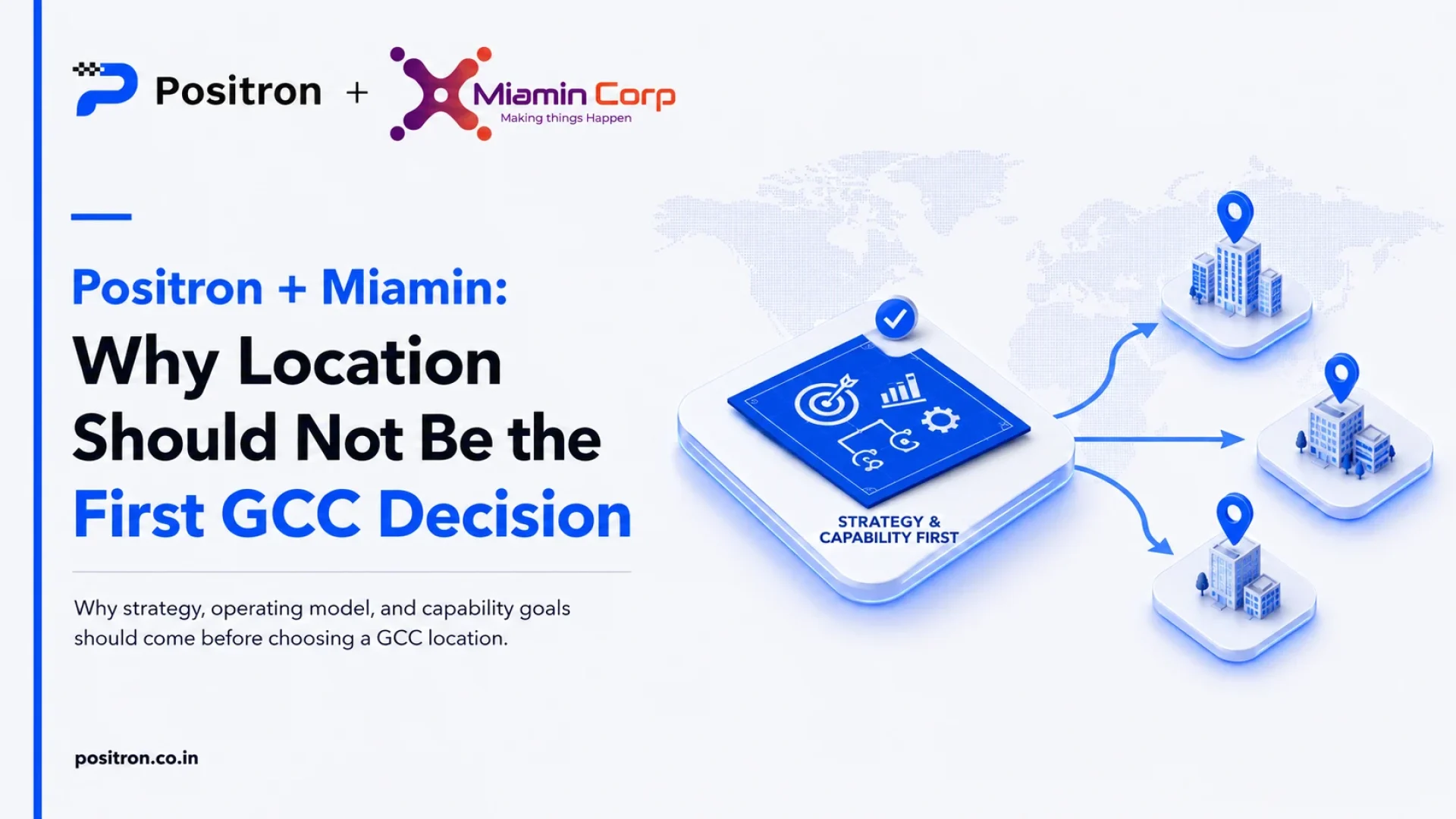
Location fit depends on skills, seniority, customers, time zones, data, regulation, infrastructure, scale and the centre’s three-year mandate. That means the work should shape the scorecard—not a generic market ranking.
In our latest article, we explain why location should follow capability design and how to evaluate regions, countries and city ecosystems with evidence.
The first GCC question is often, “Which country?” The better first question is, “Which capability, for which customers, under which constraints?”
Location matters enormously. It shapes talent access, cost, time-zone overlap, language, regulation, data flows, leadership supply, resilience and employee experience. But a location can only be “best” in relation to a mandate.
A city that works well for multilingual finance operations may be a poor fit for advanced product engineering. A country suited to nearshore customer operations may not offer the same depth for specialised R&D. A large talent market can still be unsuitable if critical data cannot travel or if headquarters cannot support the required decisions across time zones.
Define the demand before comparing supply
Start by describing the capability in operational terms:
- Which products, processes or services are in scope?
- Which languages, domain skills and seniority levels are required?
- Where are the customers, decision-makers and upstream dependencies?
- What data, intellectual property or regulated activity is involved?
- How fast must the capability scale, and what should it become over three years?
Once this is clear, location analysis becomes a test rather than a beauty contest.
Evaluate three geographic layers
Region
The regional choice establishes time-zone coverage, customer proximity, geopolitical diversification and broad regulatory context. The Americas can support proximity to North American operations; Europe, the Middle East and Africa offer different language, market and regulatory combinations; Asia-Pacific contains several deep technology and services ecosystems. No region is a single talent market.
Country
Country analysis should cover financial attractiveness, people skills and availability, business environment, digital maturity, legal conditions, infrastructure, taxation and security. Kearney’s 2023 Global Services Location Index uses these broad categories, illustrating why wage level alone is an incomplete measure.
Cross-border data rules deserve early attention. For example, the European Commission explains that personal data transferred outside the European Economic Area needs appropriate safeguards through mechanisms such as adequacy decisions, standard contractual clauses or binding corporate rules. The applicable mechanism depends on the specific data and entities, so legal advice belongs in the design process.
City and ecosystem
Most hiring happens in a city or commuting market, not in a national average. Compare role-level talent depth, competition, universities, industry clusters, transport, housing, quality of life, leadership supply and the presence of service partners. Test whether the city can support both the initial team and the future capability.
Use capability-weighted evidence
Create a scorecard whose weights come from the mandate. If customer proximity is essential, time-zone overlap and language may outweigh headline labour cost. If the centre will own sensitive platforms, security ecosystem, data rules and experienced engineering leadership may dominate. If the work is high-volume and standardised, scale, continuity and process talent may matter more.
The score should show uncertainty, not hide it. Separate verified market data from estimates. Use interviews and small hiring tests to validate reported talent supply. Compare compensation by role and level rather than one blended average. Include attrition, recruitment lead time, employer-brand strength and productivity ramp.
Current market rankings are useful signals, not permanent answers. Deloitte’s 2025 GBS survey identifies Mexico and Portugal as rapidly emerging locations while India and the United States remain important leaders. PwC’s 2025 study discusses recalibration in Central and Eastern Europe and specialised options in Latin America. Those observations show a changing portfolio, not a universal ranking for every capability.
Design a footprint, not a winner
For many enterprises, the final answer is multi-hub. One location may hold product leadership and scarce expertise; another may provide scaled operations; smaller spokes may support languages, market proximity or continuity. The trade-off is additional governance and integration cost.
Model concentration explicitly. A second site does not create resilience if both depend on the same cloud region, vendor, leaders or decision-makers. Conversely, excessive fragmentation can weaken culture and slow learning.
The disciplined sequence is capability, constraints, regional options, country diligence, city validation and then footprint design. After that, location becomes a strategic choice rather than a fashionable answer.
The best GCC location is not the market with the strongest general story. It is the place—or combination of places—that can sustain the specific capability the enterprise intends to own.
Frequently Asked Questions
What are the biggest GCC trends in India?
Are GCCs in India still mainly technology centers?
Why is AI important for India GCCs?
What should companies watch before setting up a GCC in India?
Sources
- Kearney — 2023 Global Services Location Index — 2023.
- Deloitte — 2025 Global Business Services Survey — 29 August 2025.
- PwC — Global Business Services Study 2025 — 2025.
- European Commission — Rules on international data transfers — accessed 12 August 2026.