

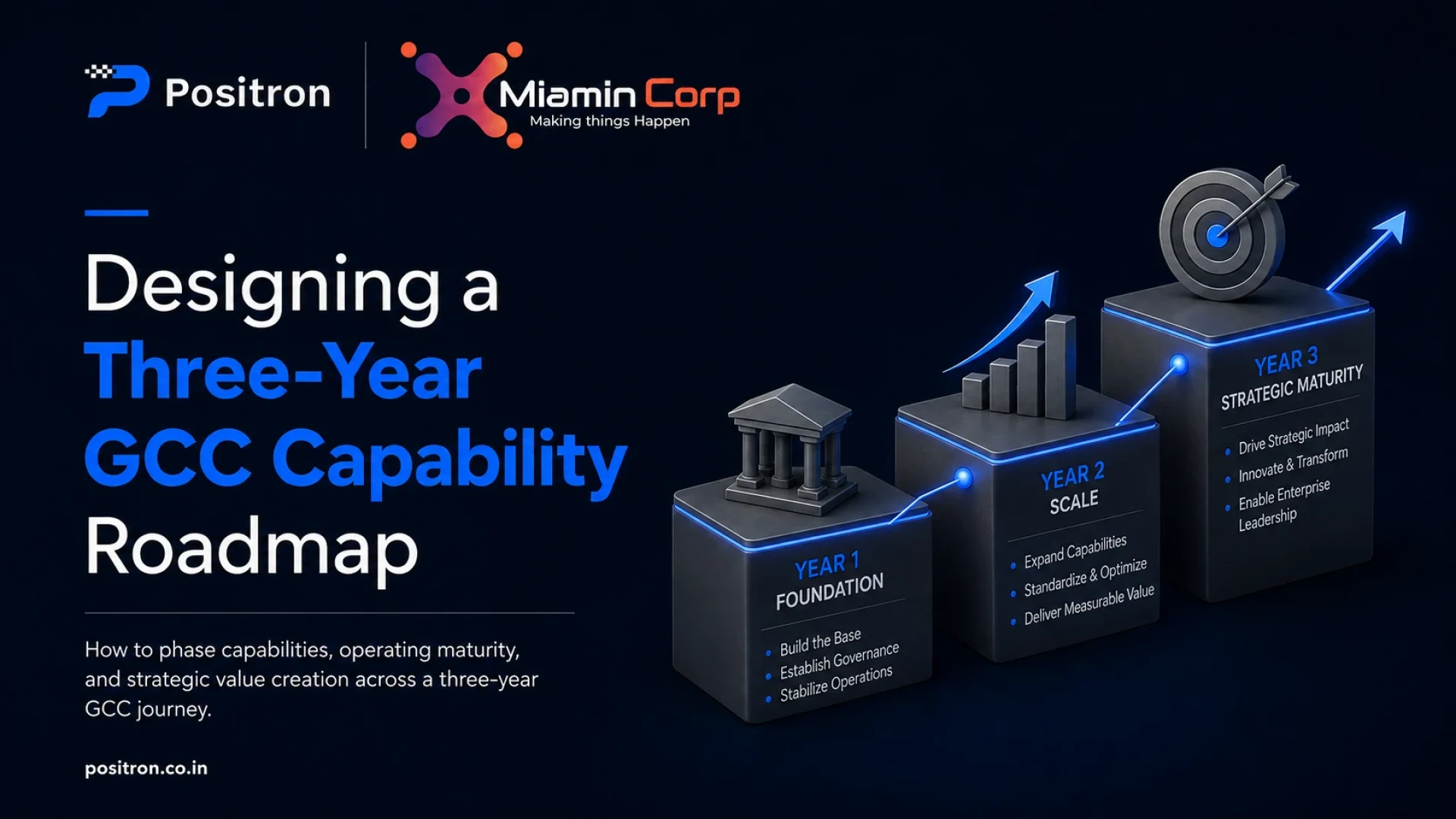
Year one must prove stable delivery. Year two should create repeatability and deeper integration. Year three can compound selected capabilities through platforms, expertise and measurable improvement—but only when evidence supports the next step.
In our latest article, we set out a stage-gated roadmap that connects capability, operating model, workforce, value and risk rather than calendar ambition alone.
A GCC roadmap should show how ownership grows, not merely how headcount grows.
Many plans are detailed for the first six months and vague after launch. They cover entity setup, office readiness and recruitment, then assume that scale will create maturity. It does not. A centre can add hundreds of people while remaining dependent on headquarters for priorities, architecture, decisions and career paths.
A useful three-year roadmap links capability, operating model and measurable benefits. It also recognises that the dates are hypotheses. Progress should be controlled by evidence-based gates, not by the calendar alone.
Before year one: design the contract with the enterprise
The roadmap begins with a mandate: customers, outcomes, services or products, ownership boundaries and explicit exclusions. Establish the baseline for cost, quality, cycle time, risk and talent before work moves. Name the executive sponsor, capability owners and benefit owners.
Design the first decision-rights matrix, data and security requirements, location logic, leadership structure, workforce plan and transition waves. If a partner, BOT or managed model is involved, define transfer or exit conditions now.
PMI’s benefits-realisation framework recommends identifying expected benefits, connecting them to strategy, defining measures and securing stakeholder sign-off. This turns the roadmap from an activity plan into a value plan.
Year one: prove stable delivery
The first year should establish trust. Priorities include leadership hiring, access and controls, knowledge transfer, service baselines, customer routines and a functioning local culture.
Move work in coherent waves rather than sending isolated roles. Each wave needs entry criteria, a period of parallel operation where necessary, acceptance measures and a clear owner. Track quality, cycle time, incidents, customer confidence, hiring performance and employee experience. Do not declare transition complete because a date has passed.
Year-one capability is often narrower than the long-term vision. That is healthy. The gate to year two should require stable service, tested controls, sufficient leadership depth and reliable management data.
Year two: scale and integrate
The second year is about repeatability. Standardise workflows where that improves outcomes, strengthen product or process ownership, expand adjacent scope and reduce unnecessary headquarters hand-offs.
Build internal mobility and succession. Add learning academies or communities of practice for scarce capabilities. Improve data quality and automate work only after understanding the process. Create common platforms or reusable assets where several teams have the same need.
BCG’s analysis of strategic GBS models emphasises end-to-end outcomes, a digital and data backbone, and stronger internal partnerships. These are useful year-two tests: Is the GCC becoming part of how the enterprise operates, or is it still treated as a remote supplier?
The year-two gate should examine whether the centre can absorb scope without proportional management overhead, whether customers see improving outcomes, and whether key responsibilities have moved with the work.
Year three: compound enterprise capability
By year three, the centre should be ready to lead selected capabilities, not only deliver them. This could mean global product ownership, process redesign, advanced analytics, automation platforms, R&D, cybersecurity leadership or a centre of expertise. The exact destination depends on the mandate.
Measure innovation carefully. Count deployed improvements, adoption and business impact—not workshops or ideas submitted. Measure capability depth through succession coverage, critical-skill proficiency and the centre’s ability to set standards across regions.
Deloitte’s 2025 survey reports that GBS organisations are prioritising next-generation capability and customer experience. A year-three roadmap should translate that broad direction into specific enterprise outcomes with named owners.
Build the roadmap on four connected tracks
Every quarter, review four tracks together:
- Capability and scope: what the centre owns now and next.
- Operating model: decision rights, processes, technology and governance.
- Workforce: leadership, skills, capacity, culture and succession.
- Value and risk: benefits, cost, customer outcomes, controls and resilience.
Dependencies should be visible. Product ownership cannot move before business authority. AI use cases cannot scale before data access and governance. A second location cannot improve resilience before continuity is tested.
Use scenarios and review the roadmap at least quarterly. ISO 31000 treats risk management as integrated with strategy, planning and decision-making, which supports adjusting investment as evidence changes.
The point of a three-year roadmap is not to predict every role. It is to make the path from launch to enterprise ownership explicit—and to give leaders permission to stop, correct or accelerate based on proof.
Frequently Asked Questions
What are the biggest GCC trends in India?
Are GCCs in India still mainly technology centers?
Why is AI important for India GCCs?
What should companies watch before setting up a GCC in India?
Sources
- PMI — Benefits Realization Management Framework — November 2016.
- BCG — Transforming Global Business Services into a Strategic Function — 14 February 2024.
- Deloitte — 2025 Global Business Services Survey — 29 August 2025.
- ISO — ISO 31000:2018 Risk management guidelines — published February 2018; confirmed current in 2023.