

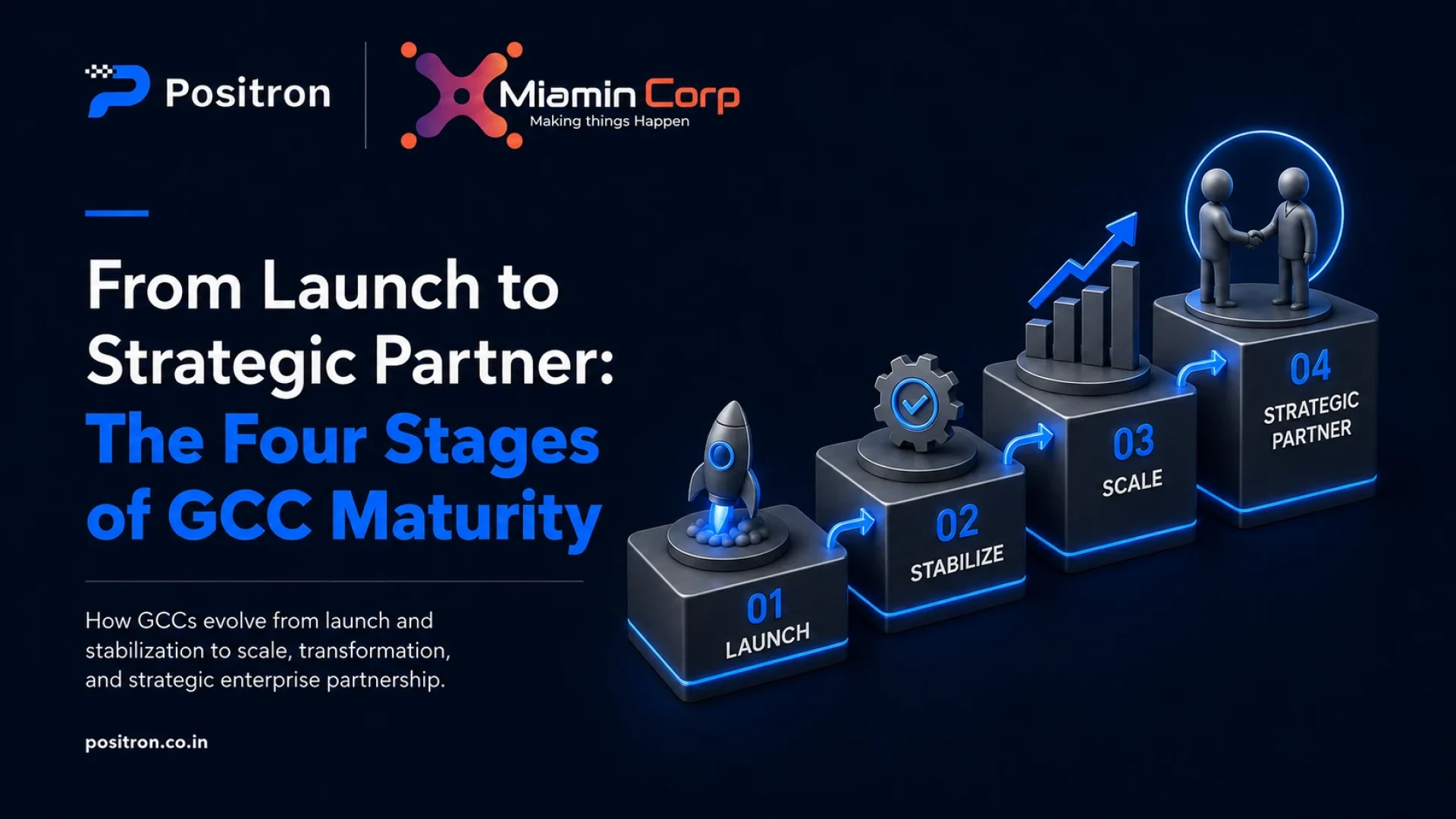
A centre may move from stable delivery to repeatability, then to end-to-end ownership and eventually strategic contribution. Different capabilities can mature at different speeds, and not every capability needs to reach the final stage.
In our latest article, we explain the four maturity stages and the evidence leaders should require before expanding a GCC’s mandate.
A GCC does not become strategic because it reaches a particular size. It becomes strategic as trust, ownership and enterprise contribution deepen.
Maturity is also not uniform. A centre may have a mature finance capability and an early-stage engineering team. The four-stage model below is therefore a management framework, not an external standard or a universal benchmark.
Stage one: Launch and prove
The first job is reliable transition. Leaders establish the local operating structure, hire the initial team, secure systems access, transfer knowledge and protect service continuity.
The centre is usually dependent on headquarters for priorities and many decisions. That is acceptable if the dependency is visible and temporary. Measures should focus on readiness, quality, service stability, incidents, hiring performance, customer confidence and control effectiveness.
The common failure is premature scale. A programme celebrates headcount while teams lack managers, documentation, decision rights or reliable data. The gate out of stage one is not the planned date. It is evidence that the core service can operate within agreed performance and risk limits.
Stage two: Stabilise and standardise
The centre now reduces variation, strengthens management routines and improves productivity. It documents exceptions, standardises work where useful, develops frontline leaders and builds a consistent employee experience.
Governance moves from transition meetings to an operating cadence. Customers and the centre agree service definitions, priorities and escalation. Technology and process improvement begin to remove manual work, but automation follows process understanding.
The common failure is becoming an efficient task factory. Standardisation can lower cost while freezing a fragmented operating model. The gate to stage three requires coherent services or products, greater local authority and evidence that improvement is changing outcomes rather than only utilisation.
Stage three: Integrate and own
At this stage, the GCC becomes part of the enterprise’s normal operating model. Selected teams own products, platforms, processes or centres of expertise end to end. Local leaders participate in global planning. Career paths include technical and business leadership, not only larger delivery teams.
Measures expand to customer adoption, product quality, process outcomes, capability depth, innovation delivery and resilience. Headquarters retains enterprise authority where required, but routine decisions move closer to the work.
BCG’s 2024 analysis of strategic GBS organisations emphasises end-to-end outcomes, digital and data foundations, internal partnerships and expansion into higher-value services. These are useful indicators of stage-three behaviour.
The common failure is ownership in name only. If the GCC owns the result but must seek approval for priorities, architecture, people or exceptions, accountability remains incomplete.
Stage four: Shape and compound
A strategic-partner GCC helps shape enterprise direction. It may lead global product or process strategy, create reusable platforms, incubate new capabilities, influence market entry, or coordinate expertise across several locations.
Its contribution compounds because knowledge, leadership and technology are reused across the enterprise. The centre is not valuable only because work happens there; it is valuable because the enterprise can now do something better, faster or more safely.
Deloitte’s 2025 GBS survey reports increasing focus on next-generation capability and customer experience, while PwC’s work describes the evolution from shared service centres toward capability-oriented models. Stage four translates that direction into enterprise-specific evidence.
The risk at this stage is innovation theatre: labs, pilots and idea counts without adoption. Measure deployed improvements, business outcomes, standards influenced and capabilities successfully scaled.
Manage transitions, not labels
For each capability, review five dimensions:
- Mandate and end-to-end ownership.
- Leadership and decision authority.
- Talent depth, learning and succession.
- Technology, data and process maturity.
- Customer, financial and risk outcomes.
Set a baseline and identify the next constraint. A centre may need better customer governance before more scope, stronger leadership before delegated authority, or cleaner data before AI-enabled transformation.
Not every capability needs stage four. Stable, controlled transaction processing may create strong value at stage two. The maturity objective should follow enterprise need, not status.
The central question is therefore not, “How mature is our GCC?” It is, “Which capabilities are ready for more ownership, and what evidence supports the next move?”
Frequently Asked Questions
What are the biggest GCC trends in India?
Are GCCs in India still mainly technology centers?
Why is AI important for India GCCs?
What should companies watch before setting up a GCC in India?
Sources
- BCG — Transforming Global Business Services into a Strategic Function — 14 February 2024.
- Deloitte — 2025 Global Business Services Survey — 29 August 2025.
- PwC — Global Business Services Study 2025 — 2025.
- PMI — Benefits Realization Management Framework — November 2016.