

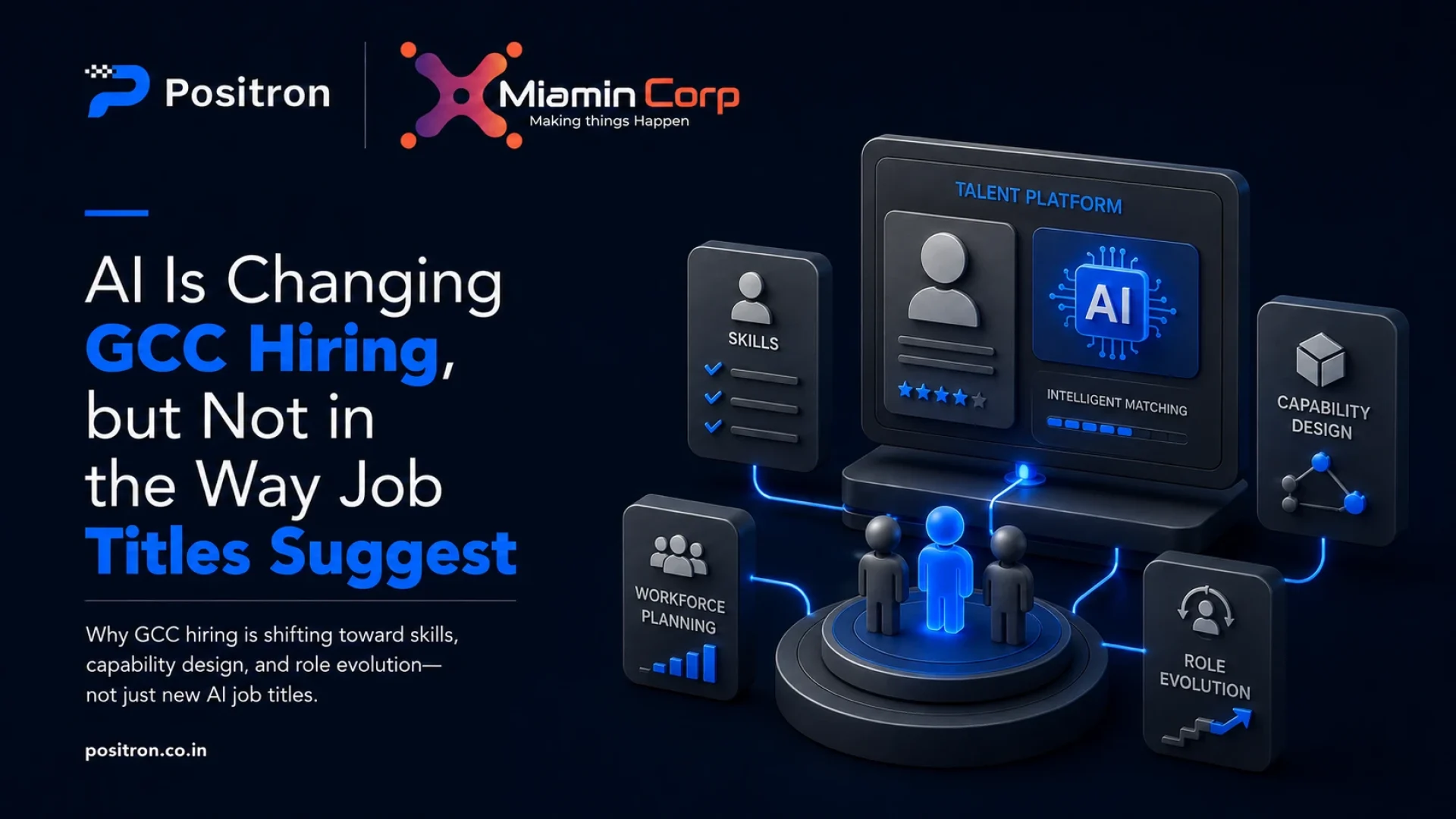
Analysts are reviewing machine-generated explanations, service teams are managing automated exceptions, and managers are deciding where human judgement must remain. This makes task and capability mapping more useful than simply adding AI-labelled roles.
In our latest article, we explain how domain judgement, data literacy, workflow design and accountable decision-making are reshaping talent requirements across GCC teams.
The clearest sign that AI is changing GCC hiring is not a sudden rise in roles called “AI Engineer.” It is the quiet redesign of ordinary work.
Finance analysts are expected to interrogate data, not only assemble reports. Customer-operations teams need to supervise automated workflows and handle exceptions. Software engineers increasingly work with AI-assisted development tools. HR, legal, procurement and marketing roles are all absorbing new tasks, even when their titles remain unchanged.
This distinction matters because job titles are lagging indicators. A workforce plan built around titles alone can miss the capability shift already happening inside the work.
The International Labour Organization’s 2025 global index assessed exposure at task level and concluded that transformation is more likely than wholesale replacement for most exposed jobs. OECD research makes a related point: most workers affected by AI will not need specialised AI skills, but the tasks they perform and the mix of skills they use can still change.
For a GCC, the hiring question is therefore not simply, “How many AI roles do we need?” It is, “Which decisions, tasks and workflows will now involve AI, and what must people be able to do around it?”
Hire for a capability stack
A useful capability stack has four layers.
Domain judgement
The employee must understand the business context well enough to recognise when an output is incomplete, unsafe or simply wrong. An AI-assisted credit, clinical, engineering or compliance workflow cannot be supervised by someone who only knows how to operate the tool.
Data and AI literacy
This does not mean that every employee must build a model. It means knowing what data an output depends on, what a model can and cannot infer, how to frame a useful instruction, and when the confidence of an answer is lower than it appears.
Workflow design
AI creates value when it is placed inside a clear process. People need to understand inputs, hand-offs, controls, exception paths and measures of quality. Otherwise, automation can make a weak process move faster without making it better.
Human and risk skills
Critical thinking, communication, collaboration and accountability become more important when machines generate plausible outputs at speed. The World Economic Forum’s 2025 employer survey placed AI, big data and cybersecurity among the fastest-growing skill areas, while also retaining analytical thinking, resilience, leadership and collaboration as important core skills. Those findings are survey-based forecasts, not guaranteed outcomes, but the combined signal is useful.
Redesign the requisition before expanding the pipeline
Start with a task map for each role family. Identify which tasks will remain human-led, which may be AI-assisted, which could be automated, and which require an explicit control or escalation. Then rewrite the role profile around observable capabilities.
Assessment should change as well. A generic interview about “AI experience” is weak evidence. A better assessment might ask a finance candidate to review an AI-generated variance explanation, identify missing evidence and explain the escalation path. A service-operations candidate could be asked to handle an exception that the automated workflow cannot resolve. The point is to test judgement in context, not familiarity with fashionable vocabulary.
This also changes internal mobility. An existing employee with strong domain knowledge and process judgement may be closer to the new requirement than an external candidate with an AI-labelled title. Targeted learning can sometimes close the tool gap faster than a new hire can acquire years of business context.
Specialist roles still matter
GCCs will still need machine-learning engineers, data engineers, AI product leaders, model-risk specialists and governance professionals. The mistake is to treat these specialists as the entire AI workforce strategy.
Specialists build and govern the capability. The wider workforce applies, supervises and improves it. Both groups need a common language for data, risk, quality and human accountability.
For global GCC networks, this capability map should be consistent enough to support mobility across locations, while allowing for differences in regulation, language, customer context and local labour supply. A role in Warsaw, Dubai, Bengaluru or Mexico City may carry the same enterprise purpose but require a different local skill mix.
The practical conclusion is simple: do not count AI transformation by counting AI job titles. Map the changing work, define the evidence of capability, and build hiring and learning around the tasks that will actually be performed.
Frequently Asked Questions
What are the biggest GCC trends in India?
Are GCCs in India still mainly technology centers?
Why is AI important for India GCCs?
What should companies watch before setting up a GCC in India?
Sources
- ILO — Generative AI and Jobs: A Refined Global Index of Occupational Exposure — 20 May 2025.
- OECD — Artificial Intelligence and the Changing Demand for Skills in the Labour Market — 10 April 2024.
- World Economic Forum — Future of Jobs Report 2025 — 7 January 2025.
- ISO — ISO 30405:2023, Guidelines on Recruitment — June 2023.