

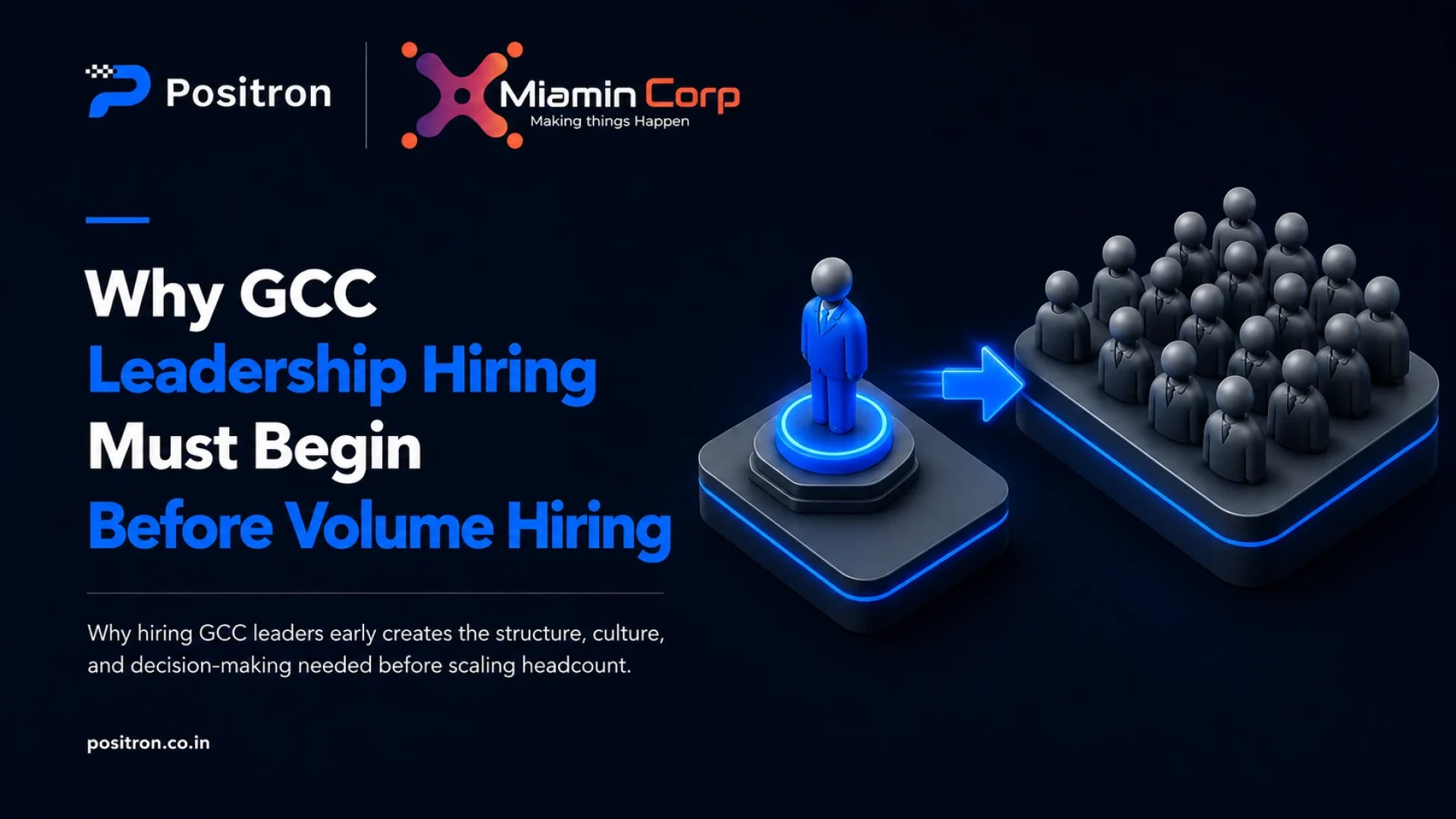
They translate the business case into capability mandates, decision rights, management standards, career paths and an operating cadence. When leaders arrive late, temporary workarounds have often already become structural choices.
In our latest article, we explain which decisions the first GCC leaders must shape and how to build enough accountable leadership without creating an oversized hierarchy.
The first hundred GCC employees do not create the operating model. They reveal whether one was created before they arrived.
When leadership hiring begins after volume recruitment, critical decisions are already being made by people with temporary authority: recruiters interpret vague roles, headquarters managers approve local exceptions, vendors shape candidate experience, and new hires learn through informal workarounds. The eventual GCC leader inherits a structure built without them.
This is why leadership hiring is a design activity, not simply the first line in a recruitment plan.
The first leader must translate enterprise intent
The role is broader than site administration. An early GCC leader must convert the business case into a local operating reality. That includes clarifying which outcomes the centre owns, how decisions move between headquarters and the GCC, what risks require escalation, and how people will build careers rather than only fill positions.
ISO 37000 describes governance through purpose, oversight, accountability, stakeholder engagement, data and decision-making. It is general guidance rather than a GCC standard, but it highlights the questions an early leader must answer: why the centre exists, who is accountable, how authority is delegated and how performance will be reviewed.
The leader should join early enough to influence five design choices.
Capability mandate
What work will the GCC execute, improve or own? “Support global technology” is too broad. A usable mandate identifies products, processes, customers and outcomes.
Organisation and decision rights
Which roles report locally, functionally or through a matrix? Who approves hiring, architecture, risk exceptions and promotions? A matrix can work, but only when each decision has one accountable owner.
Leadership spine
The site head cannot personally absorb every interface. Before volume hiring, identify the minimum leadership spine across capability, people, operations, finance, security and compliance. Some responsibilities may initially be part-time or retained at headquarters, but the ownership must be visible.
Talent proposition
Senior leaders shape role quality, management standards and career paths. If these are undefined, recruitment is forced to sell location, brand and compensation without explaining the work employees will own.
Operating cadence
The first leader should establish how priorities, risks, workforce data and delivery performance will be reviewed. Otherwise, meetings multiply while decisions remain slow.
Hire for the build phase, not only the steady state
Launching a GCC requires a different mix from running a mature one. The early leader must work through ambiguity, create systems, negotiate with enterprise stakeholders and make local decisions without fragmenting the company. A strong operator in a stable environment may not enjoy or succeed in that build phase.
Assessment should therefore use real design situations. Ask candidates to explain how they would resolve conflicting functional and local priorities, sequence the first leadership roles, handle a gap between the public employer promise and operational readiness, or slow hiring when controls are incomplete. Look for evidence, trade-offs and escalation judgement rather than polished vision statements.
ISO 30405’s recruitment guidance covers planning, stakeholders, candidate experience and review. Applied here, the hiring process itself should model the governance expected from the role: a clear brief, agreed decision-makers, documented criteria and timely communication.
Do not confuse early leadership with an oversized hierarchy
Hiring leaders first does not mean building every management layer before delivery starts. It means appointing enough accountable people to design the work and support the first teams.
Some functional leadership can be staged. A security or finance lead may initially serve several locations. A capability leader may hold a broader portfolio until scale justifies separation. The test is whether risk and decision load can be handled safely, not whether an organisation chart looks complete.
There is also a balance between enterprise experience and local credibility. An internal leader brings context and relationships; an external local leader brings market knowledge and networks. A paired model can work well if authority is explicit. Without that clarity, it can create two centres of power.
The sequence should be: define the mandate, appoint the accountable build leaders, let them shape the talent architecture, and then open volume hiring against approved capability plans.
The cost of waiting is not only slower setup. It is faster hiring into roles, reporting lines and expectations that later need to be corrected. Leadership hired early prevents that rework by turning the GCC from a staffing project into an operating organisation.
Frequently Asked Questions
What are the biggest GCC trends in India?
Are GCCs in India still mainly technology centers?
Why is AI important for India GCCs?
What should companies watch before setting up a GCC in India?
Sources
- ISO — ISO 37000:2021, Governance of Organizations — September 2021.
- ISO — ISO 30409:2016, Workforce Planning — September 2016; confirmed November 2022.
- ISO — ISO 30405:2023, Guidelines on Recruitment — June 2023.
- OECD — Guidelines for Multinational Enterprises on Responsible Business Conduct — 8 June 2023.