

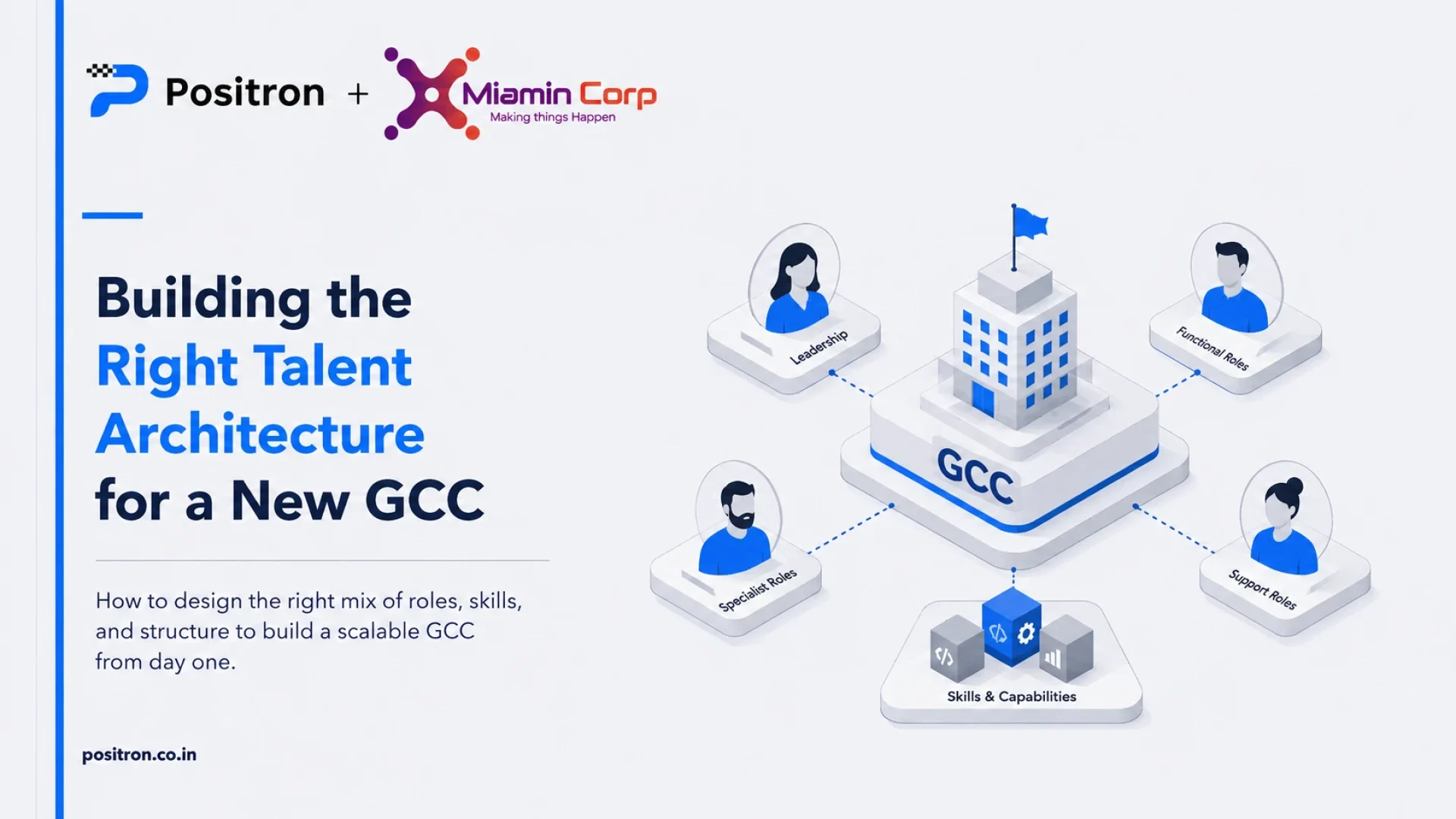
It connects capabilities, job families, levels, skills, workforce mix, mobility and data governance before inconsistent choices become embedded in pay and careers. The goal is a usable common structure with explicit local adaptations—not a perfect global catalogue.
In our latest article, we explain how to establish talent architecture early enough to support growth, fairness and cross-border career mobility.
A hiring plan tells a new GCC how many people to recruit. A talent architecture tells it what kind of organisation those people are joining.
Without that architecture, requisitions become the design tool. Each functional manager creates titles, levels and requirements independently. Similar work receives different grades. Career paths stop at local team boundaries. External recruiters search for credentials that may not predict performance. By the time the inconsistency becomes visible, it is embedded in pay, reporting lines and employee expectations.
Talent architecture should therefore be built before hiring volume. It does not need to be perfect, but it must be coherent enough to guide the first decisions.
Build seven connected layers
1. Capability map
Begin with business outcomes and the work required to produce them. Group work into enduring capabilities such as product engineering, finance control, customer operations or data governance. Avoid treating every current headquarters process as a capability that must be copied.
2. Job families
Create families around related work and transferable skills. A job family should help the organisation see adjacent career moves, shared learning needs and common assessment methods. Titles can vary for local market recognition, but the underlying family should stay comparable across the global network.
3. Levels and scope
Define levels through decision complexity, impact, knowledge and leadership responsibility rather than years of experience alone. Explain what changes from one level to the next. If a promotion only means managing more people, the architecture can unintentionally push strong specialists away from technical careers.
4. Skills and evidence
For each role, separate essential capability from trainable knowledge. State what evidence demonstrates the skill: a work sample, a design discussion, an operating scenario, a certification where regulation requires it, or verified experience with a comparable problem. ISO 30405 frames recruitment as a planned process covering attraction, sourcing, assessment, employment and learning. That supports an evidence-based design rather than a keyword list.
5. Workforce mix
Decide which work requires employees, which may use contingent specialists, and which can be delivered through a managed partner. ISO 30434’s workforce-allocation framework applies across internal and externally sourced workers and stresses documenting, communicating, measuring and improving allocation decisions. The contract type should follow the nature of the work and applicable law, not become a substitute for role design.
6. Career and mobility paths
Show how people can grow within a capability, move into adjacent work and take assignments across locations. Global mobility does not always mean relocation. It can include temporary projects, product rotations, cross-border reporting or communities of practice. The architecture should make those routes visible before employees have to negotiate them informally.
7. Workforce data and governance
Assign owners for role definitions, skill taxonomies, level changes and exceptions. Establish common data definitions. ISO 30414:2025 sets a global baseline for human-capital reporting across areas including workforce composition, recruitment, mobility, succession, turnover, skills and development. A GCC does not need every possible metric at launch, but it does need definitions that will remain comparable as it grows.
Design globally, apply locally
A global architecture should create equivalence, not identical employment packages. The same enterprise level may carry different pay ranges, statutory benefits, working-time rules or market titles across jurisdictions. Localisation is necessary; uncontrolled divergence is not.
Use a clear exception process. If a market needs a different title or qualification, record why, map it to the global family and level, and review whether the exception still serves a purpose. Otherwise, local adaptations accumulate until global mobility and pay comparison become difficult.
The architecture should also be tested against actual candidate supply. A role that combines five scarce capabilities may reflect an unrealistic wish list rather than a job one person can perform. Workforce planning guidance such as ISO 30409 encourages organisations to connect future demand with workforce availability. Sometimes the answer is to split the role, redesign the workflow or build capability internally.
Keep the first version usable
Do not delay launch while producing a catalogue for every future role. Start with the capabilities entering in the first planning horizon, define a small number of clear families and levels, and publish the governance for adding new ones. Test the model with hiring managers, employees and local HR before scaling it.
The decision rule is straightforward: if two leaders cannot explain why two similar roles have different levels, skills or career paths, the architecture is not yet doing its job.
Headcount will help a GCC open. Talent architecture determines whether it can grow without rebuilding its people system every year.
Frequently Asked Questions
What are the biggest GCC trends in India?
Are GCCs in India still mainly technology centers?
Why is AI important for India GCCs?
What should companies watch before setting up a GCC in India?
Sources
- ISO — ISO 30409:2016, Workforce Planning — September 2016; confirmed November 2022.
- ISO — ISO 30434:2023, Workforce Allocation — June 2023.
- ISO — ISO 30405:2023, Guidelines on Recruitment — June 2023.
- ISO — ISO 30414:2025, Human Capital Reporting and Disclosure — August 2025.