

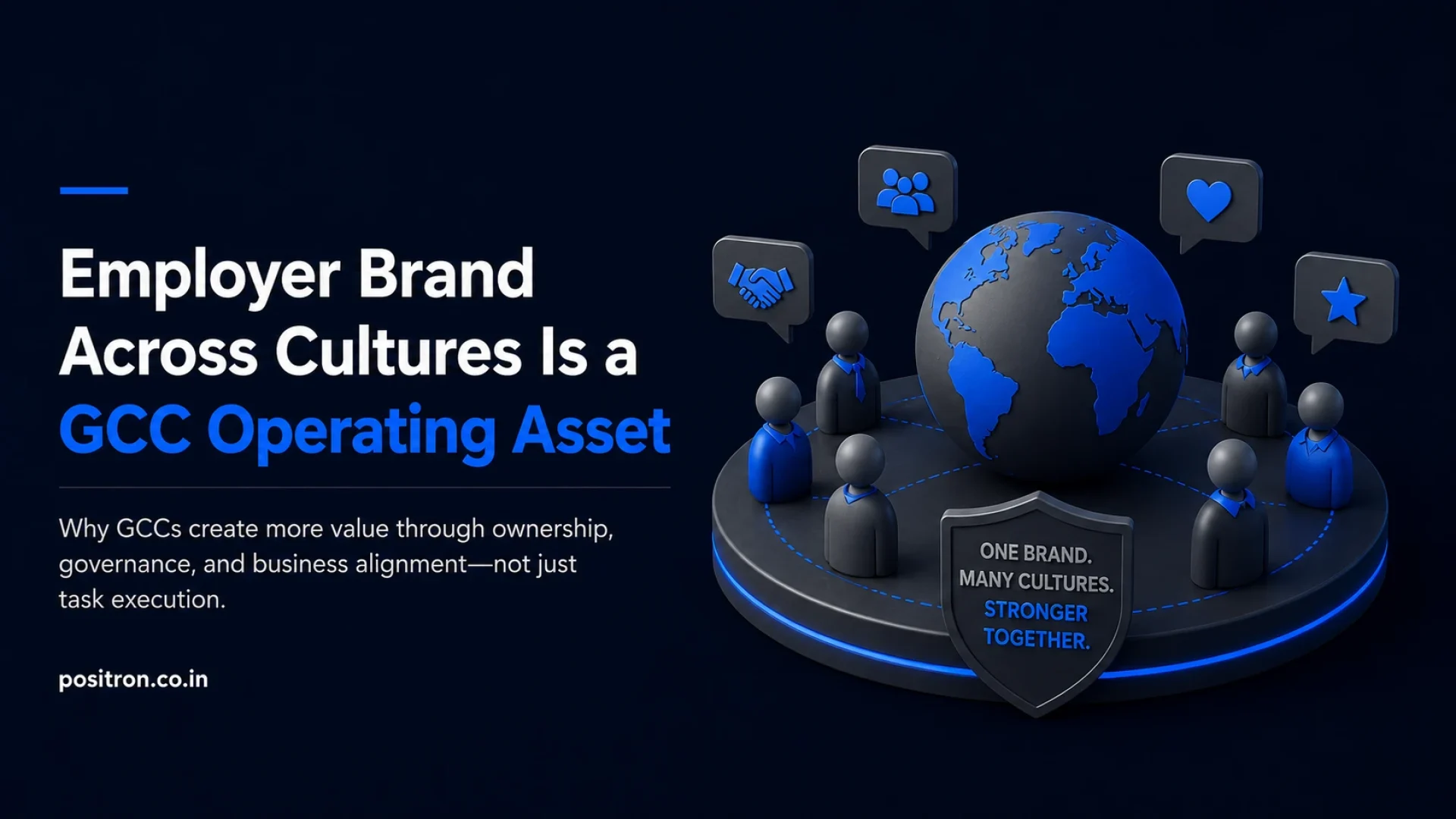
Truthful roles, capable managers, visible careers, inclusive processes and a credible employee voice do more than advertising to shape trust. The promise can remain consistent globally while its language and emphasis reflect local context.
In our latest article, we explain why employer brand is a GCC operating asset and which experience measures reveal whether the promise is being kept.
An employer brand is not the message a GCC launches in a new market. It is the pattern employees and candidates observe after that message.
They compare the advertised role with the actual work. They notice whether local leaders can make decisions, whether global careers are accessible, whether managers respect working-time boundaries, and whether inclusion survives contact with everyday processes. When the promise and the operating experience diverge, the market learns quickly.
This makes employer brand an operating asset. It affects attraction, offer acceptance, trust, retention and the willingness of employees to recommend the organisation. It cannot be owned by communications alone.
Keep one core promise, not one global script
A global GCC network needs a consistent employee proposition: the purpose of the work, the standards of leadership, the approach to growth, and the rights and respect employees should expect. But the way that proposition is expressed must respond to local context.
Career security may be discussed differently in a fast-growing technology market than in a mature specialist hub. Family benefits, flexibility, learning, social impact and international exposure may carry different weight across cultures and career stages. Local language and examples matter.
Localisation should change the expression, not invent a different reality. If one location promises product ownership while the operating model gives it only task execution, the problem is not copy. It is role design.
Test the brand against five operating truths
The job truth
Do job descriptions explain the real outcomes, decision scope, working relationships and location expectations? The ILO’s fair-recruitment guidance calls for clear, accurate and understandable information about employment terms. That principle applies whether the candidate moves across a border or joins locally.
The manager truth
Most employees experience the enterprise through a manager. A global statement about empowerment is weak if local managers cannot approve routine decisions or if headquarters overrides them without explanation. Employer-brand investment should therefore include manager selection, training and accountability.
The career truth
Can employees see how they move into larger roles, specialist paths or other locations? A GCC that recruits with a global-career promise needs transparent access to projects, learning and promotion. Otherwise, “global exposure” becomes participation in late meetings rather than meaningful mobility.
The inclusion truth
ISO 30415 provides guidance across the employment lifecycle and emphasises accountability, context and measurement for diversity and inclusion. For a GCC, this means examining whether assessment, onboarding, allocation, development and promotion work fairly across language, gender, disability, age and other locally relevant dimensions. A global campaign image is not evidence of an inclusive system.
The worker-voice truth
Do employees have safe channels to raise concerns and influence work? The OECD’s 2023 Guidelines for Multinational Enterprises cover employment, industrial relations, equality of opportunity, health and safety, information and consultation. The Guidelines are recommendations, not a single global employment law, but they provide a useful responsible-business baseline.
Measure experience, not only reach
Brand dashboards often emphasise impressions, applications and follower growth because these are easy to count. GCC leaders need measures closer to operating reality: qualified applications by capability, candidate withdrawal reasons, offer acceptance, early attrition, internal mobility, promotion patterns, manager quality, grievance themes and employee referrals.
Segment carefully. A network-wide average can hide a weak experience in one function, level or location. At the same time, protect privacy and avoid creating reports that identify small groups or collect sensitive data without a lawful and necessary purpose.
Listen qualitatively as well. Candidate interviews, new-hire check-ins and employee forums can explain why a number moved. The aim is not to defend the campaign. It is to find the gap between promise and experience and assign an owner to close it.
Treat culture as an operating input
Cross-cultural work requires more than festivals and translated content. Examine how people challenge seniority, give feedback, make decisions, handle disagreement and interpret urgency. Then design meeting norms, escalation paths and manager practices that do not make one culture the unspoken default.
The strongest global employer brand is neither completely centralised nor locally improvised. It has a common promise, local relevance and operating evidence.
Before launching the next campaign, ask a harder question: if a candidate joined tomorrow, which part of the promise would they experience in their first thirty days?
Frequently Asked Questions
What are the biggest GCC trends in India?
Are GCCs in India still mainly technology centers?
Why is AI important for India GCCs?
What should companies watch before setting up a GCC in India?
Sources
- ISO — ISO 30415:2021, Diversity and Inclusion — 4 May 2021.
- ILO — General Principles and Operational Guidelines for Fair Recruitment — 17 February 2019.
- OECD — Guidelines for Multinational Enterprises on Responsible Business Conduct — 8 June 2023.
- ILO — The Governing Body and the MNE Declaration — updated 25 March 2026.
Follow Positron for More Recruitment Industry Insights
Check-out Positron on LinkedIn for sharper insights on Global Capability Centres, hiring strategy, workforce execution, and scalable operating models built for growth.