

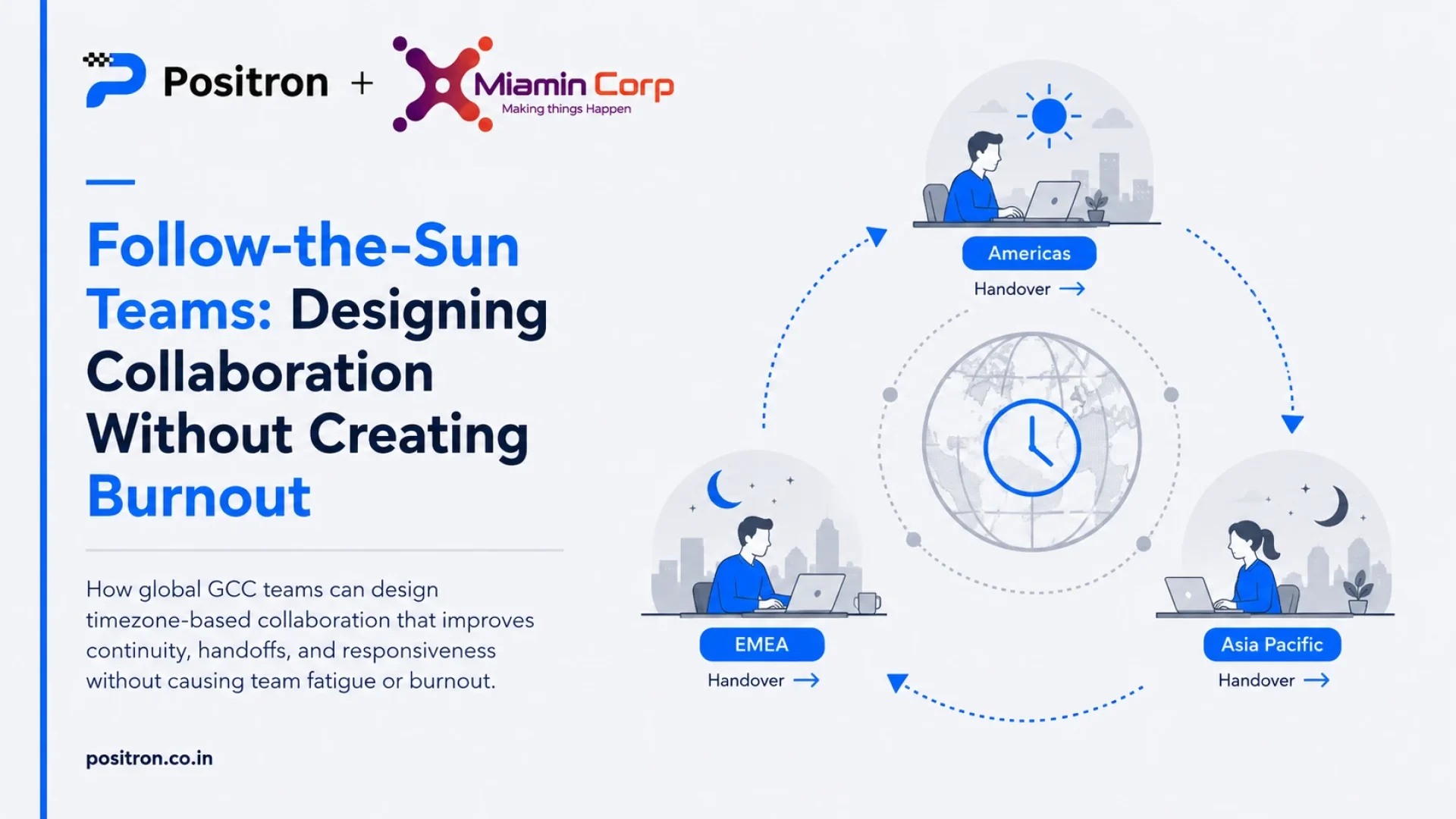
Sustainable global coverage requires a defined service window, a standard hand-off contract, protected overlap and response tiers that separate routine work from genuine incidents. Leaders must measure delivery and hand-off quality alongside late-meeting load and on-call concentration.
In our latest article, we explain how to design global collaboration that improves continuity without turning availability into a hidden form of burnout.
“Follow the sun” should mean that work moves between teams. It should not mean that the same people remain available across every time zone.
The difference is operating design. A genuine follow-the-sun model uses clear ownership, documented hand-offs and limited overlap to extend service or development coverage. A poorly designed model uses meetings and personal responsiveness to bridge structural gaps. It may look collaborative for a while, but the hidden cost appears in fatigue, error, attrition and dependence on a few people who know how everything fits together.
The ILO’s global work on working time links longer-than-desired hours with poorer reported work-life balance. WHO guidance also identifies excessive workloads, low job control and long or inflexible hours as psychosocial risks. These are not arguments against global teams. They are reasons to design them properly.
Design the relay before selecting the runners
A follow-the-sun workflow needs three layers.
A coverage map
Define the service window in business terms. Which customer, platform or process needs coverage, at what level, and for which events? Not every activity requires continuous attention. Separate planned work, urgent incidents and true emergencies.
Then assign each time block to a team, not to an individual. A team-level model provides redundancy and allows local managers to plan leave, training and workload.
A hand-off contract
Every transfer should state the current status, evidence, decision history, next action, risk, owner and expected completion time. The receiving team should not need a meeting to discover the context.
Use standard artefacts in the workflow system, not private messages. If the hand-off depends on one person remembering to explain the work, the process is fragile.
A protected overlap window
Some live collaboration is valuable for planning, learning and complex decisions. Define a limited overlap that rotates fairly when regions are far apart. Do not let every cross-border relationship create its own recurring meeting. The combined calendar, not each invitation in isolation, determines the burden.
Set response rules by consequence
“Urgent” is not an operating category. Establish response tiers.
A critical production event may require immediate escalation through an on-call structure. A customer request may have a defined service target. A design question can usually wait for the next local working period. A status update may belong in an asynchronous record.
Each tier needs an owner, channel, expected response, escalation point and recovery practice after out-of-hours work. Local working-time, overtime, rest and on-call rules vary, so legal and HR review is required in every jurisdiction.
This clarity protects both service and people. Employees can disconnect because they know which channel will be used for a real incident. Leaders can see whether demand is exceeding the capacity designed for the coverage window.
Reduce coordination load at the source
Global teams often add meetings to compensate for unclear product ownership, weak documentation or slow decisions. Fixing those causes is more effective than running another collaboration workshop.
Give teams bounded decisions they can make locally. Keep one accessible record of standards and prior decisions. Write work in smaller transferable units. Use common definitions for priority and completion. Ensure tools and access are available in every participating location.
ISO 45003 treats work organisation, communication, leadership and pressure as areas relevant to psychosocial risk. Its risk-based approach is useful here: identify the design conditions creating harm, then change the conditions rather than relying only on individual resilience.
Measure whether the model is sustainable
Delivery measures alone can hide human cost. Review hand-off defects, work reopened after transfer, incident recurrence, response-time exceptions, meeting load outside local hours, unused leave, on-call concentration and employee feedback on control over working time.
Segment by team and time zone. A global average may look healthy while one location absorbs nearly every late meeting. Look for people who repeatedly act as informal bridges; they may be carrying operational risk that the organisation has not formally recognised.
The ILO’s 2026 global report on psychosocial working environments places job demands, role clarity, workload, autonomy, working time and fair processes in the same operating picture. That is the right way to view distributed work: performance and wellbeing are properties of the system, not separate agendas.
Follow-the-sun works when the sun follows the work. If people must follow every time zone, the model has not yet been designed.
Frequently Asked Questions
What are the biggest GCC trends in India?
Are GCCs in India still mainly technology centers?
Why is AI important for India GCCs?
What should companies watch before setting up a GCC in India?
Sources
- ILO — Working Time and Work-Life Balance Around the World — 6 January 2023.
- WHO — Mental Health at Work — 2 September 2024.
- ILO — The Psychosocial Working Environment: Global Developments and Pathways for Action — 22 April 2026.
- ISO — ISO 45003:2021, Psychological Health and Safety at Work — June 2021.