

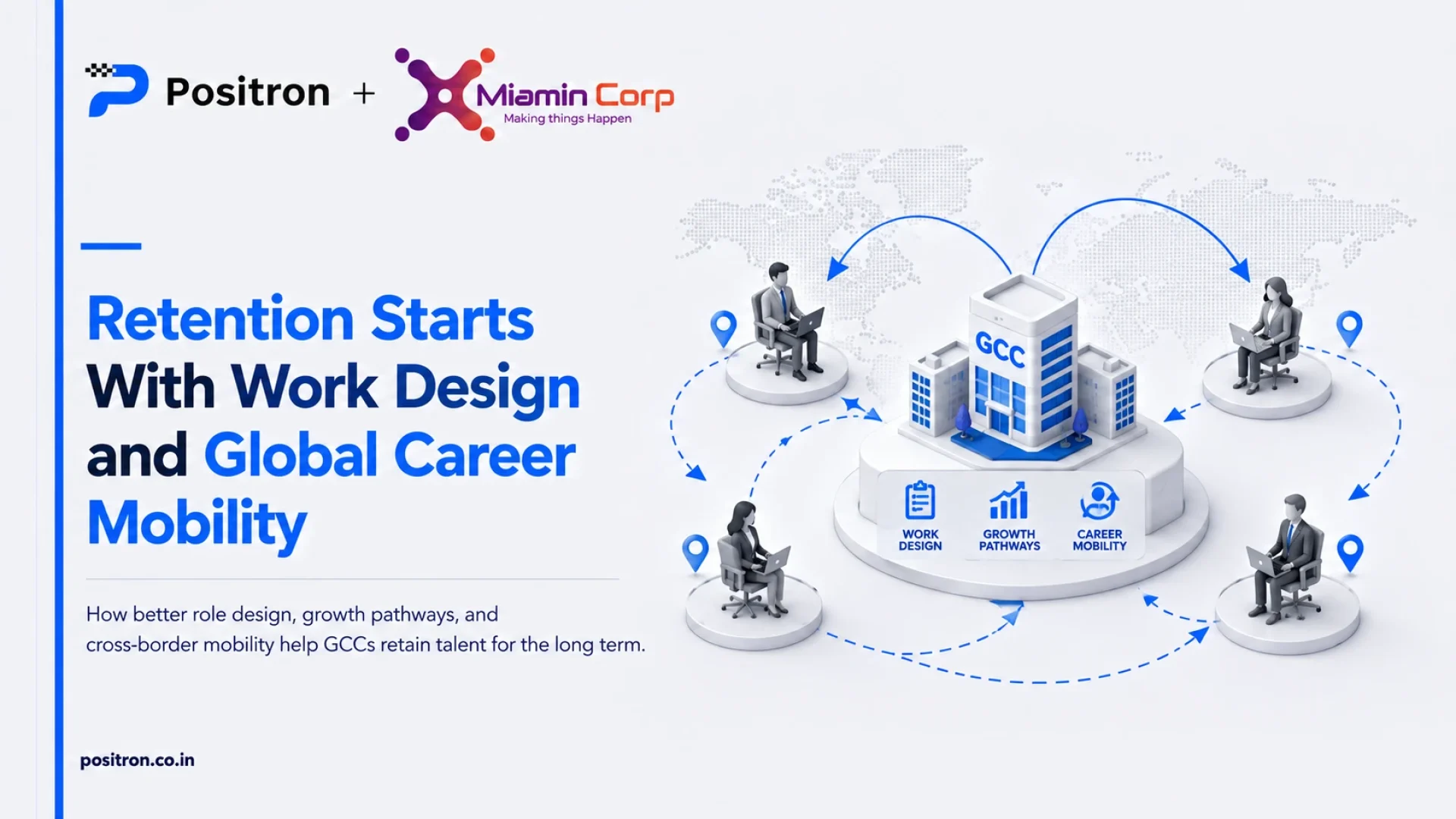
Ownership, learning, sustainable demands, capable managers and credible career paths matter across every location. Global mobility can include enterprise projects, rotations, specialist paths and cross-border responsibility—not only relocation.
In our latest article, we explain how work design and career mobility can reduce avoidable loss without creating a two-tier system between headquarters and GCC talent.
Retention is often managed after an employee signals an intention to leave. By then, the organisation is negotiating with the outcome rather than fixing the system that produced it.
Compensation matters, and market corrections are sometimes necessary. But a global GCC cannot build durable retention through counteroffers alone. People also evaluate the quality of the work, the authority they hold, the manager they experience and the future they can see.
This is why retention begins with work design and career mobility.
Examine the job before examining the exit
A role can look attractive in a job description and become narrow after work is divided across borders. If headquarters retains the decisions, customer contact and complex problems while the GCC receives only repeatable tasks, employees may gain experience without gaining scope.
Review five features of the work.
Ownership
Can the team own an outcome, or does it only complete activities? Ownership needs bounded decisions, access to stakeholders and accountability for results.
Variety and learning
Does the work expose employees to new problems and skills, or repeat the same workflow indefinitely? Automation can remove low-value tasks, but leaders must intentionally redesign the remaining work rather than simply reduce staffing effort.
Workload and control
WHO identifies excessive workload, low job control, long or inflexible hours and poor investment in career development among psychosocial risks at work. A wellbeing programme cannot compensate for a role designed around permanent overload or inconvenient cross-border meetings.
Manager quality
Managers translate global policy into daily experience. They need the time, authority and skill to set priorities, give feedback, support development and protect sustainable working practices.
Purpose and connection
Employees should see how their work affects a product, customer, risk or enterprise outcome. This requires access to context and feedback, not a slogan about being strategic.
Build mobility as a system
Career mobility should not depend on an employee discovering a vacancy or having a sponsor at headquarters. Create visible job families, skill expectations and routes between adjacent capabilities. Publish how project rotations, promotions, specialist paths and cross-location assignments are selected.
Not every move requires relocation. Global career mobility can include leading a cross-border programme, joining a product team for a defined period, rotating into a control function, mentoring another hub or taking enterprise responsibility from the existing location.
OECD’s 2025 Skills Outlook argues for transparent skills assessment, recognition and credential portability to support mobility and better use of talent. The policy context is broader than GCCs, but the operating lesson is relevant: skills need to be visible and transferable if people are to move into new work.
Prevent a two-tier global career system
Track who receives high-visibility work, travel, leadership exposure, learning and promotions. Compare locations and role families while accounting for job mix and local law. A global network loses credibility if strategic assignments repeatedly flow to headquarters while GCC employees are told that opportunity is global.
ISO 30414:2025 includes mobility and succession, turnover, skills and development within a common human-capital reporting baseline. That supports connecting retention data to opportunity data rather than treating exits as an isolated HR measure.
The World Economic Forum’s Future of Jobs Report 2025 is based on an employer survey and should be read as directional. It nevertheless shows how strongly employers are focusing on upskilling, talent progression and wellbeing as they anticipate changing skill needs. A GCC should convert that broad intention into funded time, role pathways and accountable managers.
Use retention evidence diagnostically
Segment regretted and non-regretted exits by tenure, manager, role family, location and career history. Review internal applications, time since last meaningful scope change, learning access and repeated workload exceptions. Use exit interviews carefully; departing employees may not disclose the full reason, and a single explanation should not become a general conclusion.
Some turnover is healthy. People make personal choices, labour markets change and organisations need new capability. The objective is not zero attrition. It is to identify avoidable loss, protect critical knowledge and create fair opportunity.
Retention improves when employees do not have to leave the GCC to find larger work. The strongest global network makes capability and careers portable while keeping expectations honest.
Before funding another retention campaign, ask: which parts of the job, manager system or mobility path are giving talented people a reason to look elsewhere?
Frequently Asked Questions
What are the biggest GCC trends in India?
Are GCCs in India still mainly technology centers?
Why is AI important for India GCCs?
What should companies watch before setting up a GCC in India?
Sources
- WHO — Mental Health at Work — 2 September 2024.
- OECD — Skills Outlook 2025 — 9 December 2025.
- ISO — ISO 30414:2025, Human Capital Reporting and Disclosure — August 2025.
- World Economic Forum — Future of Jobs Report 2025, Workforce Strategies — 7 January 2025.