

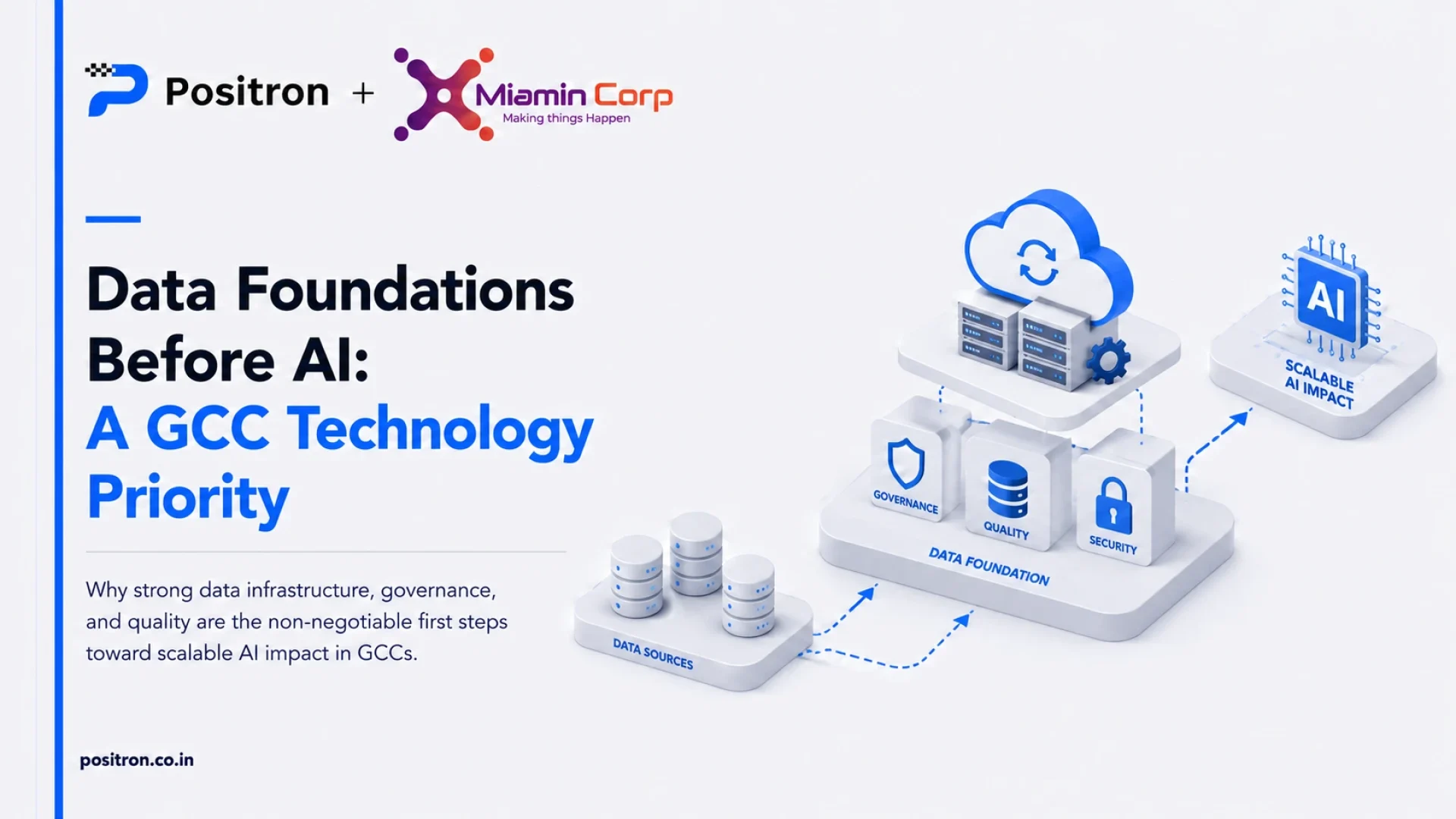
Before scaling AI, GCC leaders need common meaning, fit-for-use quality, lineage, ownership, access controls and lifecycle rules around an important workflow. A production use case should be explainable, reproducible and correctable.
In our latest article, we explain why data foundations should come before model ambition—and how to create a practical readiness gate for AI-enabled operations.
The fastest way to expose weak enterprise data is to place an AI system on top of it.
Duplicate customer records become conflicting answers. Inconsistent role codes distort workforce analysis. Missing lineage makes an output difficult to defend. Old permissions give a new tool access to information its users should never see.
AI does not remove these weaknesses. It increases the speed, scale and confidence with which they can affect decisions.
For a GCC, the technology priority is therefore not “AI first.” It is a usable data foundation tied to specific business outcomes.
Start with a decision and its data path
Avoid beginning with a plan to clean all enterprise data. That programme is too broad to govern and too distant from value. Select an important workflow: a finance forecast, service triage, talent plan, product-quality analysis or supply-risk review.
Trace the decision backwards. Which output is needed? Which source records support it? Who creates and changes them? What transformations occur? Which definitions are disputed? Who is allowed to see the data? How will an error be detected and corrected?
This creates a bounded data product with an owner and a user, not another lake of information waiting for a purpose.
Build six foundations
Common meaning
Define critical terms and identifiers. “Active employee,” “customer,” “resolved case” or “critical skill” may have different meanings across systems and countries. The definition should state the business rule, owner, effective date and permitted local variation.
Quality that is fit for use
Data does not need to be perfect. It needs to be suitable for the consequence of the decision. Establish measures for completeness, accuracy, consistency, timeliness, validity and representativeness where relevant.
ISO/IEC 5259-2 provides a data-quality model and measures for analytics and machine learning. ISO/IEC 5259-5 moves data-quality governance to senior oversight across the data lifecycle. These standards support discipline; implementation still needs the enterprise context and licensed detail.
Traceable lineage
Record where data originated, how it was transformed, which version a model used and which output informed a decision. Without lineage, teams cannot reproduce an analysis, investigate an incident or explain why two locations received different results.
Named ownership
A data owner is accountable for meaning, acceptable use and quality priorities. A steward manages definitions and issues. Technology teams maintain platforms and controls. These roles can be combined in a small programme, but responsibility should not disappear between functions.
Access and protection
Classify data, apply least privilege and separate development, test and production use. Mask or de-identify data where appropriate, while recognising that privacy risk can remain when datasets are combined. Review cross-border access as well as physical storage.
Lifecycle controls
Define collection, retention, correction, archival and deletion. Training or evaluation data should not remain indefinitely because it may be useful one day. Vendor copies, model logs and exported files belong in the lifecycle map.
Treat workforce data as an early test
GCCs often want AI-supported skills matching, capacity forecasting or attrition analysis. These use cases depend on stable job families, accurate manager relationships, dated skills evidence and consistent location and worker-type fields.
ISO 30435 describes workforce data quality through determination, capture, maintenance and review. The key lesson is that a new analytics layer cannot compensate for unclear source definitions and weak maintenance.
Before building a workforce model, ask whether historical decisions reflect policies the enterprise wants to reproduce. A technically clean dataset can still encode outdated job structures or unequal access to opportunity.
Use governance as an accelerator
Governance should make safe work repeatable. Create reusable data contracts, approved access patterns, quality tests, documentation templates and review gates. Teams then spend less time negotiating the same questions for each AI pilot.
NIST’s AI RMF highlights documented context, data collection and selection, representativeness, suitability, testing and human oversight. ISO/IEC 42001 similarly provides a management-system approach to responsible AI. Both make the lifecycle visible; neither turns weak source data into reliable evidence.
A practical readiness gate is simple. Do not move an AI use case into consequential production until the organisation can name the data owner, explain the source and transformations, state the quality threshold, control access, reproduce the evaluation and correct an error.
The GCC advantage will not come from connecting the most models. It will come from making trusted data usable across capabilities while keeping ownership and control clear.
Frequently Asked Questions
What are the biggest GCC trends in India?
Are GCCs in India still mainly technology centers?
Why is AI important for India GCCs?
What should companies watch before setting up a GCC in India?
Sources
- ISO — ISO/IEC 5259-2:2024, Data Quality Measures for Analytics and ML — November 2024.
- ISO — ISO/IEC 5259-5:2025, Data Quality Governance Framework — February 2025.
- ISO — ISO 30435:2023, Workforce Data Quality — July 2023.
- NIST — AI Risk Management Framework Core — AI RMF 1.0 published 2023; accessed 12 August 2026.
- ISO — ISO/IEC 42001:2023, AI Management System — December 2023.