

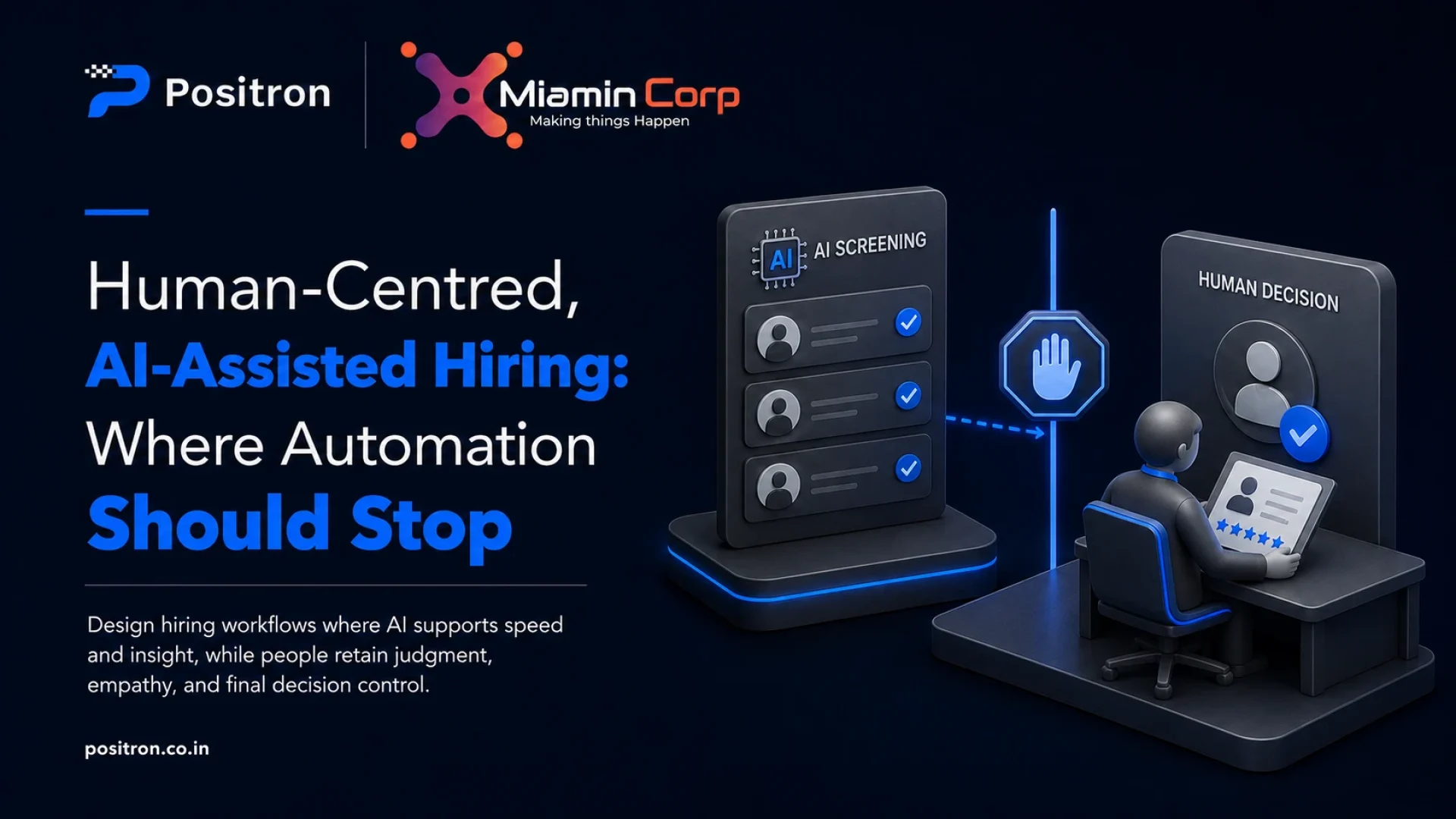
Low-risk administration can be automated. Bounded support should be verified by a trained person. Rejection, accommodation, sensitive evidence, exceptions and appeals need informed human authority with the context and power to disagree.
In our latest article, we explain where automation should stop and what meaningful human oversight, candidate notice, correction and challenge should look like in practice.
The most important question about AI in hiring is not whether a task can be automated. It is whether automation should carry the authority to affect a person’s access to work.
That boundary changes with consequence. Scheduling an interview is not the same as rejecting an application. Summarising a transcript is not the same as judging communication ability. Finding a duplicate record is not the same as inferring a candidate’s personality, health or future performance.
A human-centred model separates administration, decision support and accountable judgement.
Automate low-consequence administration
Automation can reduce repetitive coordination: scheduling, reminders, status updates, document routing, duplicate detection and structured data checks. Even here, teams need accuracy controls, accessibility and a route for candidates who cannot use the standard channel.
Do not let administrative convenience become hidden selection. A scheduling system that only offers one time zone, an application form that fails with assistive technology or an identity check that rejects certain documents can exclude candidates before a formal assessment begins.
Use AI to assist bounded professional tasks
AI may help recruiters organise large amounts of information, draft consistent communications, identify missing evidence or surface applications for further review. The role of the system should be explicit, and the user should verify the source material.
The model should not invent evidence, convert weak proxies into capability or make a ranking appear objective merely because it is numerical. Job relevance remains the anchor. ISO 30405’s recruitment guidance focuses on planned attraction, sourcing, assessment, employment, candidate experience and learning; AI should improve those processes without weakening their purpose.
Keep humans accountable for high-consequence judgement
Final authority should remain with competent people for decisions that admit, exclude or materially disadvantage a candidate. That includes rejection based on an assessment, interpretation of unusual career evidence, reasonable accommodation, suspected fraud, sensitive background information, exceptions and appeals.
This does not mean a recruiter can simply click “approve” after an algorithm decides. Meaningful oversight requires enough information to understand the output, time to examine it, authority to disagree, training to recognise limitations and a documented route to override or stop the system.
The EU AI Act requires human oversight for covered high-risk systems and lists certain employment and recruitment uses as high risk. The implementation schedule changed in 2026, so current dates and applicability must be checked for the specific use. The principle is still clear: high-consequence employment technology deserves more than nominal human involvement.
Draw four red lines
Do not allow an AI system to make an unreviewable final rejection.
Do not infer sensitive or protected characteristics when they are not necessary and lawful for the process.
Do not use opaque personality, emotion or behavioural claims as a shortcut for validated job evidence.
Do not deploy a tool without a workable candidate route for notice, accommodation, correction and challenge.
Jurisdiction-specific rules may prohibit or restrict additional practices. These boundaries are a governance minimum, not legal advice.
Test the whole selection pathway
Bias and error can enter before or after the model: job requirements, sourcing channels, application design, recruiter overrides, interview rubrics and offer decisions all matter. Evaluate each stage and the combined outcome.
The UK Information Commissioner’s 2024 audits of recruitment AI reported problems including excessive collection, indefinite retention, unfair filtering and the inference of gender or ethnicity from names. The US Equal Employment Opportunity Commission has also warned that algorithmic tools may screen out people with disabilities and stresses processes for reasonable accommodation. These are jurisdiction-specific sources, but they illustrate failure modes relevant to a global control design.
Monitor selection outcomes, false positives and negatives, overrides, complaints, accommodation use, accessibility failures and model or vendor changes. Review whether the tool still improves the process compared with a reasonable non-AI alternative.
NIST’s AI RMF is voluntary, but its Govern, Map, Measure and Manage structure reinforces an important point: risk management continues after deployment. A model that passed a launch review can drift, encounter a new population or change through a vendor update.
Human-centred hiring is not human-only hiring. It uses automation where it removes friction, AI where it provides bounded support, and people where judgement, context and accountability cannot be delegated.
The stopping rule is simple: the greater the consequence for the candidate, the stronger the case for informed human authority and a real path to challenge the decision.
Frequently Asked Questions
What are the biggest GCC trends in India?
Are GCCs in India still mainly technology centers?
Why is AI important for India GCCs?
What should companies watch before setting up a GCC in India?
Sources
- EUR-Lex — Regulation (EU) 2024/1689, including Human Oversight and Annex III — 13 June 2024.
- UK ICO — AI Tools Used in Recruitment — 6 November 2024.
- US EEOC — AI, Algorithms and Disability Discrimination in Employment — 12 May 2022.
- NIST — Artificial Intelligence Risk Management Framework 1.0 — 26 January 2023.
- ISO — ISO 30405:2023, Guidelines on Recruitment — June 2023.