

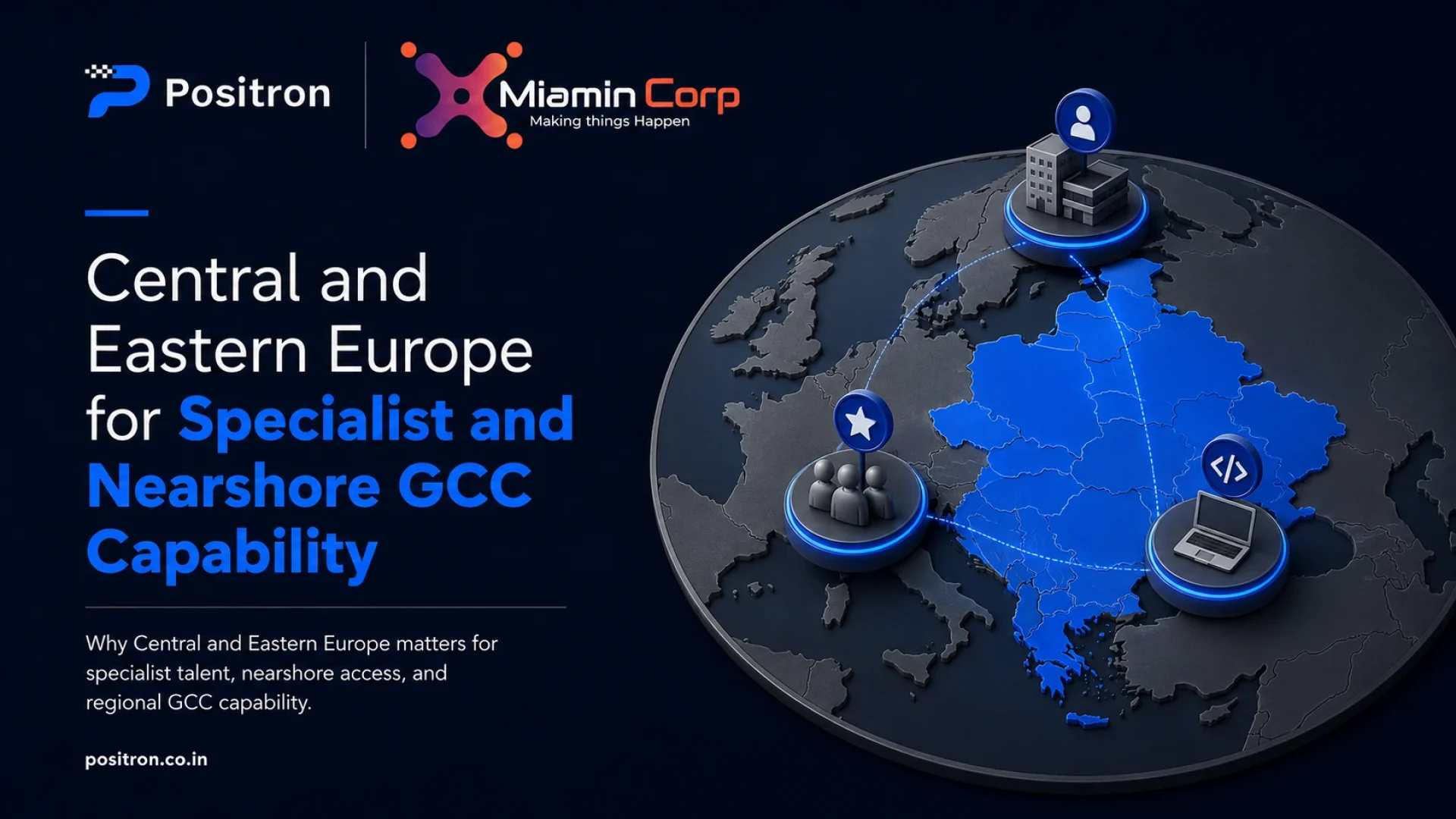
Engineering depth, languages, sector clusters, regulation, infrastructure and risk vary across the region. The durable opportunity is specialist capability with European adjacency—not a wage gap assumed to last indefinitely.
In our latest article, we explain how to evaluate CEE locations and give a nearshore GCC enough ownership to remain relevant as the work becomes more complex.
Central and Eastern Europe is often presented as one nearshore market. It is better understood as a network of specialist city ecosystems inside—and adjacent to—the European operating environment.
That change in frame is important. An enterprise choosing between Warsaw, Kraków, Prague, Budapest, Bucharest, Sofia, the Baltic capitals or other regional hubs is not comparing identical pools at different prices. It is choosing among different combinations of engineering history, languages, sector clusters, universities, infrastructure, regulation and labour-market pressure.
Nearshore value is more than time-zone overlap
The region can support frequent collaboration with European business, product and regulatory teams. Travel can be practical, working hours overlap substantially and many locations sit within the EU’s legal and commercial environment.
Those conditions can make Central and Eastern Europe attractive for specialist software engineering, cybersecurity, data, finance, regulated operations, product support and multilingual services. They can also make it useful for work that benefits from close iteration with headquarters but does not need to sit in the same office.
The available evidence still calls for selectivity. Eurostat reported that more than 10 million people worked as ICT specialists across the EU in 2024, but country shares varied considerably. The same dataset showed substantial variation in women’s participation. The European Commission’s 2025 Digital Decade report also found that the EU remained far from some 2030 targets, including digital skills and foundational technologies.
In other words, membership of a digitally ambitious region does not remove local talent constraints.
Cost is real, but it is not static
Eurostat’s 2024 labour-cost release showed wide gaps among EU countries. Several Central and Eastern European markets remained below the EU average, but labour costs were rising, in some cases quickly.
That should change the investment question. The case cannot rest on preserving a fixed wage differential for ten years. It should rest on whether the ecosystem can produce valuable outcomes as wages, expectations and role complexity increase.
A durable centre therefore needs a capability ladder: experienced technical leaders, meaningful product or process ownership, specialist development, internal mobility and links to local education. If the operating model depends on continually replacing people at the lowest available rate, the centre is unlikely to mature.
Assess cities by mandate and risk
A structured shortlist should examine four layers.
Capability: Which cities show depth in the required domain, languages and seniority? Is the market broad enough to support growth without relying on one employer or vendor?
Ecosystem: Are there relevant universities, professional communities, industry clusters, cloud and security partners, transport links and peer centres?
Operating environment: What employment, works-council, data, tax, immigration and entity requirements apply? EU-level rules create common ground, but national implementation and practice still matter.
Resilience: How exposed is the operation to geopolitical tension, energy and infrastructure disruption, cyber risk or excessive concentration in one city? What work can move, and what dependencies would move with it?
Country averages should be used only to form hypotheses. Actual diligence must reach the city, role and employer-competition level.
Give the nearshore centre real interfaces
Proximity creates value only when the operating model uses it.
Teams need direct access to product owners, customers and enterprise architecture. Decision rights should be explicit. Work should be organised around products, services or outcomes rather than a queue of tickets sent eastward. Shared engineering standards, observability and security controls can connect the centre to the global platform without removing local autonomy.
Central and Eastern Europe can then play a distinctive portfolio role: specialist capability with European adjacency. It may complement larger scale hubs in India, market-facing teams in the Middle East, and Americas coverage in Latin America.
That is a stronger thesis than “lower-cost Europe.” It recognises what the region can become while remaining honest about talent competition, regulatory variation and geopolitical risk.
The best nearshore location is not the one that looks cheapest at launch. It is the ecosystem that can stay strategically relevant as the work becomes harder.
Frequently Asked Questions
What are the biggest GCC trends in India?
Are GCCs in India still mainly technology centers?
Why is AI important for India GCCs?
What should companies watch before setting up a GCC in India?
Sources
- Eurostat, *Rising Share of ICT Specialists Among Employed People* — 8 July 2025, reporting 2024 data.
- European Commission, *State of the Digital Decade 2025* — 16 June 2025.
- Eurostat, *EU Hourly Labour Costs Ranged from €11 to €55 in 2024* — 28 March 2025.
- ENISA, *Threat Landscape 2025* — October 2025.