

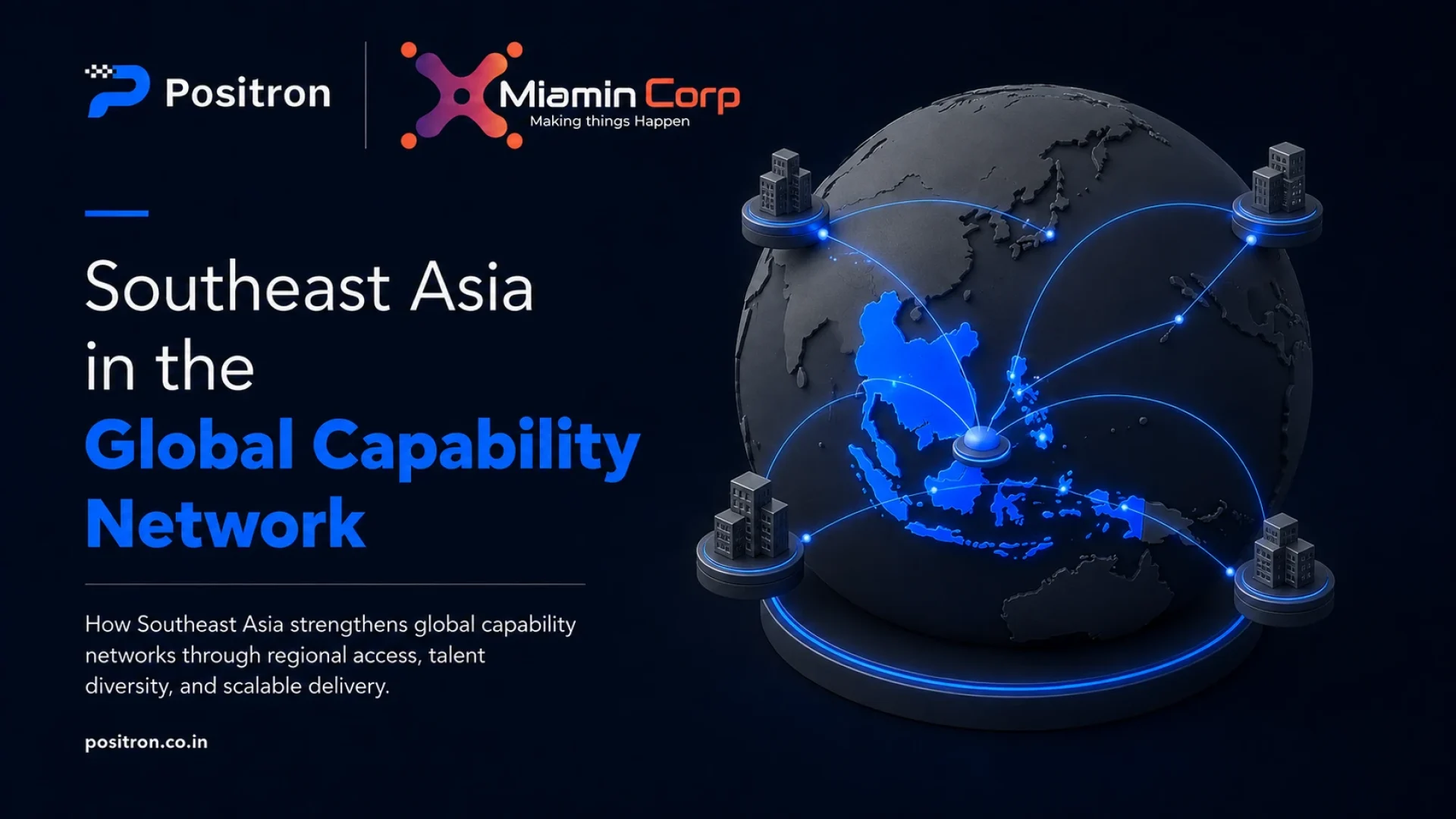
The strategic question is which role each node should own: regional governance, product engineering, industrial capability, multilingual operations or market adaptation. Regional digital integration is progressing, but country-level rules and ecosystem evidence still determine what is viable.
In our latest article, we explain how to evaluate Southeast Asia as part of a global capability portfolio rather than a generic low-cost ranking.
Southeast Asia should not be treated as a single alternative location. It is a connected but highly varied set of markets that can perform different roles across an enterprise capability network.
That diversity is the strategic opportunity. The region links large consumer markets, manufacturing value chains, financial and commercial hubs, multilingual service ecosystems and fast-growing digital activity. A company can use those strengths to combine regional proximity with global delivery—if it resists the temptation to reduce the decision to a country cost table.
Define the node before choosing the country
The location question becomes clearer when the enterprise defines what the centre must own.
A regional control and commercial hub may need regulatory access, senior leadership and cross-border connectivity. A product and engineering centre needs technical communities, managers and a credible career market. An industrial capability node needs proximity to plants, suppliers and operational technology. Customer or finance operations require language, process and service depth.
Different Southeast Asian cities may be credible for different combinations of those needs. Possible portfolio patterns include regional leadership and governance, software or data engineering, multilingual operations, manufacturing-linked R&D and market-facing product adaptation. These patterns are hypotheses to validate, not labels to assign automatically to Singapore, Malaysia, the Philippines, Viet Nam, Thailand, Indonesia or any other market.
Regional integration is progressing, but not complete
ASEAN’s digital agenda is strategically relevant. Its Digital Masterplan 2025 set out a vision for a secure and transformative digital community. The subsequent Digital Masterplan 2030 continues the regional focus on digital integration.
Negotiations for the ASEAN Digital Economy Framework Agreement were concluded in May 2026, according to Singapore’s Ministry of Trade and Industry, with signing targeted for November 2026. As of this article’s 12 August 2026 review date, that target is forward-looking: enterprises should not treat the agreement as signed, in force or a substitute for country-level legal diligence.
That caveat captures the wider operating reality. ASEAN coordination can improve the long-term environment, but employment, tax, data, cybersecurity, licensing and entity requirements remain jurisdiction-specific.
Look for ecosystem fit, not regional averages
World Bank work on Thailand illustrates the kind of evidence needed. Its July 2025 economic monitor pointed to strengths in mobile connectivity, digital public infrastructure and growth in financial, software and engineering activity, while also identifying gaps in data, compute, skills and coordination.
Every shortlisted ecosystem should face a similar test:
- Does the location have the exact functional and leadership depth required?
- Which industries create adjacent knowledge and career pathways?
- Can data move as the operating model requires?
- How resilient are power, connectivity, cloud and transport dependencies?
- What language and cultural coverage is genuinely available at scale?
- How will wage growth, mobility and retention affect the multi-year case?
- What political, climate, geopolitical and supply-chain scenarios need mitigation?
These questions are especially important in a region exposed to natural hazards and deeply connected to global trade.
Connect capability to the regional economy
A Southeast Asian centre becomes more valuable when it learns from the market around it. Manufacturing-linked teams can work with regional plants and suppliers. Product teams can study diverse digital customers. Finance and operations centres can develop knowledge across ASEAN markets. A regional hub can coordinate partnerships and regulation while drawing on specialist delivery nodes elsewhere.
The centre must still connect to the global enterprise. Shared architecture, security controls, data standards, product governance and performance measures prevent a regional node from becoming an isolated local operation. Clear decision rights prevent the opposite problem: a nominal hub that cannot make decisions. Cross-border leadership forums should turn those standards into timely choices rather than another approval layer.
Southeast Asia’s role is therefore not to “beat” India, Central Europe or Latin America. It is to contribute capabilities those locations may not combine in the same way: Asia-Pacific market context, industrial adjacency, digital growth and regional connectivity.
Build the thesis around that contribution. Then decide which city—and which complementary global nodes—can deliver it.
Frequently Asked Questions
What are the biggest GCC trends in India?
Are GCCs in India still mainly technology centers?
Why is AI important for India GCCs?
What should companies watch before setting up a GCC in India?
Sources
- ASEAN, *ASEAN Digital Masterplan 2030* — January 2026.
- Singapore Ministry of Trade and Industry, *Singapore and ASEAN Member States Conclude Negotiations on Landmark ASEAN DEFA* — 31 May 2026.
- World Bank, *Thailand’s Digital Future Key to Boosting Growth* — 3 July 2025.
- Asian Development Bank, *Asian Development Policy Report 2025: Harnessing Digital Transformation for Good* — 6 May 2025.