

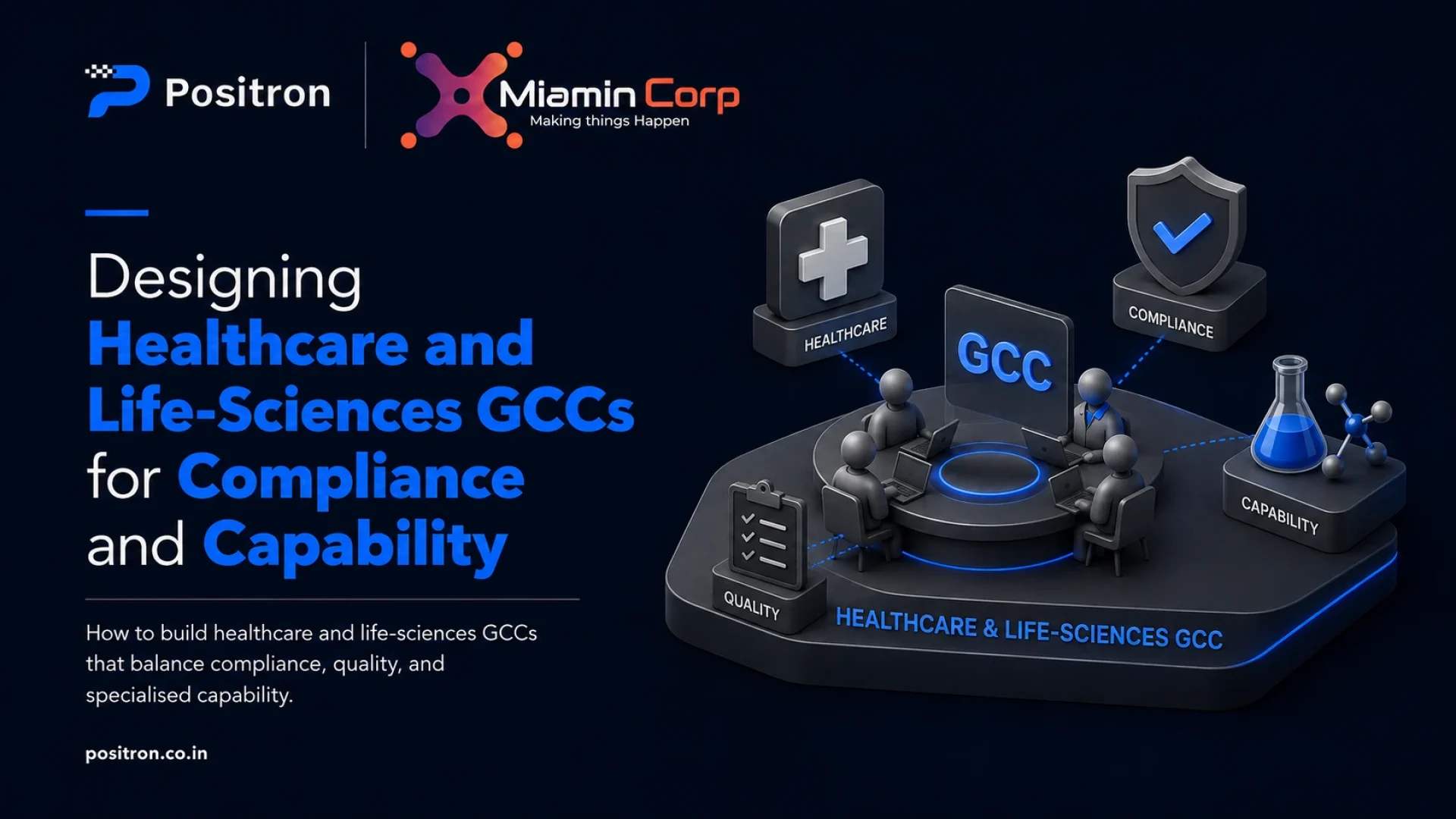
Clinical, safety, quality, regulatory, engineering and patient-data workflows need distinct controls, evidence and domain expertise. Risk-proportionate rigour supports innovation more effectively than forcing every activity into one generic checklist.
In our latest article, we explain how traceability, technology assurance, domain careers and accountable judgement can support both compliance and capability growth across the operating model.
In healthcare and life sciences, compliance is not a gate at the end of delivery. It is part of how the work is designed, performed and evidenced.
That makes the GCC mandate unusually consequential. A centre may support product engineering, clinical data, pharmacovigilance, regulatory operations, quality systems, medical information, analytics or patient-facing processes. Each activity carries a different combination of patient, product, data and business risk.
The first mistake is to group them all under “healthcare operations.” The second is to assume that a strong general technology team can learn the regulated context later.
Map obligations to workflows
The GCC should begin with a regulatory and quality map for every proposed capability.
For health information in the United States, the current HIPAA Security Rule requires appropriate administrative, physical and technical safeguards for electronic protected health information. Covered entities that use business associates also need written arrangements defining permitted work and protection obligations.
For clinical trials, the ICH E6(R3) guideline endorsed in January 2025 uses a proportionate, risk-based approach to trial quality and emphasises reliable results and participant protection. Pharmacovigilance work in Europe sits within the EMA’s Good Pharmacovigilance Practices framework. Medical-device production and quality-system software may need the risk-based assurance described in the FDA’s February 2026 final guidance.
These frameworks apply to different activities and jurisdictions. They should not be blended into one generic “global compliance” checklist. Legal, quality and regulatory leaders must confirm the rules for the actual product, data, entity and market.
Design the operating model around traceability
Regulated work requires the enterprise to reconstruct what happened.
The centre therefore needs controlled processes for data provenance, access, review, approval, change, deviation, investigation and retention. System and process owners must be named. Training must be linked to roles and versions of procedures. Quality events must have clear escalation paths and documented resolution.
This does not require making every activity bureaucratic. Risk-proportionate design is the better principle: apply more rigour where an error could affect patient safety, product quality, trial integrity or a regulatory submission. Apply lighter but still controlled methods to lower-risk work.
That distinction should be documented before teams optimise for speed.
Build domain capability beside delivery capability
A mature centre needs several kinds of expertise working together:
- clinicians, scientists or safety specialists who understand the underlying judgement;
- regulatory and quality professionals who interpret applicable requirements;
- data and engineering teams who can build reliable, secure systems;
- process leaders who understand global handoffs and service controls; and
- privacy and security professionals who understand sensitive health information.
The organisation should not isolate these groups into approval queues. Cross-functional product or service teams can bring quality and regulatory thinking into design decisions while preserving independent oversight where required.
Career architecture matters here. Domain experts need leadership paths that do not force them to become generic managers. Technical teams need structured exposure to the clinical or quality context. The centre should become a place where regulated judgement deepens, not a factory for executing predefined steps.
Validate technology and continuity for intended use
“The system works” is not a sufficient conclusion for a regulated workflow.
Teams need to define intended use, identify risk, establish appropriate assurance and retain evidence. Data interfaces, automated decisions, audit trails, electronic records and access models must be considered across the full workflow, including vendors and cloud services.
Continuity planning should also begin with patient, product and reporting consequences. A delay in a low-risk internal dashboard is different from disruption to safety-case intake, a trial data flow or a quality release process. Recovery priorities must reflect that distinction.
Keep accountability close to the science and the patient
A GCC can centralise expertise and improve consistency, but it should not obscure who remains accountable. Product owners, quality leaders, clinical sponsors and regulated entities need clear decision rights and oversight.
The strongest healthcare and life-sciences centres combine two qualities that are sometimes treated as opposites: disciplined control and high-value innovation.
They achieve both because compliance is built into the capability. Teams understand why evidence matters, where judgement belongs and how to improve a process without weakening its safeguards.
That is the design standard: not simply work performed correctly, but capability that remains trustworthy under review, change and pressure.
Frequently Asked Questions
What are the biggest GCC trends in India?
Are GCCs in India still mainly technology centers?
Why is AI important for India GCCs?
What should companies watch before setting up a GCC in India?
Sources
- U.S. Department of Health and Human Services, *The HIPAA Security Rule* — current rule page reviewed 12 August 2026.
- International Council for Harmonisation, *ICH E6(R3) Good Clinical Practice Guideline* — 6 January 2025.
- European Medicines Agency, *Good Pharmacovigilance Practices* — current modules reviewed 12 August 2026.
- U.S. Food and Drug Administration, *Computer Software Assurance for Production and Quality Management System Software* — February 2026.