

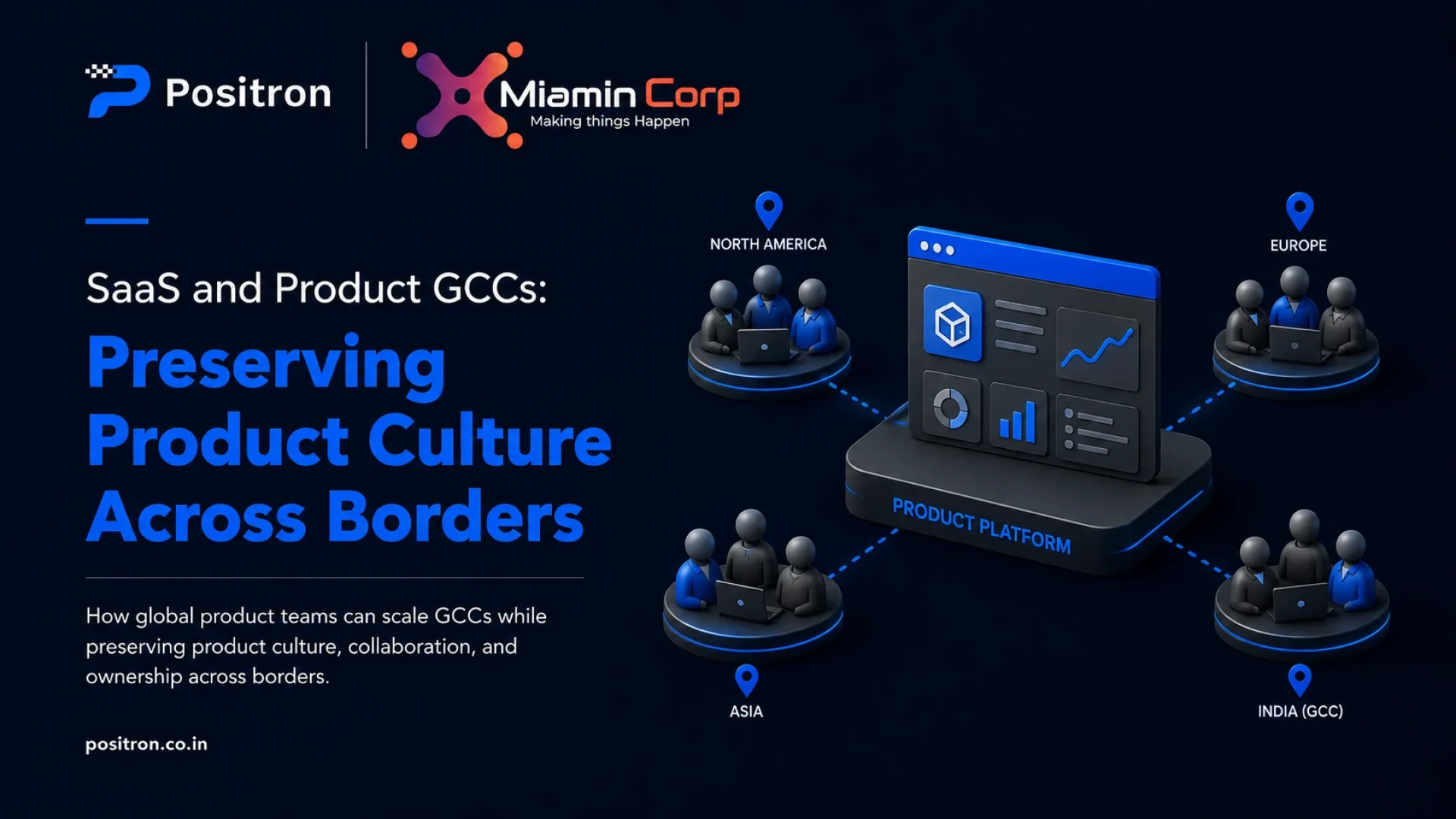
A SaaS or product GCC needs a problem space to own, direct access to users, architecture that supports autonomy and responsibility after release. Reproducing headquarters meetings cannot replace those operating conditions.
In our latest article, we explain how shared principles, product evidence and distributed decision rights can create one product system across locations.
Product culture does not weaken because a team crosses a border. It weakens when customer context, decisions and consequences stop travelling with the work.
That is the central design risk in a SaaS or product GCC. The centre may hire excellent engineers, but if it receives detailed requirements from elsewhere, ships into architectures it cannot influence and learns about users through escalation tickets, it becomes a delivery dependency rather than a product organisation.
Preserving culture requires more than copying headquarters rituals.
Move the product problem, not just the build tasks
A product team needs a problem space it can understand and own.
The centre’s charter should define customers or users, desired outcomes, product boundaries, reliability obligations and decision rights. Engineers, product managers, designers, data specialists and operations leaders should be able to discover, decide, build, release and learn together.
This does not require every discipline to sit in one country. It requires the complete feedback loop to include the GCC. Customer interviews, usage data, roadmap discussions, commercial constraints, incidents and support patterns must reach the team in a usable form.
If only code crosses the border, culture will not.
Preserve principles, not local habits
Headquarters may have meetings, phrases and informal networks that appear to define its culture. Reproducing them can create theatre without the underlying conditions.
The more durable elements are shared principles:
- decisions start with user and business outcomes;
- teams own services after release;
- risks and failures are surfaced early;
- architecture enables local change within clear boundaries;
- security and quality are part of delivery; and
- learning changes priorities and practices.
Google Cloud’s 2024 DORA research found that user focus, stable priorities, leadership and a learning-oriented environment were associated with stronger product and organisational outcomes. The findings are survey-based associations, not guarantees for a specific company, but they reinforce an important point: tools and process cannot compensate for confused priorities or weak information flow.
Use architecture to distribute autonomy
An organisation cannot delegate product ownership if every change requires coordination across many tightly coupled teams.
Clear service boundaries, interfaces, automated testing, observability and deployment capability make autonomy safer. An internal platform can reduce repeated infrastructure work, but it should provide paved paths rather than centralise every engineering decision.
Security needs the same balance. NIST’s Secure Software Development Framework provides a common set of high-level practices that can be integrated into different development lifecycles. A global product organisation can use common secure-development outcomes while allowing teams to choose context-appropriate implementation details.
The aim is one product system with distributed teams—not separate engineering cultures held together by approvals.
Create shared consequences
Teams develop product judgement when they see what happens after a decision.
The GCC should participate in on-call and incident learning for the services it owns. It should see adoption, retention, performance, cost and customer-support evidence. Product and engineering leaders in the centre should join portfolio choices, not only sprint planning.
Metrics should avoid turning the centre into a feature factory. Story points, utilisation and output volume are easy to count but weak signals of product value. Better measures combine customer outcomes, reliability, delivery flow, quality, security, unit economics and learning.
Protect mobility in both directions
Short rotations can transfer context, but permanent dependence on travel is a design failure. The organisation needs durable channels: shared documentation, recorded decisions, common career levels, cross-location communities and leadership relationships.
Mobility should be reciprocal. People from headquarters should spend time in the GCC, and centre leaders should influence global planning. This prevents the silent creation of a “core” and “remote” hierarchy.
Cloud-native adoption and distributed delivery are now widespread, but no platform removes the human work of building trust. The CNCF’s 2024 survey is a useful industry signal, not a representative measure of every enterprise. Technology gives teams options; governance and culture determine whether those options create ownership.
A product GCC succeeds when users cannot tell which location built a capability—and when the people who built it can explain the customer problem, the trade-offs and the result.
That is product culture across borders: shared context, distributed authority and common consequences.
Frequently Asked Questions
What are the biggest GCC trends in India?
Are GCCs in India still mainly technology centers?
Why is AI important for India GCCs?
What should companies watch before setting up a GCC in India?
Sources
- Google Cloud DORA, *Accelerate State of DevOps Report 2024* — published 2024; page updated 13 April 2026.
- NIST, *Secure Software Development Framework Version 1.1* — 3 February 2022.
- Cloud Native Computing Foundation, *Cloud Native 2024 Annual Survey* — 1 April 2025.
- Google Cloud DORA, *Generative Organisational Culture* — current guidance reviewed 12 August 2026.