

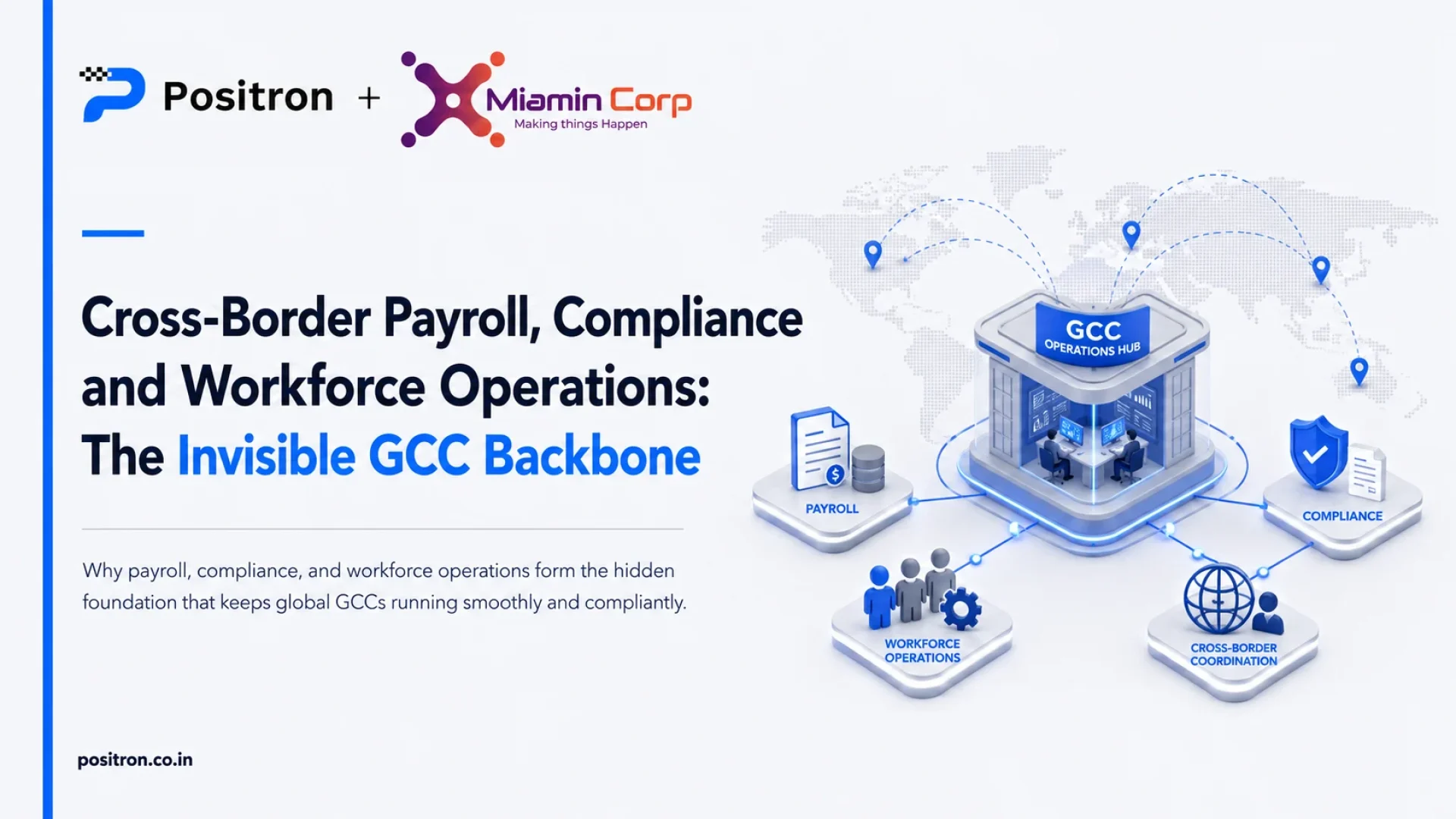
Every worker event must move through an authoritative source, a clear owner and controlled local configuration. Remote work, mobility, social security, data transfers and vendor dependencies make informal hand-offs increasingly risky for both the enterprise and the employee.
In our latest article, we explain why payroll and workforce operations are critical GCC infrastructure—and how a governed lifecycle protects control and trust.
The employee experience of payroll is simple: the right amount should arrive on the right date.
The operating system underneath is not simple at all.
A global capability network can involve multiple employers, currencies, tax rules, social-security systems, benefit plans, time records, mobility arrangements and data-transfer requirements. Every employee change can flow through several teams and systems before it reaches a payslip, filing or general-ledger entry.
That is why cross-border payroll and workforce operations should be designed as critical enterprise infrastructure—not treated as administration that will somehow scale behind the GCC.
Build one lifecycle, not a chain of local handoffs
The operating model should map the worker lifecycle from workforce approval through hiring, onboarding, time and absence, compensation changes, mobility, payroll, benefits, performance events and exit.
For each event, the organisation needs an authoritative source, named owner, approval path, effective date and downstream destination. Otherwise, the same change is rekeyed into HR, payroll, finance, identity and vendor systems, creating delay and conflicting records.
Global consistency should define the event model, data ownership, control evidence and service measures. Local configuration should address the employment, tax, social-security, benefit, filing and record requirements of each jurisdiction.
Standardisation does not mean pretending local rules are identical. It means handling local differences through a controlled architecture rather than informal exceptions.
Maintain a jurisdiction and worker-status matrix
Before hiring begins, the enterprise should document the permitted workforce structures in each location.
That includes the employing entity or approved arrangement, worker classification, mandatory contract terms, payroll registration, statutory benefits, tax withholding, social contributions, working-time rules, leave, termination, immigration and data requirements. The matrix needs a legal owner and a review cycle because rules and interpretations change.
Cross-border remote work deserves particular attention. The OECD’s 2025 update to its Model Tax Convention added guidance on when home-office arrangements may create a taxable business presence. The Model Convention guides treaty interpretation; it does not replace domestic law or the wording of the applicable treaty. A remote-work policy therefore needs country-specific tax, employment, immigration and social-security review.
The same caution applies to mobility. Within the EU, for example, social-security coordination and A1 documentation can affect where a posted worker remains insured. Other corridors may depend on bilateral agreements or have no equivalent portability mechanism.
Control payroll as a financial and employee-risk process
Payroll controls should cover input, calculation, payment, reporting and accounting.
At minimum, the model needs controlled master-data changes, segregation of duties, payroll calendars, reasonableness checks, variance review, funding approval, bank-file control, statutory filing evidence, reconciliations and exception management. Access to sensitive workforce data should follow role and purpose, with secure transfer and retention.
The European Data Protection Board describes standard contractual clauses as one mechanism for transfers of personal data outside the EU. They are not a universal answer: the enterprise still needs to identify the data flow, parties, lawful basis, applicable transfer mechanism and supplementary safeguards where required.
Service design should also anticipate human consequences. A tax or payroll error can affect an employee’s rent, credit, immigration status or trust in the company. High-severity cases need clear escalation, rapid correction and accountable communication—not a generic ticket queue.
Make vendors visible inside the control environment
Payroll bureaus, employer-of-record providers, benefits platforms and mobility advisers can supply valuable local capability. They do not eliminate the enterprise’s need for governance.
Contracts should define data roles, processing scope, controls, service levels, audit rights, subcontractors, incident handling, change notification, continuity and exit support. Internal owners must reconcile vendor outputs and monitor recurring exceptions. The organisation should know how it will retrieve data and continue critical payroll if a provider fails or a relationship ends.
Treat workforce operations as an integration layer
The best global model connects HR, finance, legal, tax, security and local operations around the same worker events and evidence.
This is also where the combined Positron and Miamin Systems proposition can become meaningful: workforce capability, GCC operations and technology should connect through one governed lifecycle rather than appear as separate services.
Employees may never see that architecture. They will experience its result every time they join, move, get paid or leave.
That is why the invisible backbone deserves visible executive ownership.
Frequently Asked Questions
What are the biggest GCC trends in India?
Are GCCs in India still mainly technology centers?
Why is AI important for India GCCs?
What should companies watch before setting up a GCC in India?
Sources
- OECD, *The 2025 Update to the OECD Model Tax Convention* — 19 November 2025.
- International Labour Organization, *Extending Social Protection to Migrant Workers, Refugees and Their Families* — 2021.
- European Commission, *Social Security: Which Rules Apply to Me?* — current guidance reviewed 12 August 2026.
- European Data Protection Board, *Standard Contractual Clauses* — current guidance reviewed 12 August 2026.