

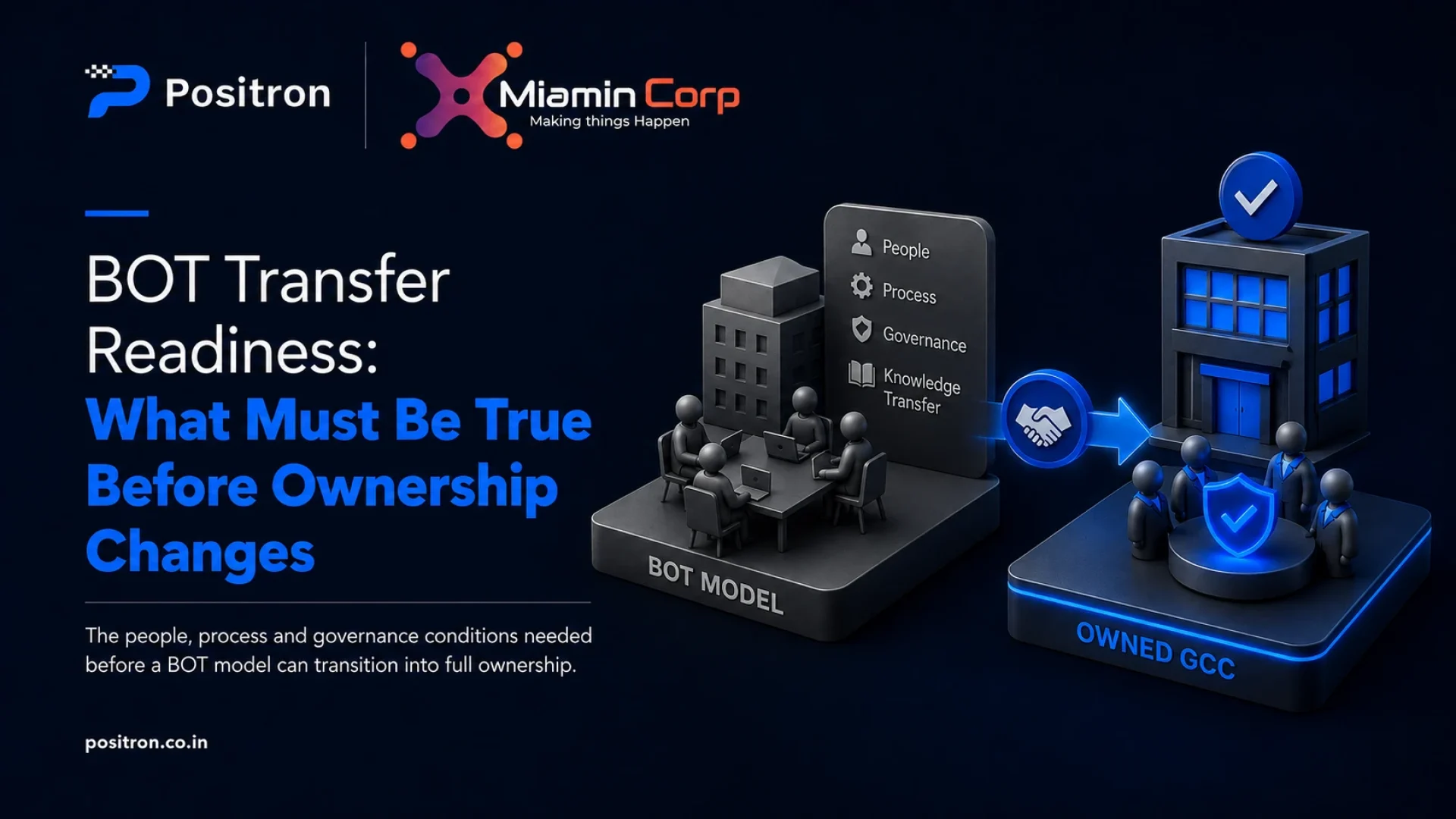
Operations, leadership, knowledge, assets, controls, economics and continuity all need evidence. The strongest test is whether the receiving team can operate, decide and recover without hidden dependence on the outgoing provider.
In our latest article, we set out six readiness gates that help enterprises identify transfer risk before it becomes a handover problem.
In a Build-Operate-Transfer model, the transfer date is not evidence of readiness.
It is only a contractual milestone.
Ownership should change when the enterprise can accept the people, services, assets, controls and liabilities without losing operational stability. If the transfer depends on the outgoing operator continuing to make hidden decisions, retain undocumented knowledge or repair every exception, the centre has changed hands but has not transferred capability.
Define transfer as an acceptance event
Readiness criteria should be agreed during the build phase, not negotiated shortly before handover.
The parties need to define the transfer perimeter: employees, leadership roles, legal entity, facilities, leases, technology, licences, data, contracts, intellectual property, policies, records, vendors, service obligations and open liabilities. Each item needs an owner, required evidence and acceptance authority.
ISO 37500 describes outsourcing through lifecycle phases and governance shared between client and provider. The standard is broader than BOT, but its emphasis on governance, risk and changing business requirements is useful: transition is part of the operating relationship, not a final administrative task.
Test readiness across six systems
1. Operational stability
Services should meet agreed performance and control thresholds over a representative period. Major incidents, recurring exceptions, capacity constraints and technical debt need transparent treatment. A short run of favourable metrics should not conceal structural dependence on a few individuals.
2. Leadership and people
The receiving organisation needs accountable leaders, succession for critical roles, employee-transfer plans, role mappings and a credible communication process. Retention risk should be assessed by capability, not only by number of employees accepting transfer.
3. Knowledge and decision rights
Runbooks are necessary but insufficient. Teams must understand why processes work, how exceptions are judged, which trade-offs matter and when to escalate. Reverse-shadowing is a strong test: the receiving team operates while the provider observes and intervenes only against agreed criteria.
4. Assets, data and contracts
The enterprise must be able to use what it is acquiring. Ownership, assignment, consent, licence rights, source repositories, credentials, records, data lineage, vendor contracts and facility obligations should be verified. Any item that cannot transfer needs an approved substitute or continuing-service arrangement.
5. Risk, compliance and security
Policies, control ownership, access, audit evidence, incidents, regulatory commitments, privacy roles and remediation plans need to move into the receiving governance structure. NIST’s updated cybersecurity supply-chain guidance reinforces the value of due diligence across suppliers, components and dependencies.
6. Economics and continuity
The post-transfer budget must reflect actual operating cost, not only the provider-era price. Funding, payroll, benefits, insurance, technology, vendor renewals, facilities and retained transition support all need owners. Business-continuity and exit plans should be tested for the new structure.
Use evidence-based gates
A transfer board should review a common readiness pack rather than rely on functional assurances.
Useful evidence includes service and control trends, dependency maps, asset registers, employee and leadership status, security findings, open legal consents, vendor assignments, recovery-test results, financial reconciliations and a risk-acceptance log.
Conditions should be classified clearly: required before transfer, permitted with a dated remediation plan, or accepted as a continuing risk by an authorised executive. Ambiguous “green” status hides more than it communicates.
Plan knowledge transfer from day one
Knowledge becomes expensive to transfer when documentation starts late.
The build phase should create named process and product owners, decision records, repositories, service maps, training pathways and communities of practice from the beginning. The enterprise’s leaders should participate in governance well before ownership changes.
Continuity after handover also needs a time-bound support model. That may include hypercare, retained specialists and escalation commitments, but it should not recreate indefinite operational dependency.
In regulated financial services, EBA guidance on critical outsourcing expects arrangements to support transfer to another provider or reintegration into the institution. That rule is sector- and jurisdiction-specific, yet its operational logic applies more widely: an organisation should know how a critical service will move before it needs to move it.
A successful BOT transfer is therefore not a ceremonial handoff. It is a demonstrated change in control with stable service, accepted risk and usable capability on the receiving side.
The date matters. Readiness matters more.
Frequently Asked Questions
What are the biggest GCC trends in India?
Are GCCs in India still mainly technology centers?
Why is AI important for India GCCs?
What should companies watch before setting up a GCC in India?
Sources
- ISO, *ISO 37500:2014—Guidance on Outsourcing* — published November 2014; confirmed current in 2021.
- NIST, *Cybersecurity Supply Chain Risk Management Practices for Systems and Organizations* — updated 1 November 2024.
- ISO, *ISO 22301:2019—Business Continuity Management Systems* — published October 2019; amended in 2024.
- European Banking Authority, *Consideration of Cloud Services as Outsourcing Arrangements* — final answer 11 November 2022.