

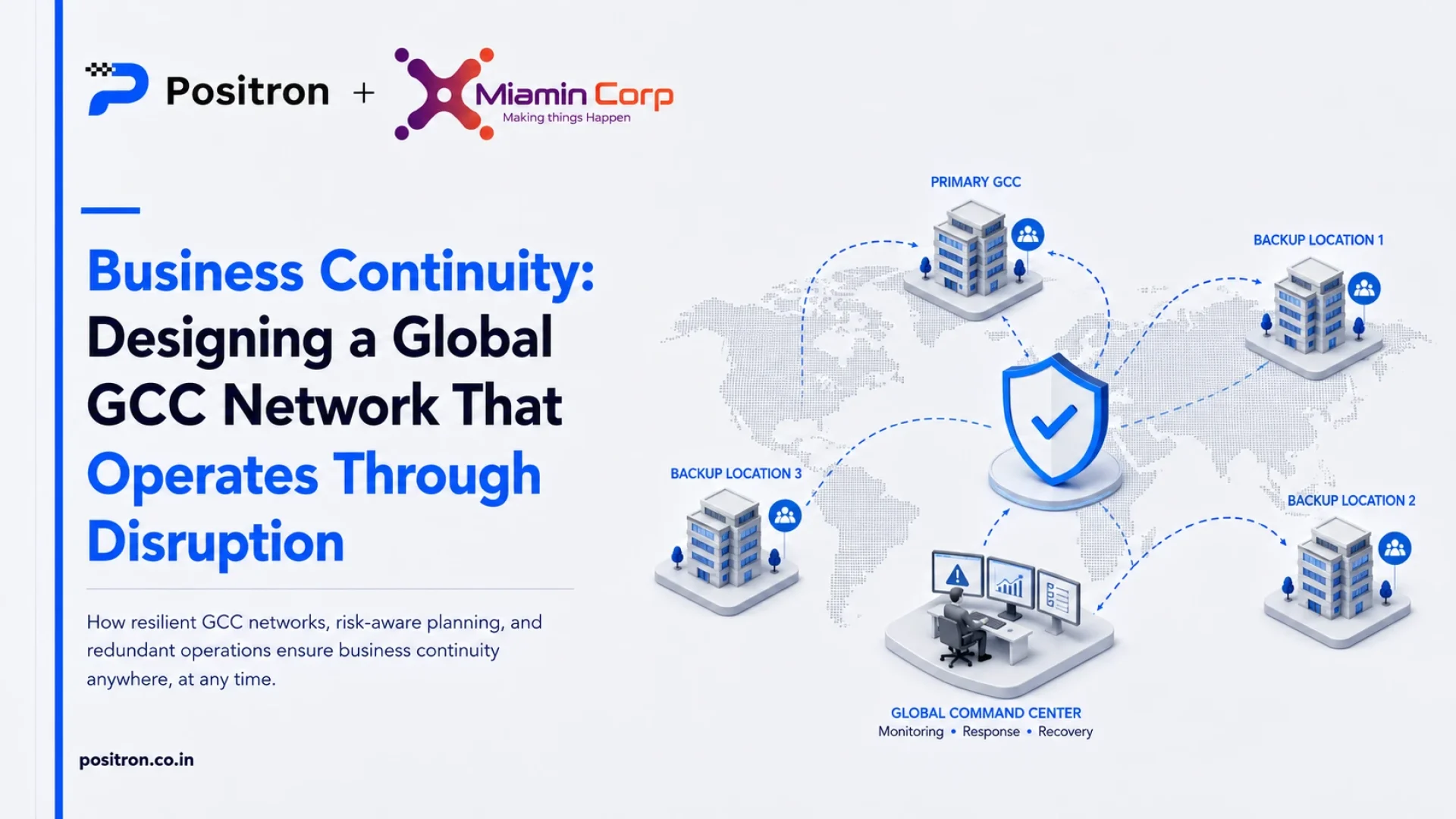
Cloud, identity, telecoms, specialist roles, source data or decision authority may connect apparently independent sites. Continuity design therefore needs critical-service priorities, full dependency maps, service-specific recovery patterns and severe-scenario testing.
In our latest article, we explain how to build a global GCC network that can continue operating through disruption—not simply a network with multiple addresses on a map.
Three GCC locations do not automatically create resilience.
They may share the same cloud region, identity service, telecom provider, specialist team, workflow engine or decision-maker. If that common dependency fails, the map shows three dots but the operating model still has one point of failure.
Business continuity must therefore be designed around services and dependencies, not office count.
Begin with the outcome that must continue
The enterprise should identify its critical products and services, then define an acceptable level and duration of disruption.
That analysis needs business ownership. Technology recovery is only one part of the answer. A service may also depend on people, data, facilities, vendors, approvals, customer communication and regulatory reporting.
ISO 22301 provides a management-system framework for planning, implementing, reviewing and improving business continuity. NIST’s contingency-planning guidance similarly connects business-impact analysis, recovery priorities and system plans. The detailed implementation will vary by company, but both point toward a repeatable system rather than a static emergency document.
Map the whole dependency chain
For each critical service, map:
- the teams and scarce roles needed to operate and recover it;
- applications, data stores, integrations and identity services;
- cloud, network, power, facilities and equipment;
- internal approvals and leadership succession;
- third parties and their subcontractors;
- upstream and downstream processes; and
- customer, regulator and employee communications.
The Basel Committee uses this kind of mapping for banks’ critical operations, including people, technology, processes, information, facilities and third parties. Its principles are written for banking, but the dependency logic is relevant to any enterprise service that must operate through disruption.
The map should expose concentration. Two teams in different countries may depend on the same group of database administrators. Two cloud regions may use one identity plane. A backup payroll provider may receive the same broken source data as the primary one.
Choose continuity patterns by service
Not every service needs active-active duplication. The design should match the impact and recovery requirement.
Options include live multi-site operation, warm standby, cross-trained recovery teams, alternate suppliers, manual fallback, delayed processing or an orderly suspension with customer communication. The choice should state what data may be lost, how quickly the service must recover, what capacity is required and who can invoke the plan.
Independence should be real. A recovery team needs current access, knowledge, equipment and authority. A backup system needs tested data and integrations. A secondary site needs a scenario in which it remains available when the primary site is not.
Design for people and decision continuity
Disruption does not follow the organisational chart.
The plan needs deputies for critical leaders, current contact paths, delegated emergency authority and clear crisis roles. Cross-training should focus on recoverable services and judgement, not generic job descriptions.
Teams also need humane operating assumptions. A location affected by a natural disaster, conflict or public-health event cannot be expected to preserve service by asking impacted employees to work longer. The global network should absorb the work so local people can respond safely.
Test the failure, not the presentation
Tabletop exercises are useful for decision practice, but critical technical and operational assumptions also need execution tests.
Can the alternate team authenticate? Can data be restored within the required window? Can a vendor be replaced? Can payments, orders or cases be reconciled after manual fallback? Can leaders communicate with customers and regulators using approved channels?
Exercises should include severe but plausible combinations: cyberattack plus vendor outage, facility loss plus telecom disruption, or geopolitical restriction plus staff unavailability. ENISA’s 2025 threat landscape is one current input for cyber scenarios; enterprise-specific risk and regional evidence must complete the picture.
Every test should produce owners, dates and verified remediation. A plan that repeatedly records the same gap is not improving resilience.
Govern continuity as a network capability
Local plans should connect to one enterprise service model. Common terminology, dependency data, scenario standards and escalation thresholds make cross-location action possible. Local teams still need adaptations for their infrastructure, authorities and risk environment.
The most resilient GCC network is not necessarily the one with the most sites. It is the one that knows what must continue, where its hidden dependencies sit and how authority moves when normal operations fail.
Resilience is not geographic decoration. It is an operating capability that has been tested under pressure.
Frequently Asked Questions
What are the biggest GCC trends in India?
Are GCCs in India still mainly technology centers?
Why is AI important for India GCCs?
What should companies watch before setting up a GCC in India?
Sources
- ISO, *ISO 22301:2019—Business Continuity Management Systems* — published October 2019; amended in 2024.
- NIST, *SP 800-34 Rev. 1: Contingency Planning Guide for Federal Information Systems* — May 2010; current page reviewed 12 August 2026.
- Basel Committee on Banking Supervision, *Principles for Operational Resilience* — 31 March 2021.
- ENISA, *Threat Landscape 2025* — October 2025.