

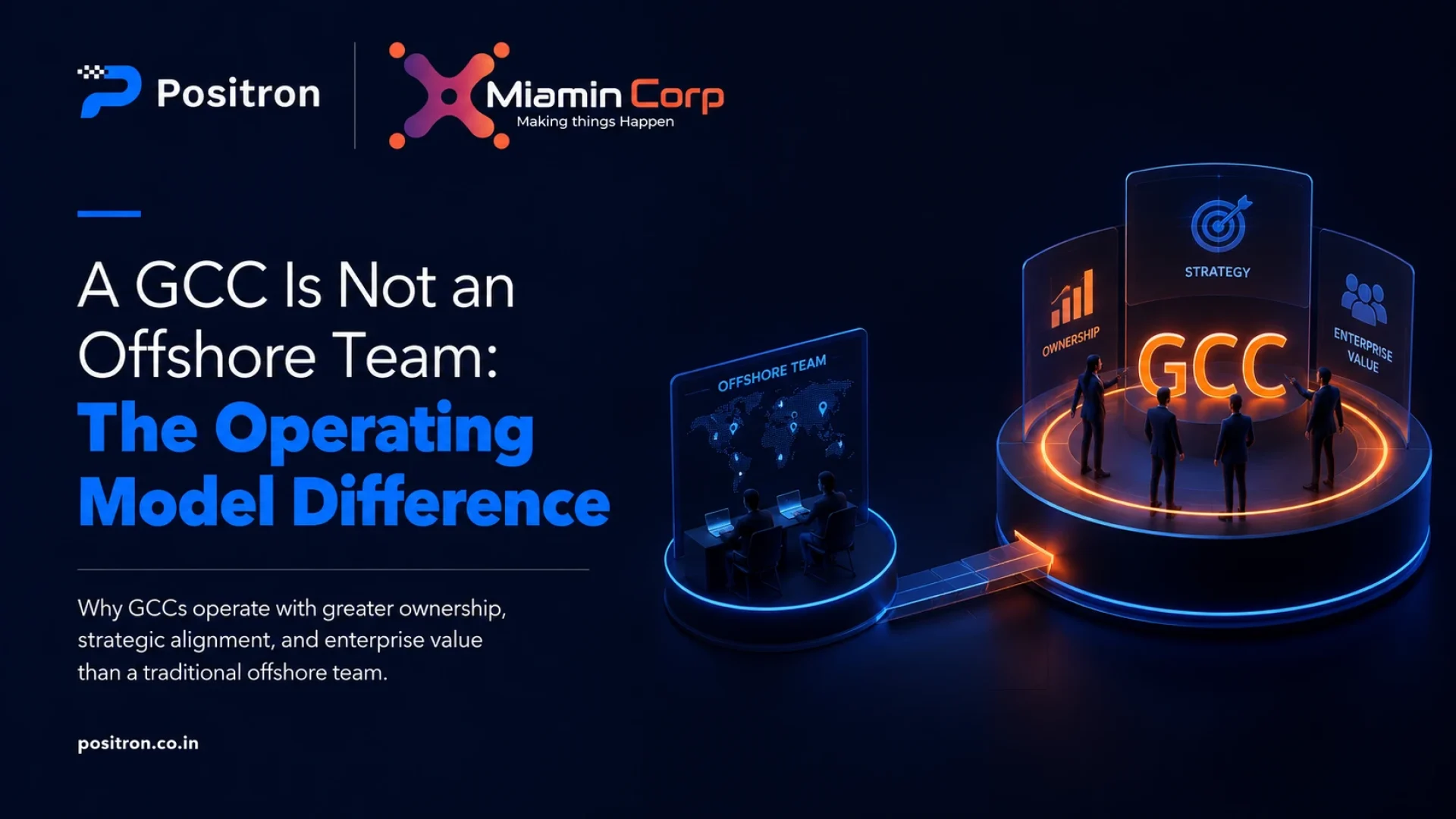
An offshore team can execute tasks from another location. A GCC owns defined capabilities, develops institutional knowledge and carries decision rights linked to enterprise outcomes. That changes how leaders design the mandate, governance, talent system and measures of success.
In our latest article, we explain the operating-model difference—and when an owned GCC, BOT structure or managed team may be the better fit.
An offshore team tells you where people work. A Global Capability Center tells you how enterprise capability is owned, governed and improved.
The two can look similar at first. Both may include employees or dedicated professionals working from another country. Both may deliver technology, finance, analytics, engineering or operations. Both can provide access to talent and a different cost base.
The difference appears when the work becomes important enough to shape the enterprise.
An offshore team is often created to add delivery capacity. The immediate questions are practical: How many people are needed? Which skills? How quickly can they start? Who will manage their output? This can be the right model for a bounded project, variable demand or a capability that does not yet justify a permanent operating structure.
A GCC is designed as part of the company’s operating model. It needs a mandate, leadership, decision rights, controls, career paths, technology access, performance measures and a multi-year capability roadmap. It is expected to develop institutional knowledge and increasingly own outcomes, not simply complete assigned tasks.
Five operating-model differences
1. The mandate
An offshore team usually receives work. A GCC has an explicit reason to exist. That reason might be to own a product platform, create an analytics capability, run a global process, strengthen cybersecurity or build a new engineering discipline. The mandate defines what success means and prevents the centre from becoming a collection of unrelated requisitions.
2. The ownership model
Capacity can be managed through a vendor, an internal team or a hybrid arrangement. A mature GCC normally has clearer enterprise ownership of the capability, even when partners support setup or operations. The company decides its architecture, standards, risk appetite and long-term talent model.
3. Governance and decision rights
An offshore team may report through a project manager. A GCC needs governance across functions and geographies. Headquarters, business units and centre leadership must know who decides priorities, budgets, hiring standards, technology exceptions, data access and service changes. Deloitte’s 2025 GBS survey linked effective governance and digital technology with value realisation and highlighted the role of unified global leadership.
4. Talent development
An offshore team can be staffed for today’s requirements. A GCC must build tomorrow’s capability. That means leadership pipelines, learning paths, succession, internal mobility and a local employer proposition. This is especially important when AI, data and cybersecurity skills are changing quickly. The World Economic Forum’s 2025 employer research identifies skills gaps as a leading barrier to business transformation.
5. Performance
Offshore capacity is often measured through utilisation, vacancies filled, delivery dates or ticket volumes. A GCC needs a wider scorecard: customer outcomes, process performance, product quality, innovation, resilience, capability depth, employee health and total economics. Headcount and labour cost remain useful, but they are not the purpose of the centre.
The practical decision
Not every global team should become a GCC. A managed team may be more sensible when demand is uncertain, speed matters more than ownership, or the enterprise lacks the capacity to establish a new entity and operating structure. A BOT model can provide a bridge when the desired destination is internal ownership but the enterprise wants support during launch and stabilisation.
The right question is therefore not, “Should we offshore this work?” It is, “What capability do we need, how strategically important is it, and what level of ownership should we build?”
If the work is repeatable but peripheral, buy or manage capacity. If it contains differentiating knowledge, needs long-term leadership and must improve across several years, design a capability centre. If the answer is mixed, use a portfolio: own the differentiating core, partner for specialised or variable needs, and automate where the process supports it.
Geography matters, but it comes after the operating choice. A GCC can sit in India, Mexico, Poland, Portugal, the Philippines, the UAE or another market. Its defining feature is not the map pin. It is the combination of mandate, ownership, governance and the ability to turn distributed talent into enterprise capability.
Frequently Asked Questions
What are the biggest GCC trends in India?
Are GCCs in India still mainly technology centers?
Why is AI important for India GCCs?
What should companies watch before setting up a GCC in India?
Sources
- BCG — Transforming Global Business Services into a Strategic Function — 14 February 2024.
- Deloitte — 2025 Global Business Services Survey — 29 August 2025.
- World Economic Forum — Future of Jobs Report 2025 — 7 January 2025.
- Positron — Engagement Models — accessed 12 August 2026.